
Most people want to love freely and be loved the same way, yet something always seems to get in the way. Old wounds, fear of rejection, unspoken expectations, and past hurts quietly shape every relationship we enter. Feeling loved by a partner, it turns out, predicts relationship satisfaction more powerfully than how loving you yourself are, which means the quality of love you receive and give carries real, measurable weight in your life. This guide walks you through what unconditional love actually is, the inner work it requires, and the practical steps that can help you heal from past hurts and start growing today.
Table of Contents
- What is unconditional love—and what isn't?
- Prerequisites: The roots of unconditional love in personal growth
- How to practice unconditional love: Step-by-step
- Troubleshooting: Challenges and common pitfalls
- How to know you're making progress: Signs and outcomes
- A different perspective: Why popular advice on unconditional love often misses the mark
- Resources to deepen your journey
- Frequently asked questions
Key Takeaways
| Point | Details |
|---|---|
| Boundaries matter | Unconditional love requires clear limits and self-respect, not blind acceptance. |
| Self-love first | Cultivating unconditional love for others begins with self-acceptance and healing. |
| Healthy attachment leads to growth | Secure emotional bonds and feeling loved predict satisfaction and positive change. |
| Daily practice is key | Simple, small acts and consistent practice help make unconditional love real in your life. |
What is unconditional love—and what isn't?
Now that you see why unconditional love matters, it's crucial to clarify what it truly means and what it doesn't.
Unconditional love is the choice to value, accept, and care for someone regardless of their performance, mistakes, or changing circumstances. It does not mean you approve of every behavior. It means your core regard for that person stays steady even when you disagree, feel hurt, or need to set a firm limit. Think of a parent who still loves a child who has made serious mistakes. The love doesn't vanish. The behavior may be unacceptable, but the person remains worthy of care.
Here is where most people get tripped up. Unconditional love is frequently confused with three harmful patterns:
- Enabling: Accepting or excusing destructive behavior because you don't want to upset someone
- Codependency: Losing your own identity and needs in the service of another person's emotional state
- Enmeshment: Blurring personal boundaries so completely that you can no longer tell where you end and the other person begins
Unconditional love does not mean tolerating abuse, abandoning your safety, or removing all conditions around respect. In fact, real unconditional love requires emotional intelligence (the ability to recognize, understand, and manage emotions in yourself and others) and clear boundaries. Without those two things, what looks like unconditional love can quietly become a pattern that harms everyone involved.
| True unconditional love | What it is NOT |
|---|---|
| Steady regard despite flaws | Tolerating abuse or mistreatment |
| Honest, caring feedback | Constant approval of all behavior |
| Healthy personal boundaries | Losing yourself to please others |
| Respecting autonomy | Controlling or clinging behavior |
| Self-awareness and growth | Ignoring your own needs entirely |
"Love without self-awareness is not freedom. It is just a different kind of cage."
Improving self-awareness is one of the most direct routes to loving well. When you understand your own triggers, fears, and patterns, you stop projecting them onto the people you love.
Prerequisites: The roots of unconditional love in personal growth
With a clear definition in hand, let's explore what inner resources set the stage for unconditional love.
You cannot pour from an empty cup. That phrase is overused, but the psychology behind it is real. Before you can love others without strings attached, you need a foundation of self-love, emotional intelligence, and some degree of healing from your own past. This is not selfish. It is necessary.

Early maternal care strongly predicts adult attachment security, and unresolved attachment patterns show up at much higher rates in clinical populations dealing with trauma, anxiety, and relational difficulties. In plain terms: the love you received as a child shapes how you love and receive love as an adult. If that early experience was inconsistent, cold, or absent, you may carry wounds that make unconditional love feel either terrifying or impossible.
The good news is that your early experience is not your destiny. Here are the inner resources that create the foundation:
- Self-love: Treating yourself with the same patience and acceptance you want to offer others
- Emotional intelligence: Recognizing your feelings without being controlled by them
- Self-reflection: Regularly examining your motivations, reactions, and relationship patterns
- Willingness to seek help: Therapy, coaching, or trusted mentorship can accelerate healing dramatically
- Healing emotional wounds: Acknowledging past hurts rather than burying them
| Inner resource | Why it matters | How to build it |
|---|---|---|
| Self-love | Prevents giving from depletion | Daily affirmations, self-compassion practice |
| Emotional intelligence | Reduces reactivity | Journaling, mindfulness, therapy |
| Secure attachment | Reduces fear of abandonment | Consistent relationships, healing work |
| Self-reflection | Reveals hidden patterns | Regular review of reactions and choices |
Building self-awareness is a practical starting point. When you understand what drives your behavior, you can choose responses rather than simply react. This shift alone changes how you show up in every relationship.
If you are new to this kind of inner work, a personal growth guide can help you map the territory. And if family dynamics are part of your healing journey, exploring how family support shapes mental health can give you important context.
Pro Tip: Start with yourself before trying to extend unconditional love outward. Even five minutes of daily self-compassion practice, where you speak to yourself the way you would speak to a close friend, begins rewiring how you relate to others.
How to practice unconditional love: Step-by-step
Once you've done the inner work, you're ready for practical steps. Here's how to make unconditional love a reality.
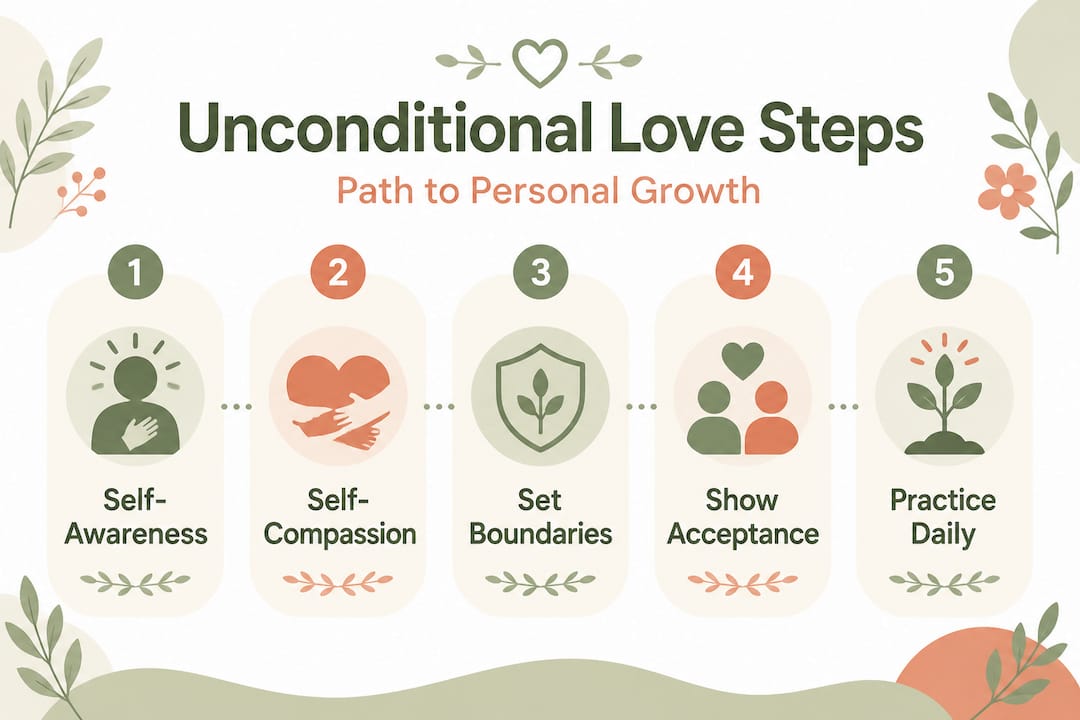
Unconditional love is not a feeling you wait for. It is a practice you build. Cultivating unconditional love starts with yourself and then gradually extends outward, using daily habits that strengthen your capacity for acceptance, compassion, and honest connection.
-
Practice self-compassion daily. Each morning, acknowledge one thing you accept about yourself without conditions. This is not about ignoring flaws. It is about separating your worth from your performance.
-
Try loving-kindness meditation (metta). This ancient practice involves mentally sending goodwill first to yourself, then to people you love, then to neutral people, and finally to those you find difficult. Even ten minutes a day builds measurable emotional resilience over time.
-
Set and honor your boundaries. Boundaries are not walls. They are the clear agreements that allow love to remain safe and sustainable. Practice stating your needs calmly and directly, without apology.
-
Respond rather than react. When someone disappoints or frustrates you, pause before responding. Ask yourself: "Is my reaction about this moment, or is it about an older wound?" That pause is where unconditional love lives.
-
Offer acceptance before advice. Most people feel unloved not because no one cares, but because they feel judged before they feel heard. Practice listening fully before offering solutions or corrections.
-
Repair after conflict. Unconditional love does not mean conflict-free relationships. It means returning to connection after rupture. A sincere apology or a simple "I still care about you even when we disagree" goes further than any grand gesture.
-
Extend compassion to difficult people. This is the hardest step. You do not have to like someone or agree with them to hold basic goodwill toward them. Start small: one difficult person, one moment of choosing curiosity over contempt.
Staying current with personal development trends can also help you find new tools and frameworks that support this ongoing practice. And if you are working on love within a family context, practical strategies for thriving families offer concrete guidance.
Pro Tip: Focus on small, consistent acts rather than grand gestures. A daily moment of genuine listening or a simple "I'm proud of you" builds more lasting connection than occasional dramatic expressions of love.
Troubleshooting: Challenges and common pitfalls
Even with the best intentions, practicing unconditional love isn't obstacle-free. Here's how to stay resilient and healthy.
The path toward unconditional love is not linear. You will hit walls. You will slide back into old patterns. That is not failure. It is part of the process. What matters is recognizing the most common pitfalls before they derail you.
Unconditional love can cross into codependency when emotional intelligence and boundaries are absent. Codependency means your emotional state is almost entirely dependent on another person's behavior, which is the opposite of healthy love.
Watch for these warning signs:
- Chronic self-sacrifice: Consistently putting others' needs above your own to the point of resentment or exhaustion
- Fear-based giving: Offering love primarily to avoid conflict, rejection, or abandonment
- Boundary erosion: Repeatedly allowing your stated limits to be crossed without consequence
- Love as leverage: Using affection as a reward or withdrawing it as punishment
- Ignoring red flags: Staying in genuinely harmful situations because you believe love should conquer all
"The person who loves without limits often ends up with nothing left to give. Sustainable love requires a self to return to."
When love is not reciprocated, the temptation is to give more, try harder, or shrink yourself to become more lovable. None of those strategies work. What does work is returning to your own foundation: your self-worth, your values, and your boundaries. You can love someone and still choose to protect yourself.
Self-awareness improvement methods are especially valuable here. When you can clearly see your own patterns, you stop repeating them unconsciously and start making deliberate choices about how and where you invest your love.
How to know you're making progress: Signs and outcomes
To complete the process, let's look at the transformation you can expect when unconditional love takes root.
Growth in unconditional love is not always dramatic. It often shows up quietly, in small moments you might almost miss. But over time, the cumulative effect is profound and measurable.
Perceived partner regard and attachment behavior are among the strongest predictors of relationship satisfaction, with effect sizes that dwarf most other factors. In plain terms: when people feel genuinely accepted and valued, their relationships and their personal wellbeing improve significantly.
Here are the signs that unconditional love is taking root in your life:
- You feel emotionally safe with key people in your life, meaning you can be honest without fear of punishment
- Your reactivity decreases. Small frustrations no longer trigger disproportionate emotional responses
- You notice you can hold space for someone's pain without immediately trying to fix it or make it about yourself
- Relationships feel more mutual and less transactional
- You experience greater self-confidence, because your self-worth is no longer entirely dependent on others' approval
- You find it easier to apologize and repair after conflict, without shame spiraling
- People around you begin to open up more, because they feel genuinely accepted
- You feel less drained after giving love, because you are giving from a place of fullness rather than depletion
Exploring personal growth through e-books can help you track and deepen these changes over time, especially when you want structured guidance alongside your daily practice.
A different perspective: Why popular advice on unconditional love often misses the mark
Most guides on unconditional love focus on what to do. Very few address the quiet danger hiding inside the concept itself.
The phrase "love without limits" sounds beautiful. In practice, it can be an invitation to erase yourself. When popular advice tells you to "just love people as they are" without addressing your own wounds, your own needs, or the real dynamics of power in relationships, it sets you up for exhaustion and resentment, not liberation.
Here is what I have observed, both through psychology and through personal experience: people who try to practice unconditional love before they have done their own inner work often end up in one of two places. They either become people-pleasers who give endlessly and receive little, or they burn out and swing to the opposite extreme, closing off emotionally to protect themselves.
Real unconditional love is not soft. It is one of the most demanding practices a human being can undertake. It asks you to stay open when your instinct is to shut down. It asks you to see the humanity in someone who has hurt you. It asks you to hold your own worth steady even when someone you love is struggling or behaving badly.
That requires differentiation, which in psychology means the ability to remain emotionally connected to others while staying grounded in your own identity, values, and needs. Without differentiation, love collapses into either fusion (losing yourself) or distance (protecting yourself by disconnecting).
Growth through feedback is one of the most underrated tools in this process. When you can receive honest feedback without feeling destroyed, and give it without weaponizing it, you are practicing one of the highest forms of unconditional love. You are saying: "I care about you enough to be honest, and I trust us enough to survive the discomfort."
The most important shift is this: stop thinking of unconditional love as something you perform for others and start thinking of it as something you cultivate in yourself. When it is rooted inside you, it becomes sustainable. When it is only directed outward, it eventually runs dry.
Resources to deepen your journey
When you're ready to go deeper, these resources can help you continue evolving.
Healing from past hurts and learning to love without conditions is a lifelong practice, not a weekend project. The insights in this article are a starting point, but real transformation happens when you engage with structured, supportive resources over time.
Dr. Arthur Scott's platform at Arthur Scott Publishing offers free e-books, audio resources, and practical guides designed specifically for people doing this kind of deep personal and family work. If you are a parent, grandparent, or caregiver, the resource on parent and grandparent roles speaks directly to how unconditional love operates across generations and why the legacy you build matters more than you might realize. These tools are accessible, grounded in real psychology, and designed to meet you wherever you are in your journey.
Frequently asked questions
Is unconditional love always healthy in relationships?
Unconditional love is healthy when it includes self-respect and clear boundaries. Unconditional love becomes harmful only when it is used to justify tolerating abuse or abandoning your own safety and needs.
Can you learn unconditional love if you didn't experience it as a child?
Yes, absolutely. While early attachment experiences shape your default patterns, self-awareness, consistent practice, and professional support can help you develop secure, unconditional love as an adult.
What's the difference between unconditional love and codependency?
Unconditional love is grounded in autonomy, self-respect, and clear boundaries, while codependency erases those boundaries entirely. Without emotional intelligence, what feels like unconditional love can quietly become an unhealthy dependency.
How can you tell if someone loves you unconditionally?
Look for consistent support during difficult times, genuine acceptance of your flaws, and respect for your boundaries. Perceived partner regard is one of the strongest measurable predictors of real relationship satisfaction.
Does unconditional love mean never criticizing or giving feedback?
Not at all. Honest, caring feedback delivered from a place of genuine acceptance is one of the most meaningful expressions of unconditional love, because it shows you care about the person's growth, not just their comfort.