
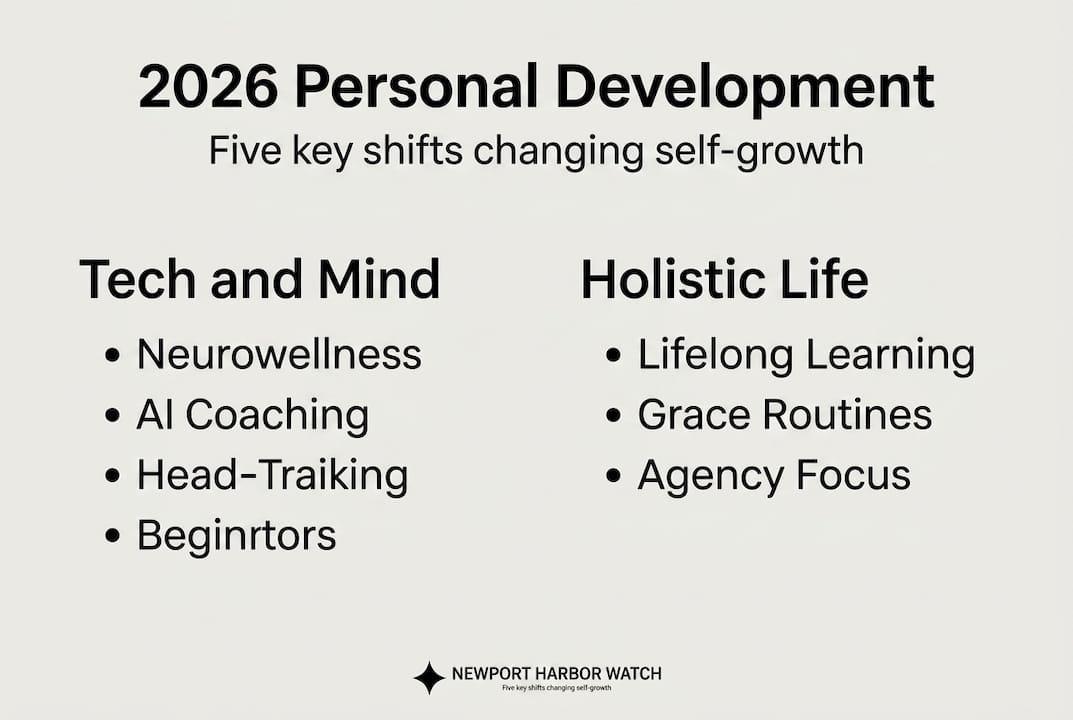
Personal development is shifting faster than most people realize. Wearable devices now track your nervous system in real time, AI coaches adapt to your exact learning style, and holistic neurowellness has become a leading trend shaping how we grow in 2026. The old model of reading a self-help book and hoping for the best is giving way to something far more dynamic and personalized. Whether you are a parent trying to support your family's emotional health, an educator rethinking how people learn, or a mental health advocate pushing for better tools, the trends covered here offer real, actionable pathways forward.
Table of Contents
- How neurowellness is reshaping self-improvement
- AI-powered personal development: Opportunities and risks
- Holistic education trends: Lifelong growth for all ages
- Integrating recovery, grace, and forgiveness into daily routines
- A new mindset: What most people miss about personal development in 2026
- Discover resources for your personal growth journey
- Frequently asked questions
Key Takeaways
| Point | Details |
|---|---|
| Precision neurowellness | Wearable tech optimizes nervous system health for stress recovery and emotional resilience. |
| Human-AI balance | Intentionally designed AI tools boost growth without sacrificing trust or agency. |
| Lifelong education | Hybrid learning and new certifications make personal improvement accessible for every age. |
| Holistic daily practices | Integrating recovery, grace, and forgiveness strengthens mental health and family relationships. |
How neurowellness is reshaping self-improvement
Neurowellness is not a buzzword. It is a practical approach to personal development that treats the nervous system as the foundation of all growth. When your nervous system is overwhelmed, learning slows, relationships suffer, and resilience crumbles. When it is regulated, you think clearly, recover faster, and handle stress with more grace. In 2026, wearable technology makes this visible in real time.

Devices like the Oura Ring, WHOOP strap, and newer EEG headbands now measure heart rate variability, sleep stages, and stress responses throughout the day. They give you feedback you can act on immediately, not just data to scroll through. Mental health advocates now focus on nervous system optimization via wearables for proactive stress training rather than reactive crisis management.
Parents are using these tools in genuinely creative ways. Some families track sleep quality together and notice how poor recovery affects a child's emotional regulation the next morning. Others use biofeedback apps to help kids identify stress signals before a meltdown happens. This is proactive parenting backed by data.
Key benefits of neurowellness tools for families and individuals:
- Real-time feedback on stress levels helps identify triggers before they escalate
- Sleep tracking creates awareness of recovery patterns for both adults and children
- HRV (heart rate variability) monitoring shows how well you are adapting to daily demands
- Breathing and mindfulness prompts from devices reinforce calm responses throughout the day
| Wearable tool | Primary function | Best for |
|---|---|---|
| Oura Ring | Sleep and recovery scoring | Adults focused on recovery |
| WHOOP Strap | Strain and HRV tracking | Athletes and high performers |
| Muse Headband | Real-time EEG meditation feedback | Stress reduction and focus |
| Garmin smartwatches | Activity and stress monitoring | Families and general wellness |
Statistic spotlight: The global wearable health device market is projected to surpass $195 billion by 2027, reflecting just how rapidly nervous system tools are entering everyday life.
Pro Tip: When choosing a wearable, prioritize devices that offer actionable recommendations, not just raw numbers. Data without direction leads to frustration, not growth.
AI-powered personal development: Opportunities and risks
Artificial intelligence is changing how people set goals, learn new skills, and track progress. Apps now analyze your reading pace, identify knowledge gaps, and adjust content difficulty on the fly. Virtual coaches provide feedback at 2 a.m. when a human mentor is unavailable. The accessibility is genuinely remarkable.
But there is a serious imbalance to acknowledge. Only 7% of AI investment goes toward people-focused applications, meaning most of the technology budget flows to automation and efficiency rather than human growth. That gap creates real risks: trust erosion, over-reliance on algorithms, and the slow hollowing out of human connection in growth spaces.
"The most dangerous outcome of AI-driven development is not that machines will replace humans. It is that humans will stop practicing the skills that make them irreplaceable: empathy, judgment, and genuine curiosity."
How to integrate AI meaningfully into your daily routine:
- Start with one AI tool that targets your weakest growth area, whether that is focus, language learning, or emotional intelligence.
- Set a clear weekly goal and let the AI track your consistency, not just your outcomes.
- Schedule one human check-in per week, a mentor, peer, or coach to review AI-generated insights together.
- Audit your tool every 30 days. Ask whether it is increasing your agency or creating dependency.
- Use AI for data and structure. Reserve human relationships for meaning, accountability, and emotional depth.
AI-driven vs. traditional self-improvement methods:
| Factor | AI-driven approach | Traditional approach |
|---|---|---|
| Personalization | High, adapts in real time | Lower, relies on self-awareness |
| Accountability | Algorithm-based reminders | Human relationships and trust |
| Emotional depth | Limited | Strong |
| Cost | Often low or free | Variable, can be high |
| Scalability | Reaches millions instantly | One person at a time |
| Risk of dependency | Moderate to high | Low |
The sweet spot in 2026 is intentional design: using AI to handle structure and feedback while keeping human interaction at the center of your growth story.
Holistic education trends: Lifelong growth for all ages
The phrase "lifelong learning" has been around for decades. What makes 2026 different is that the infrastructure finally supports it. Hybrid models, micro-credentials, and customized certification paths have made learning genuinely accessible at every life stage. Education sectors are rapidly evolving with hybrid learning and customized certifications, and this shift benefits far more than traditional students.
Parents returning to the workforce are earning credentials online during nap times. Educators are stacking micro-certifications to stay current with behavioral health research. Mental health advocates are building expertise through targeted short programs that would have required a two-year degree just five years ago.
Educational resources worth exploring for lifelong learners:
- Hybrid MBA programs that blend in-person networking with flexible online coursework
- Micro-credential platforms such as Coursera, edX, and LinkedIn Learning for skill-specific growth
- Certificate trends in 2026 for professionals who want recognized credentials without full degree commitments
- Community college partnerships with employers offering funded upskilling programs
- Free e-book libraries and audio learning platforms that support behavioral health literacy
| Learning format | Time commitment | Best for |
|---|---|---|
| Full degree programs | 2 to 4 years | Career pivots and deep expertise |
| Hybrid MBA | 18 to 24 months | Mid-career professionals |
| Micro-credentials | 4 to 12 weeks | Specific skill building |
| Certificate programs | 3 to 6 months | Career advancement and credibility |
| Self-directed learning | Flexible | Parents, educators, and advocates |
Pro Tip: When evaluating any program, search for documented outcomes, not just testimonials. Strong programs publish completion rates, employer partnerships, and salary data for graduates.
The best learning investments in 2026 are the ones that fit your actual life, not an idealized version of it. Small, consistent learning compounds over time in ways that one-time intensive programs rarely do.
Integrating recovery, grace, and forgiveness into daily routines
Here is a truth that the productivity world does not market well: recovery is not the opposite of achievement. It is the engine of it. In 2026, the most effective personal development strategies treat rest, grace, and forgiveness as non-negotiable practices rather than soft add-ons.
Blending mental and physical recovery with proactive stress training creates the holistic foundation that sustains long-term growth. Without it, even the best neurowellness tech and AI tools become noise layered onto an exhausted nervous system.
"Forgiveness is not about excusing harmful behavior. It is about refusing to carry the weight of resentment into the next chapter of your life." — Mental health advocate perspective
Daily practices for integrating grace and forgiveness:
- Begin each morning with a 60-second gratitude note, written by hand, focused on one person or moment from the previous day.
- Practice "micro-repair" after conflicts: a short, direct acknowledgment of the tension without lengthy analysis.
- Schedule a weekly family check-in where each person shares one thing they are proud of and one thing they want support with.
- Use a simple evening reflection to identify where you were hard on yourself that day, then consciously reframe it with compassion.
- Model forgiveness out loud for children and family members. Narrating your process teaches more than instruction ever will.
Signs your daily routine genuinely supports mental wellness:
- You recover from setbacks within hours rather than days
- You feel comfortable asking for help without shame
- Conflict in your household ends in repair rather than silence
- You take breaks without guilt and return to tasks with energy
- You notice stress signals early and respond rather than react
These practices do not require a therapist or an app. They require intention and repetition, which are the most underrated tools in any growth strategy.
A new mindset: What most people miss about personal development in 2026
After years of working in psychology, behavioral health, and educational publishing, one pattern stands out clearly: people invest in tools and neglect integration. They buy the wearable, download the AI app, enroll in the hybrid course, and then wonder why nothing sticks. The problem is almost never the tool. It is the absence of a daily practice that connects the tool to real life.
Technology and education are crucial starting points. But lasting change emerges from what you do on a Tuesday afternoon when no one is watching and no algorithm is prompting you. It comes from choosing recovery over hustle when your body signals exhaustion. It comes from offering forgiveness in a family conversation when pride makes silence feel easier.
Most people also underestimate the power of agency. In a world full of personalized AI recommendations, it is easy to outsource your judgment. The individuals who grow most consistently in 2026 are those who use technology as a mirror, not a compass. They stay curious, self-reflective, and willing to override the algorithm when their lived experience says otherwise.
Pro Tip: Once a month, put the devices and apps aside for one full day. Journal about your actual progress without data. You will often discover insights that no wearable can surface.
Discover resources for your personal growth journey
The trends and strategies covered in this article are most powerful when they connect to resources that match your real life. Raising a family, processing grief, or navigating career changes all require targeted support, not generic advice.
At Arthur Scott Publishing, Dr. Scott's free e-books and audio resources address exactly these crossroads. From parenting support that acknowledges the full weight of the job to celebration of life resources for families navigating loss with grace, the platform meets you where you are. Explore the full library of personal growth resources to find practical tools grounded in psychology, family empowerment, and behavioral health. Growth is not a solo pursuit, and the right resource at the right moment changes everything.
Frequently asked questions
What is neurowellness and how can I use it in 2026?
Neurowellness focuses on optimizing your nervous system through wearable tech and stress training for proactive rather than reactive health management. Start with a basic wearable that tracks sleep and HRV, then build habits around its daily feedback.
Does AI make personal development more effective?
AI personalizes growth strategies effectively, but only 7% of AI investment targets people-focused tools, so you must actively choose platforms designed to preserve human agency and meaningful connection.
Are hybrid learning programs worth it for lifelong growth?
Yes. Hybrid programs dominate education in 2026 because they combine flexibility with structured learning, making them practical for working parents, professionals, and educators at any career stage.
How can I integrate forgiveness and recovery into my daily routine?
Small daily actions like gratitude notes, micro-repair conversations, and blending mental and physical recovery practices build the emotional foundation that sustains long-term personal growth.