
Feeling stuck is one of the most frustrating experiences you can have as a parent or someone committed to growing as a person. You want to do better, feel better, and show up stronger for the people you love, but the path forward feels blurry or overwhelming. The good news is that a structured, evidence-backed personal growth action plan cuts through that fog. Research confirms that weekly plan reviews make success three times more likely, and that small, consistent steps compound into life-changing gains. This guide walks you through every stage of building and sustaining that plan for yourself and your family.
Table of Contents
- Why personal growth plans matter for you (and your family))
- What you need to get started: Tools and mindset
- How to build your personal growth action plan: Step-by-step
- Troubleshooting and sustaining your growth plan long-term
- The real key: Consistency over intensity
- Take your family's growth further: Get support and resources
- Frequently asked questions
Key Takeaways
| Point | Details |
|---|---|
| Small steps compound | Making 1% improvements daily can lead to dramatic growth across a year. |
| Consistency matters more | Weekly plan reviews and steady routines triple the chances of success compared to sporadic efforts. |
| Modeling inspires family | When parents develop their own growth plans, children benefit more than through behavioral correction alone. |
| Set clear intentions | Specifying when and where to act makes you much more likely to achieve your goals. |
Why personal growth plans matter for you (and your family)
Now that we've set the stage, let's dig into why personal growth action plans make such a difference.
Most people underestimate how deeply their own growth shapes the people around them. When you work intentionally on yourself, you're not just improving your own mood or productivity. You're reshaping the emotional environment your children grow up in. That's a bigger deal than most parenting books admit.
Self-efficacy and purpose are the real drivers. Self-efficacy is your belief in your ability to succeed at something. When you set a goal, take small steps, and see real progress, that belief strengthens. Empirical data shows that personal growth mediates self-efficacy and career exploration through psychological well-being components like purpose in life. In plain terms: working on yourself makes you feel more capable, and that ripples into everything from your work performance to how you handle a tough conversation with your teenager.
Here's why structured plans outperform vague intentions:
- Implementation intentions boost results. Saying "I will meditate" is weaker than saying "I will meditate at 7 a.m. in the kitchen before anyone wakes up." This "when and where" format, known as an implementation intention, can boost goal achievement by up to 91%.
- Small gains add up fast. A 1% daily improvement sounds almost trivial. But over a full year, that compounds to 37x yearly improvement. That's not a motivational slogan. That's math.
- Weekly reviews triple your odds. The habit of sitting down once a week to check your progress isn't just nice to have. It actively makes success three times more likely.
- Your growth models behavior for your children. Kids don't primarily learn from what you tell them. They learn from what they observe you doing.
"Children absorb the habits and emotional patterns of the adults closest to them. A parent who works openly on self-improvement teaches resilience, humility, and growth without saying a word."
The personal growth for families approach recognizes that family empowerment is not a separate project from your personal growth. They are the same project. When you are intentional about your mindset, your communication, and your well-being, your family benefits automatically. That's the leverage point most parents miss when they focus only on fixing their children's behavior rather than examining and evolving their own.
Think about a parent who starts a daily journaling habit focused on gratitude. Within weeks, they notice they're reacting less sharply to small frustrations. Their children notice the shift in tone, even if they can't name it. The home becomes measurably calmer, not because anyone lectured anyone, but because one adult committed to steady personal growth.

What you need to get started: Tools and mindset
Having seen why growth plans are powerful, let's lay out exactly what you'll need to make yours work.
Starting a personal growth action plan doesn't require expensive apps or elaborate systems. What it does require is the right combination of practical tools and an honest, open mindset. Here's a breakdown of both.
Essential tools
| Tool | Purpose | Best for |
|---|---|---|
| Journal or notebook | Reflection, tracking emotions, writing goals | Daily check-ins and mood awareness |
| Digital or paper planner | Scheduling habits and review sessions | Weekly planning and accountability |
| Timer or reminder app | Triggering your chosen habit at the right time | Consistency with implementation intentions |
| Progress tracker | Visualizing wins and streaks | Motivation and pattern recognition |
These tools are low-cost and widely accessible. What matters more than the tool itself is how consistently you use it. Research on action plan essentials confirms that simplicity and repetition outperform elaborate systems that fall apart after two weeks.
The mindset requirements
- Embrace small steps. Big overhauls are dramatic but fragile. Small steps are boring but durable.
- Practice self-compassion. Missing a day doesn't erase your progress. Beating yourself up about it is the only thing that can.
- Stay curious, not critical. Treat setbacks as information, not evidence of failure.
- Expect discomfort. Growth doesn't feel like growth while it's happening. Mild discomfort is a sign you're stretching.
Involving your family multiplies the impact
One of the most underused strategies in personal growth is involving your family openly. Research on life skills for families shows that when parents are transparent about their growth goals, children develop stronger self-regulation and communication skills. The data goes further: parent-teacher communication predicts student engagement more strongly than family income or education level. This tells us something important: it's the quality of involvement, not the level of resources, that drives positive outcomes for kids.
Pro Tip: Put your plan somewhere visible, like on the refrigerator or a shared family board. When your kids see you returning to your goals daily, you're giving them a live masterclass in discipline and purpose.
How to build your personal growth action plan: Step-by-step
Now it's time to roll up your sleeves and create your plan. Here's exactly how to do it.
This is where the real work begins. Follow these steps in order. Don't skip ahead. Each one builds on the last.
-
Identify your core growth area. Choose one area to focus on first. Common options for parents include patience, communication, self-care, emotional regulation, or physical health. Trying to improve everything at once is the fastest way to improve nothing.
-
Write a SMART goal. SMART stands for Specific, Measurable, Achievable, Relevant, and Time-bound. Instead of "I want to be more patient," write: "I will practice one deep breathing exercise when I feel frustrated, every day for 30 days." That's a goal you can act on and measure.
-
Create an implementation intention. Once your goal is clear, specify exactly when and where you'll take action. Implementation intentions can boost goal achievement by up to 91%. Your statement should follow this format: "When [situation], I will [behavior] at [time] in [location]." Example: "When my kids get home from school and things feel tense, I will take three deep breaths in the hallway before responding."
-
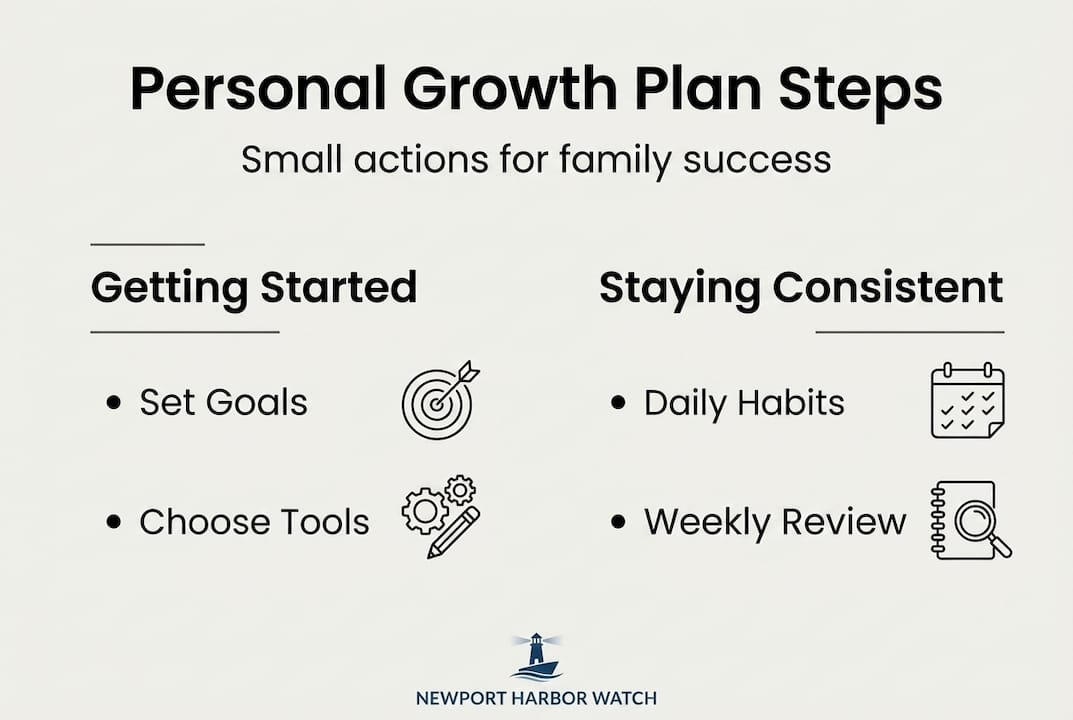
Translate the goal into a daily or weekly habit. Break your SMART goal down into the smallest repeatable action possible. If your goal is to read one personal development book per month, your daily habit might be reading just two pages before bed.
-
Schedule a weekly review. Block 15 to 20 minutes every Sunday or Monday to look at how your week went. What worked? What got skipped? Why? Adjust without judgment. This step is non-negotiable. The 1% daily gains that compound to 37 times yearly improvement only happen if you keep showing up and refining your approach.
Pro Tip: Use your review session to check in with a family member about their goals too. This builds accountability and models growth as a shared family value. For added inspiration, see how planning for milestones can give your progress greater meaning and emotional weight.
Habit tracking comparison
| Tracking method | Effort level | Best feature | Weakness |
|---|---|---|---|
| Paper habit tracker | Low | Tangible and visual | Easy to lose or forget |
| Spreadsheet | Medium | Flexible and detailed | Requires regular updating |
| Habit-tracking app | Low to medium | Automated reminders | Can feel impersonal |
| Accountability partner | High | Social support | Depends on another person |
Understanding the tradeoffs of each method helps you pick the one you'll actually stick with. For deeper insights on effective goal-setting methods, simple frameworks tend to outperform complex ones over time. You can also find value in exploring legacy planning as a family to anchor your growth plan in something meaningful for future generations.
Troubleshooting and sustaining your growth plan long-term
Once your plan is in motion, keeping it alive is key. Here's how to handle setbacks and stay consistent.
Building a plan is actually the easier part. Sustaining it through busy weeks, life disruptions, and motivation slumps is where most people struggle. Here's what the research and real-world experience teach us about staying in the game.
Common obstacles and how to address them
- Perfectionism. The belief that you have to do your habit perfectly or not at all is a plan killer. Missing one day doesn't break a habit. Deciding not to restart does. Give yourself permission to be a 90% person and still celebrate that as success.
- Loss of motivation. Motivation is not reliable. It peaks at the beginning and fades fast. This is why systems and schedules matter more than enthusiasm. Design your habit so it requires as little motivation as possible to execute.
- Busy weeks and unexpected events. Life will interrupt your plan. That's not a failure of the plan. Build a "minimum viable version" of your habit for hard weeks. If you normally journal for 20 minutes, your minimum could be writing three sentences.
- Isolation. Trying to sustain growth entirely alone is unnecessarily hard. Social support changes the equation significantly.
"Accountability isn't about pressure. It's about having someone who cares whether you show up. That simple dynamic can be the difference between quitting and continuing."
Strategies that actually sustain long-term growth
- Share your goal with one trusted person and give them permission to check in with you.
- Use a visible habit tracker that you see every day, not one buried in an app.
- Celebrate small wins deliberately. A streak of 10 days deserves acknowledgment.
- Weekly plan reviews make success three times more likely. This is the single highest-leverage habit in your entire plan.
- Reconnect with your "why" regularly. Why does this goal matter to you and your family? Write it somewhere prominent.
If you find parenting stressors are getting in the way of your personal growth, explore strategies for overcoming parenting hurdles that address the real-world demands of being a full-time caregiver while still prioritizing your own development. Practical tools for boosting productivity can also help you find pockets of time you didn't know you had.
Flexibility is not weakness. Adjusting your plan based on what your weekly review reveals is exactly what the process is designed for. A plan that evolves with you is far more powerful than a rigid one you eventually abandon.
The real key: Consistency over intensity
With the main steps and troubleshooting covered, let's shift to a unique perspective on what really fuels lasting change.
Here's something most people won't tell you: the biggest enemy of personal growth isn't a lack of ambition. It's the belief that change has to be dramatic to count. Parents especially fall into this trap. They wait for the right time, the right program, the perfect moment of clarity, and then they attempt a massive overhaul that lasts two weeks before life reclaims the space.
The research is clear, and I find it genuinely liberating. A 1% daily improvement is not inspiring on paper. But it is devastating in practice, in the best possible way. It means you don't need a breakthrough. You just need to be slightly better today than you were yesterday.
The parents who make the most lasting change in their families are not the ones who read every parenting book or attend every workshop. They're the ones their kids catch journaling quietly in the morning. The ones who say out loud, "I'm working on my patience this month." That visible, humble progress is the most powerful teaching tool in existence. Exploring building growth routines can help you design those daily rituals in a way that actually fits your life.
Empowering your family starts with your own honest, incremental effort. Not perfection. Progress.
Take your family's growth further: Get support and resources
If you're ready for deeper transformation, here are tools and resources to build momentum.
You don't have to build your growth plan alone. Arthur Scott Publishing offers a library of free, accessible resources designed specifically for parents and individuals committed to meaningful, lasting change.
Whether you're navigating the daily challenges of raising children or seeking clarity on your own path, there is support for parents that speaks to the real complexities of family life. For those thinking across generations, you'll also find thoughtful guidance for families that honors both the parent and grandparent roles. Take the next step and grow with our resources at Arthur Scott Publishing. Your family's growth story is already in motion. We're here to help you write it with intention.
Frequently asked questions
What is a personal growth action plan?
A personal growth action plan is a structured, step-by-step framework you create and follow to reach specific self-improvement goals and boost your overall well-being.
How often should I review my personal growth plan?
Weekly reviews are your most powerful tool: weekly plan reviews are proven to triple your success rate and help you course correct before small slips become full stops.
How can I make my growth plan work for my family?
Involve your family in goal setting and make your progress visible, since self-care and growth plans from parents enhance child outcomes far more effectively than focusing only on correcting behaviors.
What if I miss a day or lose motivation?
Missing a day is completely normal. Simply return to your routine the next day and use your weekly review to understand what got in the way and adjust accordingly.
What's an implementation intention, and how does it help?
An implementation intention is a specific "when and where" plan for your action, and research shows it can boost goal achievement by up to 91% compared to a vague intention alone.