
Picture this: dinner is tense, your teenager storms off without explanation, and your youngest bursts into tears over something that seems minor. You feel frustrated but also confused about your own reaction. This scenario plays out in countless homes, and the root cause is often the same: a gap in self-awareness. Emotional skills training improves emotional awareness, mindfulness, and regulation with effects that last at least six months, proving that self-awareness is not a fixed trait. It is a skill your whole family can build together, one practical step at a time.
Table of Contents
- Understanding self-awareness: Why it matters
- Preparation: Tools and resources for self-awareness
- Execution: Step-by-step methods to enhance self-awareness
- Verification: Measuring progress and overcoming challenges
- Our perspective: Reframing self-awareness for modern families
- Next steps: Grow your family's emotional health
- Frequently asked questions
Key Takeaways
| Point | Details |
|---|---|
| Family context matters | Self-awareness strategies work best when tailored to family dynamics and routines. |
| Evidence-backed methods | Naming emotions, journaling, and reflection are proven to boost self-awareness for individuals and families. |
| Measure progress consistently | Check progress using emotional skills benchmarks and self-reflection tools. |
| Sustain gains long-term | Improvement is maintained when self-awareness routines become habits in everyday life. |
| Avoid judgment | Open, non-judgmental communication is key to successful self-awareness enhancement. |
Understanding self-awareness: Why it matters
Self-awareness is the ability to recognize your own thoughts, feelings, and behaviors as they happen. Emotional awareness, a closely related concept, goes a step further by helping you name and understand those feelings rather than simply reacting to them. Together, they form the foundation of emotional health for both individuals and families.
When you are self-aware, you can pause before snapping at a partner or a child. You can recognize that the tightness in your chest during an argument is anxiety, not anger, and respond accordingly. That distinction matters more than most people realize. Families that practice emotional awareness tend to have clearer communication, fewer explosive conflicts, and stronger bonds overall.
Research confirms the tangible value of this work. Training programs that target interoceptive awareness (the ability to sense what is happening inside your body) and emotional regulation show measurable improvements in MAIA (Multidimensional Assessment of Interoceptive Awareness) and LEAS (Levels of Emotional Awareness Scale) scores. These gains serve as a buffer against major stressors, including the kind of prolonged pressure families faced during events like the pandemic. That protective effect is significant.
Here is a quick look at what improved self-awareness actually does for your family:
- Reduces reactive conflict by creating a gap between feeling and responding
- Builds empathy because you understand your own emotional landscape well enough to imagine someone else's
- Improves stress management by helping you identify triggers before they escalate
- Strengthens resilience so setbacks are processed rather than buried
- Models healthy behavior for children who are still learning how emotions work
"Self-awareness is not about having all the answers. It is about having the right questions ready when emotions arise." This is the shift families need most.
If you are ready to take concrete action, self-awareness practical steps are a great place to begin building this skill intentionally.
Preparation: Tools and resources for self-awareness
With the importance of self-awareness established, let's look at the tools and resources you need before starting. Jumping into a new practice without preparation is one of the fastest ways to abandon it. Choosing the right tools for your household makes consistency much easier.
Choosing the right approach for your family
Different methods work better depending on your family's age range, communication style, and available time. Here is a side-by-side comparison of the most common tools:
| Tool | Best for | Time commitment | Age range | Cost |
|---|---|---|---|---|
| Online emotional skills training | Adults, teens | 2 to 4 hours per week | 14 and up | Low to moderate |
| Journaling | Individuals, older children | 10 to 20 minutes daily | 8 and up | Very low |
| Family reflection routines | All ages | 15 to 30 minutes, 3x per week | All ages | Free |
| Curated reading (books, e-books) | Parents, older kids | Flexible | 10 and up | Low |
| Guided audio programs | Busy adults | 15 to 30 minutes | 16 and up | Low |
Parents raising young children should name emotions without judgment, model self-reflection openly, and use journaling or reading to build empathy and self-regulation. These approaches are not just child-friendly. They reinforce the parent's own practice at the same time.
Age-appropriateness deserves extra attention. A five-year-old cannot maintain a journal, but they can play "feelings charades" at the dinner table. A teenager may resist a structured family meeting but open up during a car ride conversation. Flexibility is not a compromise. It is a strategy.
What to have ready before you start:
- A dedicated notebook or digital journaling app for each family member who is old enough
- A consistent time slot for family reflection (right after dinner often works well)
- A list of basic feeling words to post somewhere visible in the home
- An open agreement that no emotion will be mocked or dismissed during practice time
One important nuance to understand: state mindfulness increases during training programs, but these gains may not automatically convert into lasting trait changes without deliberate framing. In plain terms, doing a mindfulness session makes you calmer right now. But becoming a more mindful person overall requires you to name that shift, talk about it, and build it into your identity. Programs explicitly designed with this in mind, such as SECT (Socio-Emotional Competence Training), outperform generic mindfulness-based interventions (MBIs) for long-term change.
Pro Tip: Before starting any family self-awareness practice, hold a short "kickoff" conversation where everyone shares one emotion they find difficult to talk about. This sets a tone of honesty and signals that the space is safe.
Execution: Step-by-step methods to enhance self-awareness
Now that you have the tools and resources, let's walk through the step-by-step methods for effective self-awareness improvement. These steps are designed to work in both solo and family contexts, and they build on each other progressively.
Step 1: Start with a daily body scan (individual) Each morning or evening, spend five minutes simply noticing physical sensations. Where do you feel tension? Is your breathing shallow? Body scans train interoceptive awareness, which is the first layer of emotional self-knowledge. You cannot name what you feel if you never tune in to feel it.
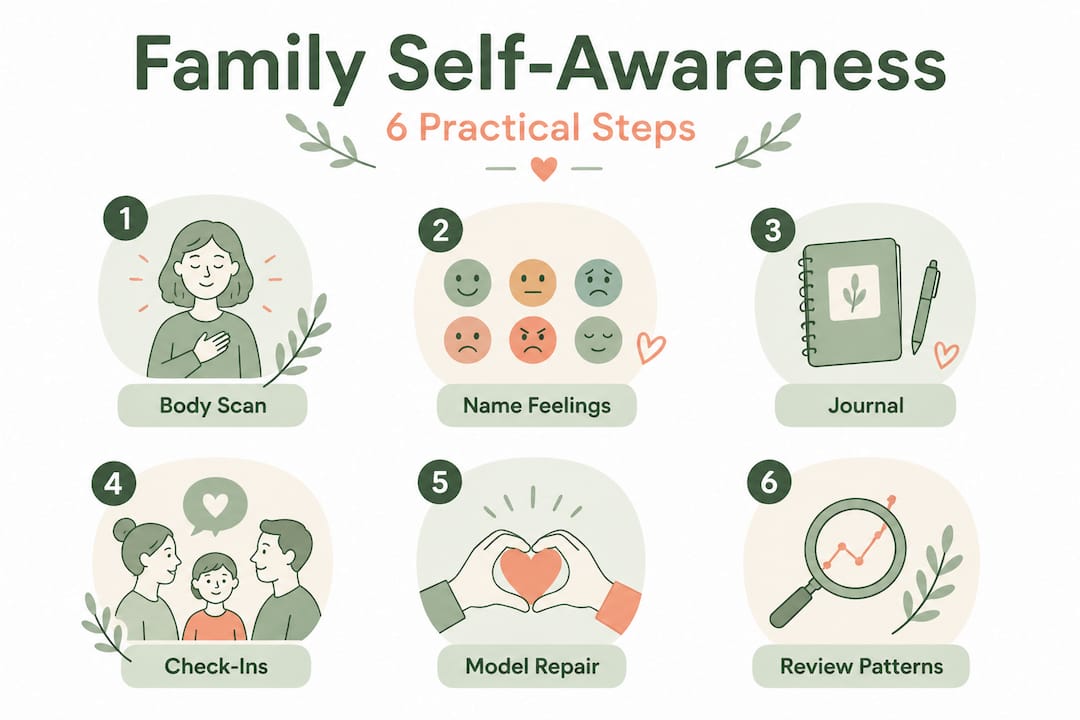
Step 2: Name the emotion out loud or in writing Once you identify a sensation, give it a word. "I feel tight in my chest and I think that is worry." Naming emotions without judgment is one of the most consistent recommendations across child development and adult psychology alike. Language gives emotion structure, and structure reduces intensity.
Step 3: Start a reflection journal Write three sentences each day: what happened, how you felt, and what you noticed about your reaction. This does not need to be literary. Short and honest beats long and polished every time. Children as young as eight can draw pictures and label them with feeling words as their version of this practice.
Step 4: Introduce weekly family check-ins Pick one evening per week where each family member answers three questions: "What was hard this week?", "What made me feel proud?", and "What do I wish had gone differently?" No cross-talk, no advice unless asked. Just listening and reflection.
Step 5: Model repair after conflict After a disagreement, come back and name what you were feeling in the moment. "When I raised my voice, I was feeling overwhelmed, not angry at you." This step is often skipped, but it is one of the most powerful because it teaches children that self-reflection is something you do after an imperfect moment, not only when you are calm.
Step 6: Track and revisit Every two weeks, review journal entries or check-in notes. Look for patterns. Do conflicts cluster around certain days or situations? Does a particular family member consistently feel unheard? Patterns point you toward the next layer of growth.
Which methods work for which age groups?
| Method | Young children (4 to 7) | Older children (8 to 12) | Teens (13 to 17) | Adults |
|---|---|---|---|---|
| Body scan | With guidance | Yes | Yes | Yes |
| Emotion naming | Yes (verbal) | Yes (written) | Yes | Yes |
| Journaling | Drawing version | Yes | Yes | Yes |
| Family check-in | Yes (simplified) | Yes | Yes | Yes |
| Conflict repair modeling | Observer role | Participant | Participant | Lead |
Research benchmarks matter here too. MAIA and LEAS score improvements following structured training indicate that you are building real, measurable capacity, not just going through the motions. Tracking your own progress, even informally, keeps motivation alive.
Pro Tip: Avoid the trap of "emotion policing." When a child says "I feel nothing," resist the urge to correct them. Instead, say "That makes sense. Sometimes feelings take a while to show up." This keeps the door open.
Verification: Measuring progress and overcoming challenges
After executing the improvement methods, it is crucial to verify progress and handle obstacles effectively. Growth without measurement tends to stall.
How to measure self-awareness progress
You do not need a formal psychological assessment to track meaningful change. Here are practical ways to gauge improvement:
- Emotional vocabulary expansion: Can family members name more nuanced emotions over time? Moving from "mad" to "frustrated," "embarrassed," or "disappointed" signals real growth.
- Conflict recovery time: How long does it take to reconnect after a disagreement? A shortening recovery window is a strong indicator of improved regulation.
- Self-reflection prompts: Use a simple 1 to 10 scale weekly. "How aware was I of my emotions this week?" Honest self-rating builds metacognitive skill (thinking about how you think).
- Journal review: Look back at entries from four weeks ago. Shifts in tone, depth, and emotional specificity are measurable signs of growth.
For those who want more formal benchmarks, sustained improvements in emotional awareness tracked through validated tools show that structured programs produce real results, often within weeks of consistent engagement.
"The goal is not perfection. It is pattern recognition. When you can say 'I see what happened and I understand why,' you have already changed something important."
Common challenges and how to beat them
Resistance is normal, especially in families where emotional openness is new. Here are the most common obstacles and direct solutions:
- Resistance from teens: Avoid forced participation. Offer journaling as an alternative to verbal check-ins and let them share on their own terms.
- Inconsistency: Anchor practices to existing habits (dinner, bedtime, car rides) rather than creating entirely new routines.
- Relapse after conflict: Expect setbacks. Plan in advance what "getting back on track" looks like so it does not feel like starting over.
- Lack of visible progress: Progress in emotional health is often subtle. Ask family members to share one small win from the week to make growth visible.
Sustaining gains requires ongoing dialogue. Checking in monthly on how the practices feel, what is working, and what needs adjusting keeps everyone invested. You can explore more strategies through self-awareness practical steps to keep building on what you have started.
Our perspective: Reframing self-awareness for modern families
Here is something most self-awareness content gets wrong: it treats emotional growth as a solo journey. You meditate, you journal, you become enlightened, and your family benefits indirectly. That model is incomplete, and the evidence is starting to confirm it.
Family context fundamentally changes what self-awareness means and how it develops. A teenager who learns emotion regulation in a classroom does not automatically bring that skill home if the home environment does not reinforce it. A parent who reads every self-help book available may still struggle in the moment if they have no shared language of emotions with their partner or children.
This is where explicit framing becomes critical. State mindfulness alone does not reliably produce long-term trait-level change. The research distinction between SECT (a socio-emotional skills program) and standard mindfulness training is telling: programs that explicitly name what is being learned and why tend to create more durable results. Families need that same explicit framing. "We are doing this together because how we understand our emotions affects how we treat each other." That sentence does more than any technique practiced in silence.
Conventional wisdom also tends to focus on the individual as the unit of change. We want families to see themselves as the unit of change. When one person grows, the system shifts. But when the whole family grows together, the shift is structural and lasting.
This does not mean every family needs to become a therapy group. It means building in moments of shared reflection, using a common emotional vocabulary, and normalizing the idea that awareness is ongoing, not a destination. Self-awareness practical steps rooted in family context are fundamentally different from the solo practice most programs assume. That difference deserves far more attention than it currently gets.
Next steps: Grow your family's emotional health
The methods in this article are a strong foundation, but every family benefits from ongoing support, curated resources, and a community that understands what growth really looks like. Dr. Arthur Scott's work was built on exactly that premise.

If you are navigating the real weight of parenting challenges, you already know that awareness alone is not always enough. Sometimes you need structured, expert-backed resources to carry the work further. Arthur Scott Publishing offers free downloadable e-books on emotional health, behavioral strategies, and family empowerment, all accessible in PDF and audio formats through Speechify. From life skills for families to deeper work on forgiveness and resilience, the resources at Arthur Scott Publishing are designed to meet your family where it actually is, not where it is supposed to be.
Frequently asked questions
What is the most effective self-awareness improvement method for families?
Combining emotion naming, journaling, and open reflection in regular family routines is the most effective approach, as it builds shared language and consistent emotional practice across all family members.
How soon can you see improvement from self-awareness practices?
Measurable gains in emotional awareness can emerge within a few weeks of consistent practice, and research shows effects are sustained at six-month follow-ups when the practice is structured and intentional.
Can online emotional skills training help long-term self-awareness?
Yes, particularly when programs include explicit framing about what is being learned. Online training programs show sustained improvements in emotional awareness and regulation, especially when paired with regular personal reflection between sessions.
What are common mistakes when improving family self-awareness?
The biggest mistakes include judging emotions during practice, allowing routines to lapse after the first difficult week, and failing to create a shared emotional vocabulary that everyone in the family actually uses.
Recommended
- Build Self-Awareness: Practical Steps for Personal Growth
- Why sharing success stories fuels growth and wellbeing
- Parenting is a Tough 24/7 Job.
- Boost SEO & AEO with Geo-targeted Blogs
- Why Reflection Helps You Understand Yourself — Caia Evergreen
- Why Massachusetts Parents Are Prioritizing Emotional Regulation in 2026 And How It Transforms Family Life