
Most people hesitate to share their success stories, afraid of coming across as boastful or self-congratulatory. But that hesitation may be costing them something real. Research increasingly shows that when people frame and share their own journeys, including the struggles and the turning points, they experience measurable gains in mental wellbeing, self-awareness, and community connection. This article breaks down the science of why storytelling works, what benefits it actually delivers, where its limits lie, and how you can put it into practice for lasting personal growth.
Table of Contents
- What makes a success story powerful?
- Personal and community benefits of sharing
- Motivation and prosocial outcomes: The ripple effect
- Limits and lessons: When stories help and when they don't
- How to share your success story for impact
- Why stories matter more than we realize: Our editorial take
- Explore, connect, and grow with Arthur Scott Publishing
- Frequently asked questions
Key Takeaways
| Point | Details |
|---|---|
| Stories empower and heal | Sharing personal journeys can enhance both self-growth and community wellbeing. |
| Impact multiplies with authenticity | Genuine accounts of growth and adversity spark positive action and reduce stigma. |
| Stories aren’t silver bullets | While stories shift attitudes, lasting change also needs resources and support. |
| Anyone can contribute | With the right approach, anyone can inspire and help others through storytelling. |
What makes a success story powerful?
Not every story lands. The ones that do share a few key ingredients, and understanding them helps you both recognize and craft narratives that genuinely move people.
The four core elements of a powerful success story are adversity, growth, moral value, and authenticity. Adversity gives the story stakes. Growth shows that change is possible. Moral value gives the listener something to take away. And authenticity is what makes the whole thing believable. Remove any one of these, and the story loses its grip.
What separates a truly empowering story from a polished highlight reel is the concept of participatory storytelling. This is when the storyteller owns and frames their own narrative, rather than having someone else narrate it for them. Participatory storytelling reclaims identity and agency, improving wellbeing and reducing stigma. That distinction matters enormously. When you tell your own story in your own words, you are not just sharing information. You are actively reconstructing your identity around growth rather than suffering.
Here is a quick comparison of what makes stories weak versus strong:
| Story element | Weak version | Strong version |
|---|---|---|
| Adversity | Vague or minimized | Specific, honest, and relatable |
| Growth | Implied or absent | Clearly described with before/after contrast |
| Moral value | Generic platitude | Concrete lesson tied to real experience |
| Authenticity | Polished and perfect | Includes doubt, setback, and real emotion |
Stories also connect directly to motivation science. When a listener hears a narrative that mirrors their own struggles, their brain maps the storyteller's experience onto their own situation. This is why stories spark action in ways that advice alone rarely does. For practical ways to boost motivation through storytelling and other evidence-based methods, the connection between narrative and drive is well documented.
The most powerful stories are also the most specific. Saying "I overcame anxiety" is far less impactful than describing the exact moment you chose to ask for help, what that felt like, and what changed afterward.
Pro Tip: Aim for specific, honest experiences rather than perfect ones. Readers and listeners connect with the messy middle of your journey, not just the triumphant ending.
Personal and community benefits of sharing
Once you understand what makes a story powerful, the next question is: what does sharing it actually do for you and the people around you?

On a personal level, sharing your story builds self-esteem and deepens self-understanding. When you articulate your journey out loud or in writing, you are forced to organize your experience into a coherent narrative. That process itself is therapeutic. It helps you see your own growth more clearly and reinforces a sense of agency over your life.
On a community level, the effects are just as significant. Success stories used as participatory storytelling improve mental wellbeing and reduce stigma, as found in public health campaigns. When one person shares openly, it signals to others that their own struggles are not shameful or unusual. That normalization is powerful. It shifts group attitudes, builds connectedness, and creates space for more honest conversation.
"Story-based communication increases commitment to resilience actions versus presenting statistics alone." This finding, drawn from resilience research on story-based communication, highlights why narratives outperform data in motivating real-world change.
Here is a comparison of personal versus community-level benefits:
| Benefit type | Personal gains | Community gains |
|---|---|---|
| Mental health | Reduced shame, greater self-awareness | Normalized struggle, reduced group stigma |
| Connection | Feeling heard and understood | Increased trust and openness |
| Motivation | Reinforced sense of progress | Inspired collective action |
| Identity | Reclaimed narrative | Shared values and belonging |
The bullet points below summarize the top benefits of sharing success stories:
- Normalizing struggle: Others realize they are not alone in their difficulties
- Boosting hope: Proof that change is possible, grounded in real experience
- Inspiring positive action: Listeners are moved to take their own steps forward
- Reducing stigma: Open sharing challenges harmful assumptions about mental health
- Building resilience: Communities that share stories develop stronger coping cultures
If you are working on building a personal development workflow that supports lasting growth, incorporating regular story reflection and sharing is one of the most underrated strategies available.
Motivation and prosocial outcomes: The ripple effect
Here is where things get genuinely surprising. Sharing your story does not just help you. It can set off a chain reaction of positive behavior in the people around you.
The ripple effect works in a sequence:
- Inspiration: A listener hears a story and feels emotionally moved
- Emotional elevation: They experience what researchers call "moral elevation," a warm, uplifted feeling that motivates them to act better
- Practical action: That elevated state translates into real behavior, such as donating, supporting a friend, or seeking help themselves
- Social spread: Their action inspires others, extending the ripple further
The evidence behind this is striking. Exposure to redemption stories enhanced charitable giving versus control groups, especially when stories blended morality and personal growth. This was not a marginal effect. The combination of overcoming adversity and demonstrating clear moral growth made stories significantly more motivating than straightforward appeals.
Statistic callout: Stories featuring redemption arcs, where a person moves from hardship to growth through moral effort, consistently outperform statistics and data-only presentations in driving prosocial behavior. Story format in resilience research drives greater investment in positive action than statistics alone.
The story features that most supercharge these prosocial effects are:
- A clear moral dimension (the storyteller made a values-driven choice)
- Visible personal growth (not just survival, but transformation)
- Overcoming real adversity (not a minor inconvenience)
- Emotional honesty (vulnerability rather than performance)
For teams, families, and organizations, this research has a direct application. When groups create space for members to share their journeys, they build collective prosocial energy that spills into everyday interactions. Understanding the role of motivation for peak productivity helps explain why story-sharing cultures consistently outperform environments where personal experience is kept private.
Pro Tip: If you lead a team, a family group, or a wellness community, try opening meetings or gatherings with a brief story-sharing moment. Even two minutes of genuine narrative can shift the emotional tone of an entire session.
Limits and lessons: When stories help and when they don't
After all this evidence for storytelling's power, it is worth being honest about what stories cannot do. Setting realistic expectations is part of using this tool wisely.
The clearest finding from research is that testimonial-based campaigns mostly improve knowledge, reduce stigma and attitude issues, but have a weaker and often short-lived impact on actual help-seeking behavior. In other words, stories are excellent at changing how people think and feel. They are less reliable at changing what people actually do over the long term.
Here is a breakdown of what stories reliably shift versus what remains difficult to move:
What testimonials and success stories shift effectively:
- Awareness of mental health issues
- Reduction in stigma and shame
- Attitudes toward people with lived experience
- Short-term emotional motivation
- Knowledge about available resources
What is harder to change through stories alone:
- Long-term help-seeking behavior
- Sustained lifestyle changes
- Structural barriers to accessing support
- Deeply held beliefs resistant to narrative
Several factors limit real-world impact. Awareness campaigns often reach people who are already sympathetic. The quality of measurement in research studies varies widely. And even when attitudes improve, access to services may remain a barrier that no story can bridge.
"Social campaigns built on testimonials mostly improve knowledge and reduce stigma, but show weaker, shorter-lived impact on actual help-seeking." This summary from a scoping review of testimonial campaigns is a useful reality check for anyone designing wellness programs around storytelling.
The lesson here is not to abandon storytelling. It is to pair it with practical resources, ongoing support, and realistic follow-through. A story can open a door. It takes a community, professional guidance, and continued effort to walk through it. For a grounded look at what student testimonial examples look like in practice, you can see how real-world story sharing plays out across different learning contexts.
How to share your success story for impact
Knowing the research is one thing. Knowing how to actually put your story out there in a way that helps both you and others is another. Here is a practical framework for doing it well.
Step 1: Identify your turning point. Every meaningful story has a moment where something shifted. It might be a decision, a conversation, a crisis, or a quiet realization. Find that moment and anchor your story there.
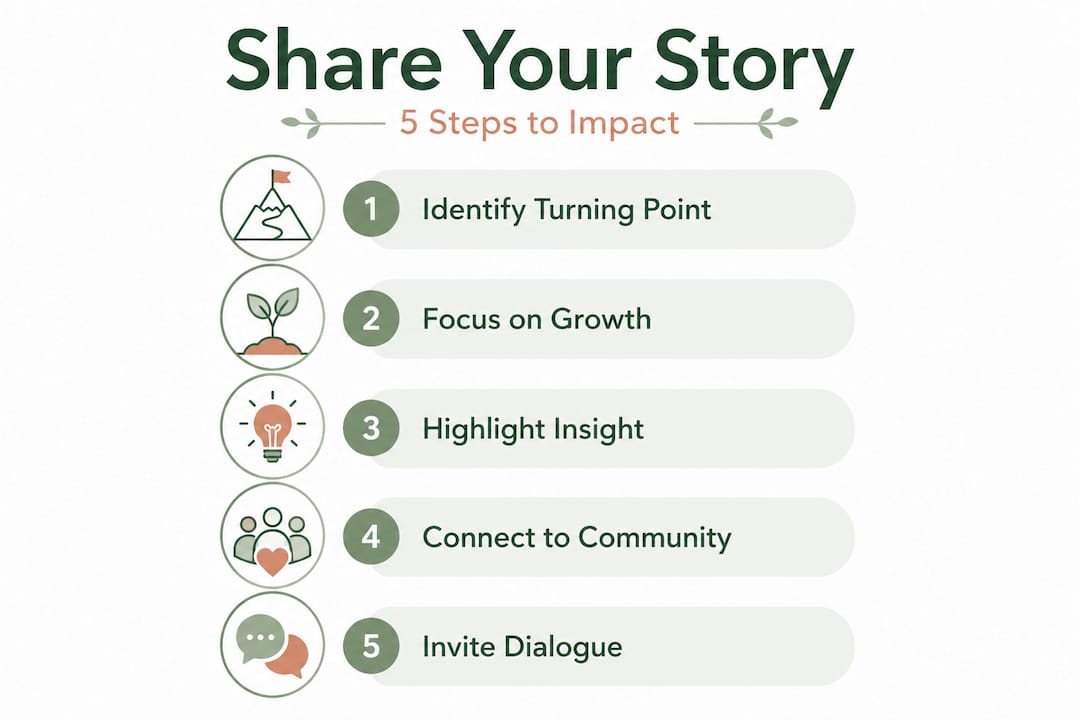
Step 2: Focus on growth, not just outcome. The destination matters less than the journey. Describe how you changed, what you learned, and how your thinking evolved. This is what listeners connect with.
Step 3: Emphasize personal insight. What did you discover about yourself? What belief did you have to let go of? What surprised you? These interior moments are what make a story feel true rather than scripted.
Step 4: Highlight community relevance. Connect your experience to something larger. How does your journey relate to what others in your family, community, or wellness group might be facing? This step transforms a personal story into a shared one.
Step 5: Invite dialogue. End your story with an opening, not a conclusion. Ask a question. Invite others to share. This shifts the experience from monologue to conversation, which is where real connection happens.
Participatory storytelling works by allowing people to own and frame their narrative, leading to greater self-empowerment and social connection. That ownership is the key. You are not performing for an audience. You are sharing something real and inviting others into it.
Before sharing publicly, assess your timing and comfort level honestly. You do not need to share everything. You do not need to be fully healed to tell your story. But you should feel stable enough that sharing does not reopen wounds before they are ready. A workflow for personal growth that includes regular reflection can help you gauge when you are ready to share and what parts of your story are worth telling.
Pro Tip: Frame past adversity honestly and center the learning rather than the pain. The goal is not to make people feel sorry for you. It is to help them see what is possible.
Why stories matter more than we realize: Our editorial take
Here is something most storytelling guides will not tell you: the advice to "share your story" is often incomplete, and sometimes even harmful when delivered without context.
We have seen wellness communities encourage story sharing as if the act of speaking is automatically healing. It is not. Sharing without being genuinely heard can feel worse than staying silent. The response to a story matters as much as the story itself. When someone shares and receives indifference or unsolicited advice, the experience can reinforce shame rather than reduce it.
Real stories, the ones that actually transform both teller and listener, include setbacks. They include the moments of giving up and trying again. They include forgiveness, which is often the most overlooked element of a growth narrative. Forgiving yourself for past choices, forgiving others for their role in your struggle, and forgiving the process for being slower than you hoped, these acts of forgiveness are what allow a story to close one chapter and genuinely open another.
We also want to push back on the idea that storytelling is primarily about inspiring others. That framing puts pressure on the storyteller to perform rather than connect. The most transformative stories we have encountered are the ones told with no agenda other than honesty. They are not crafted for maximum emotional impact. They are simply true.
Sustainable growth comes not from telling a great story once, but from being part of a community that keeps showing up, keeps listening, and keeps creating space for ongoing dialogue. That is the environment where stories do their deepest work.
Explore, connect, and grow with Arthur Scott Publishing
If this article resonated with you, the next step is finding a community and set of resources that support the kind of growth we have been describing. Storytelling is most powerful when it happens within a structure that holds you accountable and keeps you moving forward.
At Arthur Scott Publishing, Dr. Arthur Scott has built a platform specifically designed to support personal growth through accessible, psychology-grounded resources. Whether you are working through family challenges, building resilience, or exploring your own story, the free e-books and audio resources available here meet you where you are. You can explore Arthur Scott Publishing's impact to see how these resources have helped real people, and if you are navigating the challenges of parenting, the support for parents section offers practical, compassionate guidance. Your story matters. This is a good place to keep writing it.
Frequently asked questions
How does sharing success stories improve mental health?
Participatory storytelling helps people reclaim their identity and agency, reducing stigma and boosting a sense of empowerment that directly supports greater mental wellbeing.
Do success stories really change behavior?
They reliably shift attitudes and reduce stigma, but testimonial-based campaigns show that their effect on long-term behavior change, like consistently seeking help, tends to be limited and short-lived.
What features make a success story inspire positive action?
The combination of overcoming real adversity, demonstrating personal growth, and embedding moral values in the narrative drives the most prosocial action, as shown in redemption story research.
Is sharing struggles as important as sharing successes?
Absolutely. Including honest struggles makes your story relatable and helps others feel less alone, which significantly increases the story's emotional impact and its ability to inspire.
Should everyone share their personal story publicly?
Only when they feel genuinely safe and ready. Timing, audience, and personal motives all matter, and sharing before you are ready can do more harm than good.
Recommended
- Parenting is a Tough 24/7 Job.
- Arthur Scott Publishing's Impact
- Personal Growth Family Children recovery grace forgiveness freedom rule to law
- Boost SEO & AEO with Geo-targeted Blogs
- Design a personal development workflow for lasting gains – Optio Station: Best Project Management App for Prioritization