
You know that feeling when you react to something and immediately wonder, "Why did I just do that?" Most people experience recurring emotional patterns that seem to appear out of nowhere, from snapping at someone you love to freezing up before an important conversation. These moments are frustrating, confusing, and sometimes embarrassing. But they are also signals. They point directly to gaps in self-awareness, and closing those gaps is one of the most powerful personal growth moves you can make. This guide walks you through every stage of building real self-awareness, from understanding what it actually means to tracking your progress over time.
Table of Contents
- Understanding self-awareness
- Preparing for your self-awareness journey
- Step-by-step techniques to build self-awareness
- Evaluating your self-awareness progress
- A deeper perspective: What most guides miss about self-awareness
- Explore more resources for personal growth
- Frequently asked questions
Key Takeaways
| Point | Details |
|---|---|
| Self-awareness basics | Understanding what self-awareness is sets a strong foundation for personal growth. |
| Preparation matters | The right mindset and practical tools support a successful self-awareness journey. |
| Practical techniques | Daily routines and exercises make building self-awareness achievable for anyone. |
| Ongoing evaluation | Regular reflection and feedback ensure continuous improvement and lasting results. |
| Deeper insights | Recognizing overlooked challenges reveals the real value of sustained self-awareness. |
Understanding self-awareness
Self-awareness is not just knowing your personality type or listing your strengths on a resume. At its core, self-awareness is the ability to observe your own thoughts, emotions, and behaviors as they happen and understand how they influence your actions and relationships. Psychologists often break it into two types: internal self-awareness (how clearly you see your own values, feelings, and patterns) and external self-awareness (how accurately you understand how others perceive you).
Both types matter. You can be deeply reflective internally but completely blind to how your tone lands with others. Or you can be laser-focused on managing your image without ever examining your own emotional triggers. Real self-awareness requires both lenses working together.
Why it matters so much for emotional intelligence
Emotional intelligence, the ability to recognize, understand, and manage emotions in yourself and others, depends heavily on self-awareness as its foundation. Without it, you cannot accurately label what you are feeling, and without that label, you cannot regulate the emotion or respond skillfully. Research confirms that self-awareness directly boosts emotional intelligence and leadership effectiveness across nearly every industry and life domain.
Common barriers that block self-awareness
Most people do not lack the desire for self-awareness. They lack the skills or conditions that make it possible. Here are the most common obstacles:
- Emotional avoidance. When feelings are uncomfortable, the brain naturally deflects. You stay busy, scroll through your phone, or rationalize behaviors instead of examining them.
- Fixed identity beliefs. Thinking "That's just who I am" shuts down curiosity before it starts.
- Confirmation bias. People tend to seek information that confirms existing beliefs about themselves, which creates a blind spot for growth.
- Lack of feedback. Without honest input from trusted people, your self-image remains untested.
"Until you make the unconscious conscious, it will direct your life and you will call it fate." This observation, attributed to Carl Jung, captures exactly why self-awareness is not optional for meaningful personal growth.
One major misconception worth addressing directly: many people believe that more introspection automatically leads to more self-awareness. It does not. Rumination, where you replay the same thoughts or self-criticisms over and over, is a form of introspection that actually reduces clarity. The goal is reflective awareness, not obsessive self-analysis.
| Myth about self-awareness | Reality |
|---|---|
| More thinking = more self-awareness | Quality reflection matters more than quantity |
| Self-awareness is a fixed trait | It is a skill that grows with deliberate practice |
| It is only about knowing your weaknesses | It includes understanding your strengths and impact |
| Introverts are naturally more self-aware | Personality type does not determine self-awareness level |
Preparing for your self-awareness journey
Before you practice any technique, your mindset sets the ceiling for how far you can grow. Approaching self-awareness with defensiveness or perfectionism will block progress almost immediately. What you need instead is psychological safety, the internal permission to discover uncomfortable things about yourself without judgment or shame.
This is not a passive shift. You build it deliberately by reminding yourself that awareness is not the same as criticism. Seeing a pattern in yourself is neutral information, not a verdict.
The three core tools that prepare you
-
Journaling. Writing creates distance between your emotional experience and your analysis of it. Even five minutes of free-writing after a difficult moment gives your brain a way to process rather than suppress. Studies show that expressive writing reduces distress and increases emotional clarity, especially when practiced consistently.
-
Meditation and mindfulness. You do not have to sit in silence for an hour. Even brief mindfulness practices train your brain to notice thoughts without immediately reacting to them. This pause, even two or three seconds long, is where self-awareness lives.
-
Peer feedback. Ask two or three people you trust to tell you one thing they notice about how you show up under stress. Most people avoid this step because it feels vulnerable. That discomfort is exactly why it is so valuable.
Comparison: unstructured reflection vs. structured self-awareness practice
| Approach | What it looks like | Typical outcome |
|---|---|---|
| Unstructured reflection | Random self-criticism, overthinking | Anxiety, rumination, no clear insight |
| Structured self-awareness | Timed journaling, guided questions | Clarity, pattern recognition, actionable insight |
| Feedback-based | Asking others, reviewing reactions | External blind spots revealed, broader perspective |
Potential obstacles in the preparation phase
Starting a self-awareness practice often stalls because life gets busy or the process feels awkward. Common obstacles include inconsistency, setting unrealistic expectations for transformation speed, and avoiding feedback out of fear of criticism.
Pro Tip: Start with just one habit for two weeks before adding another. Pick journaling or mindfulness, not both at once. Layering habits too quickly creates overwhelm and makes it easier to quit when motivation dips.
Step-by-step techniques to build self-awareness
With your mindset prepared and your tools in place, you can move into consistent daily practices. These are not abstract ideas. Each one is concrete, repeatable, and produces visible results over time.

1. Daily emotional check-ins
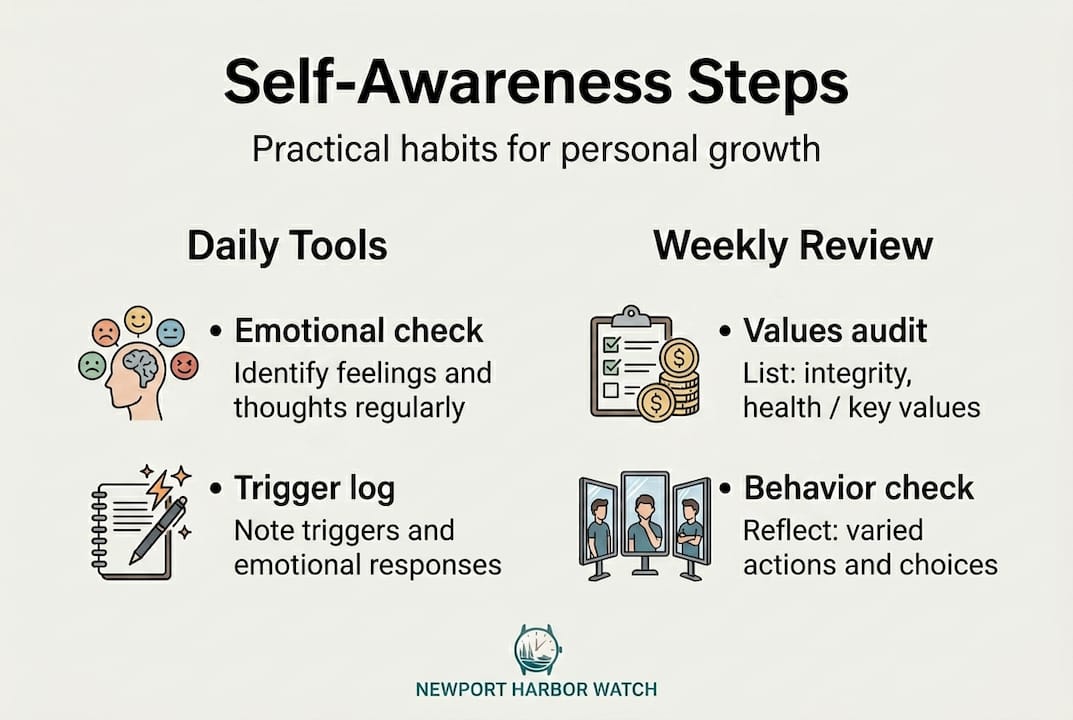
Twice a day, morning and evening, pause for sixty seconds and name your dominant emotion. Use specific language. "Stressed" is less useful than "anxious about a conversation I am avoiding." The more precise the label, the more useful the information. This practice trains your brain to notice emotional states before they escalate into reactive behavior.
2. Trigger tracking
Keep a simple log where you note situations that produced a strong emotional response. Include what happened, what you felt, what you did, and what you wish you had done instead. After two weeks, review the log for patterns. You will likely find three or four recurring triggers that account for most of your reactive moments.
3. The values audit
Write down your top five personal values. Then look at the past week and rate, honestly, how aligned your actual choices were with each value. Most people discover significant gaps. Those gaps are some of the richest territory for personal growth because they reveal the distance between who you want to be and how you are currently operating.
4. The pause and reflect technique
Before reacting in a tense situation, use a physical anchor like placing your feet flat on the floor or taking one slow breath. This creates a micro-pause that allows your prefrontal cortex (the reasoning part of your brain) to engage before your emotional brain takes over. It sounds small, but emotional regulation through pausing is one of the most well-supported behavioral techniques in psychology.
5. Weekly behavior review
Every Sunday, spend ten minutes reviewing your week through three questions: What did I do well? Where did I fall short of my own standards? What do I want to do differently? Write the answers down. The act of writing prevents vague self-assessment and forces specificity.
According to organizational research, people with strong self-awareness are 3.5 times more likely to make good decisions and experience higher satisfaction in their relationships. That kind of return justifies even a modest daily investment.
Pro Tip: Set a recurring phone reminder labeled "Check in with yourself" at 8 a.m. and 9 p.m. The reminder is not about being rigid. It is about creating the habit anchor until the practice becomes natural.
Common mistakes to avoid
- Treating self-awareness sessions as a task to check off rather than a genuine inquiry
- Skipping the practice on days when you feel good (those days offer just as much information)
- Stopping after one week because change feels slow
Evaluating your self-awareness progress
Building self-awareness without tracking progress is like exercising without any measure of fitness. You need ways to see the change happening, both to stay motivated and to troubleshoot when growth stalls.
Signs you are becoming more self-aware
- You notice your emotional reactions before they escalate, not only after
- You can name what you are feeling with greater precision
- You catch yourself in old patterns while they are happening, not just in retrospect
- Feedback from others surprises you less often
- You make decisions that align more consistently with your stated values
- You pause before reacting in situations that used to trigger automatic responses
Reflection and feedback strategies
Every two weeks, revisit your trigger log and journal entries. Look for reduction in reactive episodes and increased response flexibility. Ask a trusted person in your life whether they have noticed any changes in how you handle stress or disagreement. External validation of internal growth is one of the most motivating forms of feedback available.
"Awareness without action is just observation. When you start choosing differently, that is the proof the work is real."
Troubleshooting common pitfalls
If you feel stuck, the most common reason is that your reflective practice has become rote. You are going through the motions without genuine curiosity. Fix this by changing your journaling prompts every two weeks. Instead of "How did I feel today?" ask "What did I avoid looking at today?" or "What emotion am I most reluctant to admit to myself?"
Another common pitfall is relying only on self-assessment. Without external feedback, self-awareness can become self-delusion. Build in a regular, low-stakes check-in with someone who knows you well.
Self-awareness evaluation table
| Metric | How to measure | Frequency |
|---|---|---|
| Emotional reactivity | Count reactive episodes in your log | Weekly |
| Values alignment | Rate daily choices against stated values | Weekly |
| External perception | Ask one trusted person for honest feedback | Bi-monthly |
| Trigger pattern reduction | Review log for recurring themes | Every 2 weeks |
| Decision satisfaction | Rate major decisions after outcomes | Monthly |
Monitoring these metrics keeps your practice from drifting into vague intentions. Numbers and patterns make growth visible and keep you honest.
A deeper perspective: What most guides miss about self-awareness
Most articles on self-awareness treat it like a solo project. Journal more, meditate more, reflect more. But here is what years of working in psychology and personal development teaches you: the biggest breakthroughs in self-awareness almost never come from sitting alone with your thoughts. They come from friction with other people.
The moments when someone misunderstands you, challenges your perspective, or reacts to you in a way you did not expect are the most precise diagnostic tools you have. If you only practice self-awareness in quiet moments, you are preparing for a race you will only run in noisy, unpredictable conditions.
Real self-awareness also requires tolerating being wrong about yourself. That is uncomfortable in a specific way that journaling alone cannot prepare you for. It means discovering that the story you have been telling yourself about why you behave a certain way is incomplete, or simply inaccurate. That discovery only happens in relationship, in community, and in honest dialogue. Leaning into that discomfort rather than retreating to comfortable introspection is what separates people who grow from people who stay interesting to themselves but unchanged. You can explore how self-awareness in relationships connects to broader personal empowerment through Dr. Scott's work.
Explore more resources for personal growth
The steps in this guide give you a strong starting point, but sustained growth benefits from ongoing support, structured resources, and a community that takes personal development seriously.
Arthur Scott Publishing offers personal growth resources built specifically for people doing this kind of work, from self-awareness and behavioral health to family empowerment and perseverance. Dr. Arthur Scott's background in both psychology and music brings a unique perspective to these materials, blending emotional depth with practical strategy. Whether you prefer reading, listening via Speechify, or exploring downloadable PDFs, these tools are designed to meet you where you are. Discover more about publishing's impact on personal growth, or find resources to help you plan your celebration of meaningful milestones along your journey.
Frequently asked questions
What are the first steps to building self-awareness?
Start with regular reflection through journaling and asking for honest feedback from people you trust, ideally before adding more advanced practices.
How can I measure my progress in self-awareness?
Track repeat emotional patterns in a log, review your decision-making weekly, and solicit candid input from someone in your close circle every few weeks.
What are common barriers to self-awareness?
Avoidance of uncomfortable emotions, absence of honest external feedback, and the false belief that more introspection automatically creates more clarity are the most frequent obstacles.
Can self-awareness help with emotional intelligence?
Absolutely. Self-awareness is the foundational layer of emotional intelligence, and strengthening it directly improves your ability to recognize, label, and manage emotions in yourself and with others.