
Most people assume that buying and reading a self-help e-book is enough to spark real change. But self-help use does not necessarily translate into measurable personality or well-being improvements for typical users. That gap between reading and transforming is exactly where most families and individuals get stuck. This guide breaks down why e-books are powerful tools for personal and family growth, where they fall short, and what specific strategies actually close the gap between reading good ideas and living them out.
Table of Contents
- Why e-books appeal to self-improvers and parents
- The limits of e-book learning: Exposure vs. transformation
- How to turn e-book advice into real personal and family progress
- Common pitfalls and success factors for self-help e-book users
- Our perspective: What most self-improvement guides get wrong about e-books
- Find resources to empower your family's growth journey
- Frequently asked questions
Key Takeaways
| Point | Details |
|---|---|
| Reading isn’t transformation | Absorbing e-book content alone won’t guarantee real self-improvement or family change. |
| Practice drives progress | Combining e-books with deliberate practice and feedback leads to real growth. |
| Families grow together | Action-oriented e-books can empower parents and families when everyone participates. |
| Avoid passive consumption | Success requires moving from reading to doing, journaling, and reflecting as a group. |
Why e-books appeal to self-improvers and parents
E-books have quietly become one of the most popular formats for self-improvement, and for very good reasons. They are affordable, often free, instantly accessible, and cover nearly every topic imaginable, from managing anxiety and building discipline to strengthening family bonds and raising emotionally healthy kids. You can download an e-book during a lunch break, start reading it during school pickup, and revisit a chapter at midnight when the house finally goes quiet. That flexibility is simply unmatched by traditional print books or in-person workshops.
For parents especially, e-books fill a specific and urgent need. Raising children is one of the most demanding roles anyone takes on, and most parents feel underprepared at some point. Practical parenting strategies delivered through e-books allow moms and dads to access expert guidance without scheduling an appointment, paying for a seminar, or finding a babysitter. A parent can read five pages about emotional regulation at 10 p.m. and try the technique the next morning at breakfast.

Individuals seeking personal growth also gravitate toward e-books because they feel like a private, non-judgmental space to explore difficult topics. Mental wellness, self-awareness, overcoming fear, rebuilding self-esteem: these are subjects many people would not discuss openly but will explore quietly through a well-written digital book.
That said, there is a deeply important misconception worth naming directly:
"More reading does not equal more growth. Without intentional practice and feedback, e-books are just well-formatted ideas sitting in your downloads folder."
The appeal of e-books is real, but the assumption that exposure automatically creates change is not supported by the evidence. Research consistently finds that self-help use does not necessarily translate into measurable personality or well-being change over time for most users. Understanding this is the first step toward using e-books effectively.
Key advantages of e-books for personal and family growth:
- Instant access at any time of day or night
- Low or no cost, especially through curated publishing platforms
- Wide range of topics from behavioral health to family empowerment
- Audio formats available through tools like Speechify, making content accessible for all learners
- No social pressure, allowing exploration of sensitive personal topics
- Easy to revisit specific sections when working on a particular habit or challenge
The limits of e-book learning: Exposure vs. transformation
Here is where it gets critical. Understanding the difference between exposure and transformation will fundamentally change how you approach every e-book you read from this point forward.
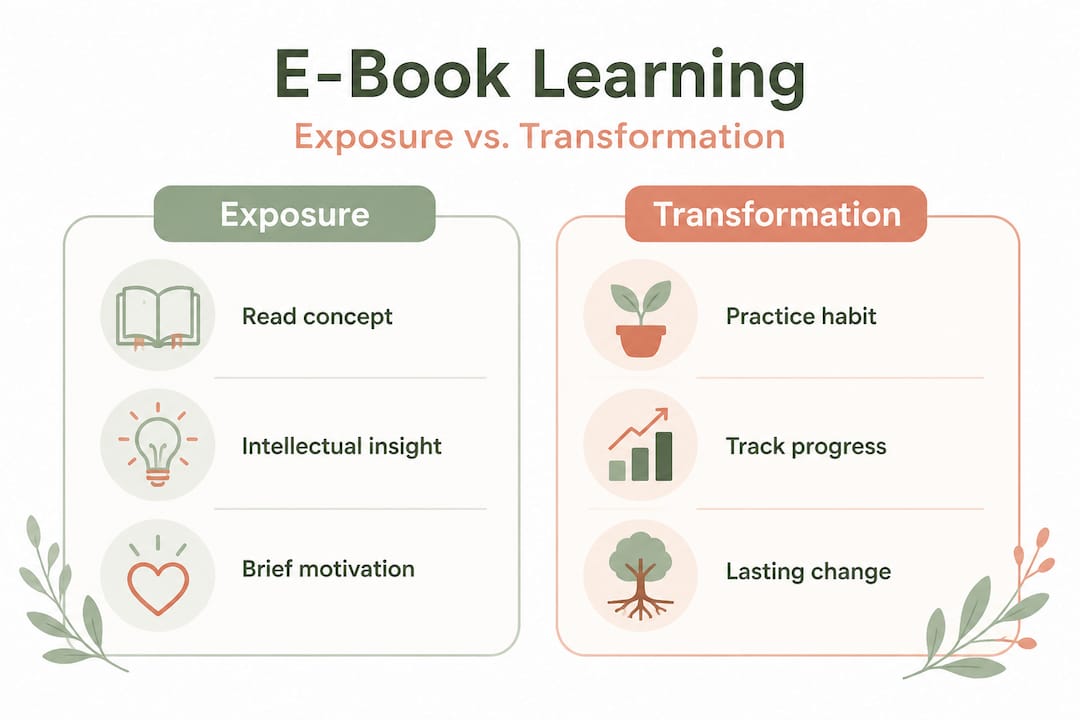
Exposure means you read about a concept, you understand it intellectually, and you might feel inspired in the moment. Transformation means you have actually changed a behavior, built a new habit, or shifted how you relate to your family or yourself. These are very different outcomes, and most e-book reading stops at exposure.
A rigorous study makes this uncomfortable but important point clear: a 2-year longitudinal analysis found no evidence that self-help product use predicted meaningful changes in personality traits, life satisfaction, or self-esteem. That is not a fringe finding. It is a well-controlled, long-term study showing that simply picking up more self-help material does not move the needle on the outcomes people most care about.
Why does this happen? Because reading activates your understanding, not your habits. Habits require repetition, feedback, adjustment, and accountability. Those four elements rarely come built into the act of reading alone.
| Reading approach | Outcome |
|---|---|
| Passive reading, no follow-up | Temporary inspiration, no lasting change |
| Reading with journaling prompts | Increased self-awareness, better retention |
| Reading with action steps | Moderate behavior change if steps are completed |
| Reading with tracking and feedback | Highest likelihood of sustained transformation |
This is not a reason to abandon e-books. It is a reason to use them differently. The publishing impact of well-designed educational content is real when readers engage actively. And life skills for families taught through structured e-books can absolutely generate growth when approached with intention.
Pro Tip: When selecting an e-book for growth, look beyond the chapter titles. Scan for action steps, reflection questions, journaling prompts, or progress checkpoints built directly into the content. These features signal a book designed for transformation, not just information delivery.
The honest reality: Self-help e-books can absolutely be motivating, clarifying, and even life-changing. But sustained change requires more than the book itself. It requires you.
How to turn e-book advice into real personal and family progress
Knowing the research, the most empowering thing you can do is shift from passive consumption to deliberate practice. The following framework works for individuals and families alike.
Step-by-step roadmap for real e-book-driven growth:
- Choose with intention. Pick one e-book focused on a specific challenge you or your family is actively facing. Avoid downloading five books at once. Depth beats breadth every time.
- Read one section at a time. Resist the urge to read straight through. Stop after each chapter or major section and write down one thing you want to try before moving forward.
- Practice the concept deliberately. Put the idea into action in a real situation within 24 to 48 hours. The timing matters. The longer you wait after reading, the less likely you are to act.
- Assess what happened. Did it work? What felt awkward? What surprised you? Write it down. Journaling your results is one of the highest-leverage habits a growth-focused person can build.
- Adjust and try again. Modify your approach based on what you learned. This is the iterative mindset in action, and deliberate practice paired with an iterative approach is what correlates with genuine improvement in self-efficacy and well-being.
- Repeat the cycle. Work through the full book using this loop before picking up anything new.
For parents, this framework becomes even more powerful when you build self-awareness as a family project rather than a solo effort. Bring your kids or partner into the conversation. Share what you read. Ask your children what they notice about how you are trying something different. This keeps everyone engaged and creates a culture of growth inside your home.
| Passive reading | Iterative practice |
|---|---|
| Reads entire book in one sitting | Reads one section at a time with pauses |
| Feels motivated briefly | Practices concepts within 48 hours |
| Forgets key ideas within a week | Reviews notes and adjusts approach weekly |
| Moves to the next book quickly | Completes full cycle before starting something new |
| Growth feels vague and unmeasured | Progress is visible, tracked, and discussed |
Topics like recovery and forgiveness are particularly powerful when worked through iteratively, because the emotional complexity of these subjects needs time, reflection, and practice to integrate fully.
Pro Tip: Schedule a weekly family check-in, even 15 minutes on a Sunday evening, to share one thing each family member tried from your current e-book, what happened, and what you will try differently next week. This ritual turns reading into a living family practice rather than a solo intellectual exercise.
Common pitfalls and success factors for self-help e-book users
Most people who start reading self-help e-books with good intentions hit one of several predictable walls. Recognizing these traps ahead of time gives you a real advantage.
Common pitfalls that stall growth:
- Bouncing between books. Starting a new e-book before completing or applying the current one is one of the most common ways people stay stuck. It creates the feeling of progress without the substance of it.
- Skipping action steps. Many e-books include exercises, prompts, or activities. Most readers skip them. These are not optional extras. They are the mechanism of change.
- Tracking progress only mentally. Telling yourself "I think I'm doing better" is very different from writing down what changed and when. Mental tracking is unreliable and tends to be overly optimistic.
- Reading in isolation. Growth is accelerated by feedback and community. Reading alone, without anyone to discuss it with or hold you accountable, limits your results significantly.
- Treating motivation as a plan. Feeling fired up after a great chapter is wonderful. But motivation fades. A written plan with specific actions does not.
Research makes this pattern clear: e-book use primarily increases exposure to ideas without structured goal pursuit and feedback, which explains why longitudinal evidence shows it may not meaningfully change personality or well-being trajectories for most users.
What successful e-book users do instead:
The people who genuinely grow through e-books share a set of identifiable behaviors. They treat each book as a course, not casual reading. They involve others, whether a partner, a child, a friend, or a support community. They embrace what does not work as data rather than failure. And they return to material repeatedly rather than chasing the new.
"Real change is not built in the reading. It is built in the returning."
An iterative mindset, which means you try, assess, learn, and adjust, is associated with meaningfully higher self-efficacy and well-being compared to passive consumption approaches. The people who get results are the ones who treat their personal growth like a series of experiments with themselves.
One of the most underused strategies is sharing success stories with family or a broader community. Sharing what worked and what you learned reinforces your own growth while inspiring others. That combination of accountability and inspiration is hard to replicate through reading alone.
Our perspective: What most self-improvement guides get wrong about e-books
Most self-improvement articles end with a list of "the best books to read." That is exactly the wrong advice to end on, and we think it perpetuates one of the most stubborn myths in personal development: that the answer is always more content.
From our experience working in psychology, education, and publishing, we have seen the same pattern play out countless times. Someone reads ten motivational books in a year and feels busy with growth but cannot point to a single measurable change in their behavior, their relationships, or their family's daily life. Meanwhile, someone else reads one book slowly, applies one idea at a time, and transforms how they parent, communicate, and face adversity.
The difference is not intelligence or dedication. It is method.
For parents especially, there is a specific blind spot worth calling out directly. Many parenting guides assume that if the parent reads and learns, the family benefits. That is only partially true. Sustainable family empowerment requires everyone to engage. Not just a parent absorbing wisdom in a quiet room and then attempting to implement it on unsuspecting children. Real growth happens when families explore ideas together, make mistakes together, and adapt together.
Viewing e-books as catalysts rather than solutions is the real game-changer. A catalyst starts a reaction. It does not complete it. Your reading is the spark. Your practice, your reflection, your willingness to try again after it goes sideways: that is the reaction that actually changes things. Building a parenting legacy that lasts across generations does not come from a single good read. It comes from a family culture that treats growth as an ongoing, shared, imperfect, and deeply worthwhile project.
Find resources to empower your family's growth journey
A new mindset deserves practical resources to match. If you are ready to move beyond passive reading and start using e-books as genuine catalysts for change, the right starting point makes a big difference.
Arthur Scott Publishing offers a curated collection of free e-books designed specifically for parents, families, and individuals committed to real growth. These resources cover behavioral health, self-awareness, perseverance, family empowerment, and more, and they are built to be used, not just read. Whether you are navigating tough parenting moments and need practical parenting support or you are looking for broader personal growth resources to fuel your self-improvement journey, the platform offers accessible, expert-informed content in both PDF and audio formats. Explore the full collection and find what fits exactly where you and your family are right now.
Frequently asked questions
Do e-books actually help with personal growth?
E-books can build motivation and introduce powerful strategies, but measurable personality or well-being change requires active practice and habit tracking, not reading alone.
What is an iterative mindset and why does it matter for self-improvement?
An iterative mindset means you try something, assess the result, and adjust your approach, and research links this cycle to higher self-efficacy and wellbeing compared to passive learning methods.
How can parents use e-books to empower their families?
Parents get the most out of e-books by sharing key ideas with their children, setting shared family goals around the content, and creating a weekly reflection habit that keeps everyone accountable and involved.
Why doesn't reading more self-help ensure real improvement?
Reading grows your awareness of ideas, but structured goal pursuit and feedback are what actually drive lasting behavioral change, and most casual e-book reading skips both of these elements.