
Family support is often reduced to its most visible form: putting food on the table, buying school supplies, or covering medical bills. But that picture leaves out the most powerful part. Research consistently shows that the emotional and psychological dimensions of family support carry enormous weight in shaping how children cope with stress, build resilience, and develop a stable sense of self. When you truly understand what family support involves, you begin to see that it operates as one of the most significant forces in a person's mental health and personal development, from early childhood all the way into adulthood.
Table of Contents
- The foundations of family support
- How family support shapes mental health
- The nuances: When family support becomes challenging
- Practical ways to foster strong family support
- Our perspective: The underestimated power and pitfalls of family support
- Explore resources to deepen family support
- Frequently asked questions
Key Takeaways
| Point | Details |
|---|---|
| Family support builds resilience | Emotionally supportive environments help children cope and grow stronger mentally. |
| Healthy dynamics prevent risks | Balanced family relationships lower chances of mental and physical health issues. |
| Judgement-free engagement is key | Open, empathetic communication fosters strong, positive family support. |
| Balanced involvement matters | Too much or too little support can create challenges—finding the right balance is vital. |
The foundations of family support
Before exploring the science, it helps to get clear on what family support actually means. Many parents and caregivers default to a narrow definition: providing shelter, food, money, and transportation. Those things matter enormously. But family support is a layered concept that operates across three distinct dimensions: emotional, psychological, and practical.
Emotional support is what children experience when a parent listens without judgment, validates their feelings, or simply shows up during a hard moment. It communicates safety. A child who feels emotionally supported learns that their inner world is worth paying attention to, which is the seed of healthy self-esteem.
Psychological support is more subtle. It involves helping children understand their own thoughts and behaviors, modeling healthy ways to handle conflict, and creating an environment where it feels acceptable to fail and try again. This kind of support teaches coping strategies, the skills children and adults use to manage stress, regulate emotions, and navigate difficulty without falling apart.
Practical support includes tangible assistance: helping with homework, managing schedules, providing transportation to activities, or advocating for a child within the school system. On its own, practical support delivers limited emotional benefit. But when it works together with emotional and psychological support, it forms the backbone of a genuinely nurturing family environment.
Here is what that looks like in real life:
- A parent who listens to a child's worries before a big test (emotional support) AND helps them prepare a study plan (practical support) is providing layered support that builds confidence alongside competency.
- A caregiver who models calm behavior during conflict (psychological support) teaches far more than any lecture about managing anger.
- Consistent routines and family rituals, like weekly dinners or bedtime conversations, deliver all three types of support simultaneously.
"Supportive family environments enhance psychological well-being by building resilience, self-esteem, and coping strategies, and they mediate the connection between quality of life and psychological wellbeing."
This finding from supportive family environments research reinforces something many parents intuitively sense but rarely articulate clearly: family support is not just a safety net. It is an active builder of the mental and emotional tools children will use for the rest of their lives.
Understanding these foundations changes how you show up. Instead of asking only "Are my child's needs being met?" you begin asking "Is my child learning how to handle life?" Those are very different questions with very different answers.
How family support shapes mental health
Once you understand what family support actually includes, the question becomes: what does the science say about its impact? The answer is striking.
Healthy, consistent family support does far more than prevent mental illness. It actively builds the neurological and emotional infrastructure that makes children more capable, more self-aware, and more resistant to the effects of stress and trauma. Coping skills, emotional regulation, the ability to seek help and sustain relationships, these are not personality traits children are born with. They are learned, largely within the family system.
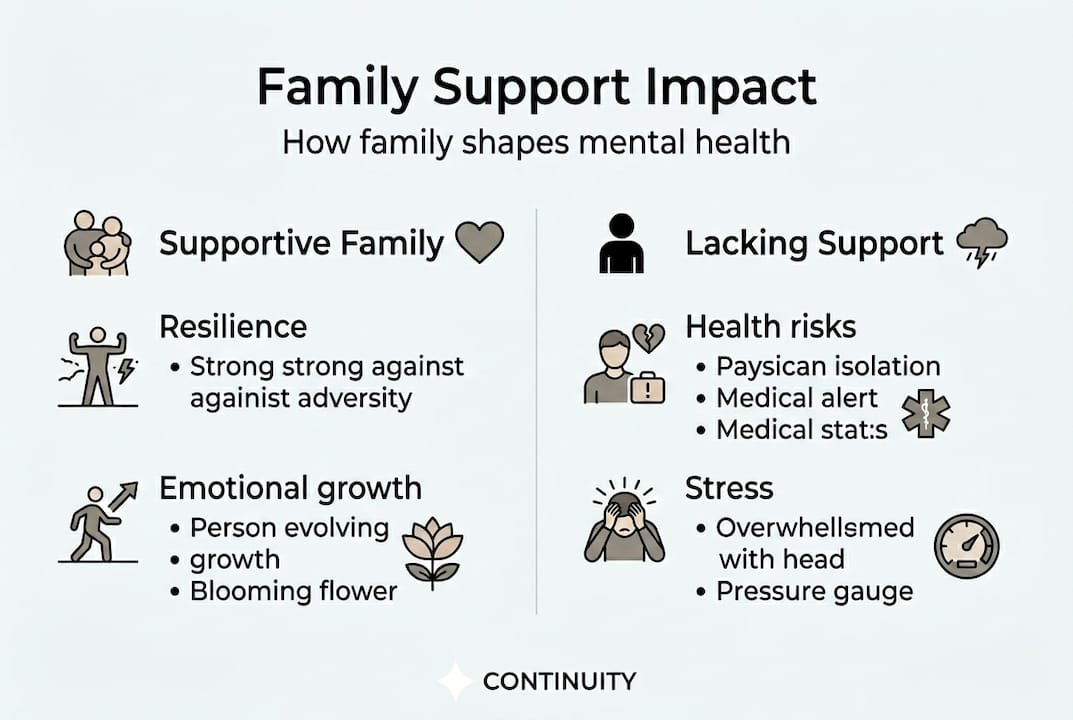
The comparison between supportive and unsupportive family environments is telling.
| Factor | Supportive family environment | Unsupportive or dysfunctional environment |
|---|---|---|
| Emotional regulation | Developed through modeling and open communication | Delayed or disrupted by chronic stress or fear |
| Resilience | Built through safe risk-taking and validation | Weakened by unpredictability or neglect |
| Self-esteem | Nurtured through consistent positive regard | Damaged by criticism, comparison, or emotional absence |
| Coping strategies | Learned and practiced within family interactions | Absent or replaced by avoidance behaviors |
| Mental health outcomes | Reduced incidence of anxiety, depression | Higher risk of behavioral and psychological issues |
The contrast is not subtle. Research on family dynamics and health risks confirms that family dynamics profoundly influence psychological, physical, and behavioral pathways, and that unhealthy dynamics are directly linked to increased health risks across all three of those areas.
This matters beyond the emotional realm. Children who grow up in unsupportive family environments are more likely to struggle with chronic physical health issues, risky behaviors, and difficulties sustaining employment and relationships as adults. The ripple effect is enormous.
Pro Tip: Start with small, consistent moments rather than grand gestures. A two-minute check-in after school, asking "What was hard today?" builds far more emotional connection over time than a single long heart-to-heart conversation happens once a year.
There is also a common misconception worth addressing. Some parents assume that children who seem fine, performing well academically, appearing happy at school, do not need active emotional support at home. In reality, children who appear most composed are sometimes the ones who most need an outlet. High-performing children often carry invisible pressure, and without a safe family space to process it, that stress accumulates in ways that surface much later in life. Visible distress is not the only signal that support is needed.
The nuances: When family support becomes challenging
Here is where most conversations about family support go quiet: support is only beneficial when it is healthy. And healthy support is harder to get right than most people realize.
Well-intentioned parents and caregivers can slip into patterns that undermine the very thing they are trying to build. Over-involvement is one of the most common traps. When a parent solves every problem before a child has a chance to struggle with it, the message the child receives is "you are not capable of handling this." That message erodes confidence and creates dependency rather than resilience.
The following patterns are worth watching for:
- Over-control: Making decisions for children without explaining the reasoning or including them in the process.
- Conditional support: Withdrawing warmth or approval when a child makes a mistake, which links self-worth to performance.
- Judgment-laden communication: Using phrases that shame or compare, such as "Why can't you be more like your sister?" or "You always do this."
- Emotional neglect: Being physically present but emotionally unavailable, checking your phone during a child's important moment, or dismissing emotions as overreactions.
- Conflict avoidance: Sweeping tension under the rug instead of modeling healthy disagreement and repair.
When dysfunctional family patterns such as conflict and neglect are present, they do more than create tension. They actively exacerbate isolation and diminish the benefits of social support, while over-involvement can strain adult relationships and delay the development of independence.
This is a nuanced but critical point. Over-involvement does not feel harmful in the moment. It often feels like love. A parent who micromanages homework, rushes in to defend their child in every social conflict, or never allows natural consequences to teach life lessons genuinely believes they are helping. But the long-term effect is a child who enters adulthood without the skills to self-regulate, make decisions, or tolerate frustration.
Pro Tip: Ask yourself this question regularly: "Am I solving this problem for my child, or am I helping my child solve it?" The first builds dependency. The second builds competence. The answer changes what support looks like in practice.
Healthy family support requires that parents and caregivers develop a tolerance for watching their children struggle in safe ways. Sitting with a child who is frustrated with a math problem, without jumping in with the answer, is a form of support. It communicates: "I believe you can figure this out, and I am here while you do."
Practical ways to foster strong family support
Knowing what good family support looks like and actually building it in the daily chaos of family life are two different things. The good news is that the most effective strategies are not complicated. They are consistent.
Here are actionable steps grounded in how healthy family systems actually work:
-
Practice judgment-free check-ins. Set aside time each day, even just five minutes, for each child to share something about their day without it turning into a performance review or problem-solving session. The goal is connection, not correction.
-
Model the emotional behaviors you want to see. Children learn more from watching than from being told. If you want your child to manage frustration well, let them watch you do it. Narrate your own coping out loud: "I am feeling really stressed right now, so I am going to take a few deep breaths before I respond."
-
Use family routines as anchor points. Regular meals, bedtime rituals, or weekly activities are not just logistics. They create a sense of predictability and belonging that research connects directly to reduced anxiety and stronger emotional security in children.
-
Acknowledge feelings before offering solutions. When a child comes to you upset, resist the urge to immediately fix the problem. Start with: "That sounds really frustrating" or "I can see why you feel that way." Feeling understood is often more healing than having the problem solved.
-
Build in family meetings or shared reflection time. Even once a month, sitting together and talking about what is working well and what feels hard creates a model for open, healthy communication.
A helpful framework for thinking about your approach to family engagement:
| Engagement level | What it looks like | Impact on child |
|---|---|---|
| Too low (uninvolved) | Little emotional availability, few shared activities | Isolation, low self-esteem |
| Balanced (connected) | Responsive, empathetic, allows healthy autonomy | Resilience, independence |
| Too high (over-involved) | Micromanagement, solving all problems, few boundaries | Dependency, low confidence |
External resources also play a real role. Research confirms that support services for caregivers enhance coping, reduce caregiver burden, and provide family engagement frameworks that build capacity for genuine, meaningful partnerships between caregivers and children.
Pro Tip: If you find certain parenting patterns coming up repeatedly, like losing patience, withdrawing emotionally, or over-controlling, consider reading a focused book or guide on that specific dynamic. Self-awareness is the first tool in every effective caregiver's kit.
Our perspective: The underestimated power and pitfalls of family support
Most articles on this topic read like a celebration of family support. They highlight the benefits, offer a few tips, and leave readers feeling good. We think that approach is incomplete, and in some ways, it is doing parents a disservice.
The real challenge is not knowing that family support matters. You already know that. The real challenge is recognizing when your support is coming from a healthy place and when it is coming from anxiety, guilt, or the need for control. Those are very different motivations, and they produce very different outcomes in children.
Over the years, working closely with families navigating behavioral health and personal development, a pattern becomes clear: the most well-meaning caregivers often struggle the most with balance. They care deeply, which means they intervene often. But intervention without restraint teaches children that they cannot trust their own judgment.
The parents who do this best are not the most knowledgeable. They are the most self-aware. They ask themselves hard questions. They notice their own discomfort when their child struggles and choose not to act on it immediately. That pause, that moment of self-regulation before responding, is where genuine family support actually lives. Empathy and active listening are not soft skills. They are the core tools of effective caregiving, and they work best when they are guided by curiosity about what your child actually needs, not assumptions about what you think they need.
Explore resources to deepen family support
If today's conversation resonated with you, the next step is finding the right resources to support both you and your family in this ongoing work.

At Arthur Scott Publishing, we recognize that parenting is a tough 24/7 job that deserves real, substantive guidance, not surface-level advice. Our free digital books and guides are designed to help parents and caregivers build genuine emotional and psychological support within their families. You can explore publishing's impact on families just like yours, or look deeper into intergenerational family dynamics through the lens of a parent and grandparent legacy. Each resource is crafted to meet you where you are, practical, accessible, and grounded in real psychological understanding.
Frequently asked questions
How does family support enhance psychological resilience?
Supportive family environments build resilience by strengthening coping skills and self-esteem, which together help individuals manage stress and recover from adversity more effectively.
Can unhealthy family dynamics affect children's health?
Yes, research confirms that family dynamics and health risks are directly linked, with conflict and neglect increasing a child's vulnerability to psychological, physical, and behavioral health problems.
What are simple ways to provide positive family support?
Judgment-free communication, consistent empathy, and active engagement in daily family routines all nurture support, and support services for caregivers can strengthen these capacities further.
Is it possible to be too involved as a parent?
Yes, over-involvement can strain adult relationships and undermine a child's independence, making balance between connection and autonomy essential for healthy development.