
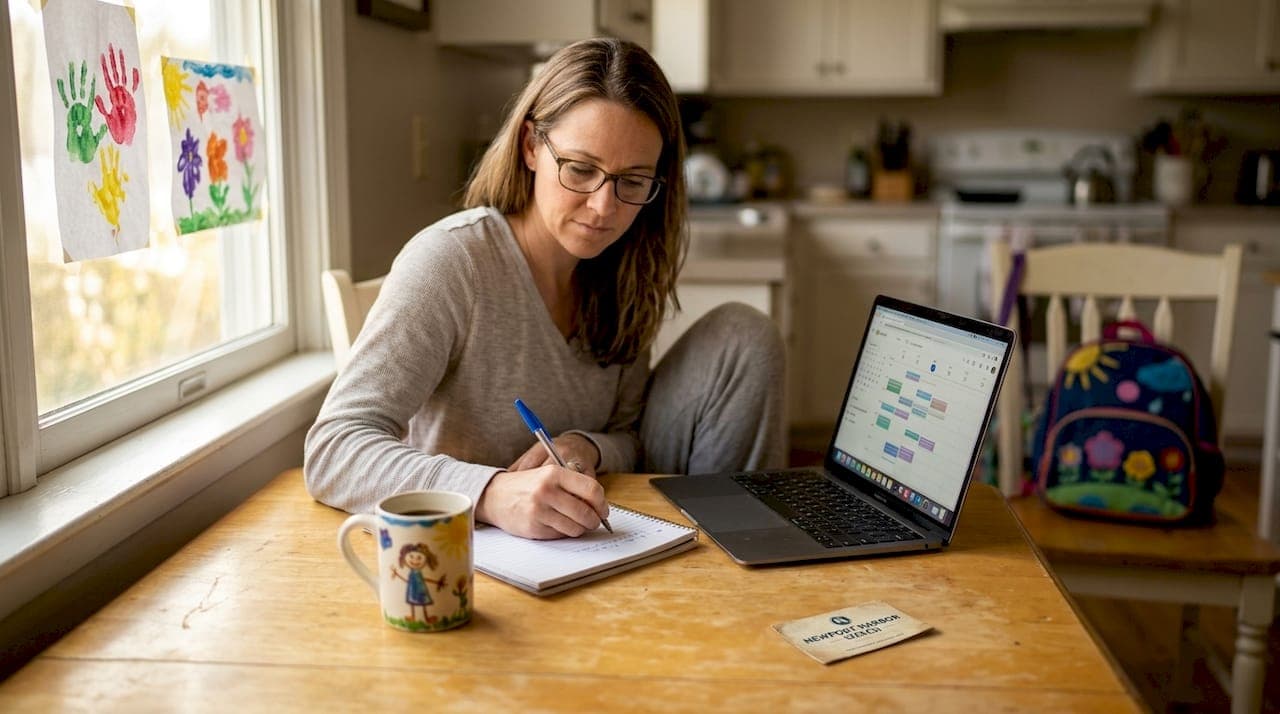
What if 15 to 30 minutes each day could meaningfully shift your mood, lower your stress, and make you a more connected parent? For most moms and dads, personal growth feels like a luxury saved for someday. Between school pickups, work deadlines, and the endless mental load of running a household, there is simply no room left. But daily personal time on most days leads to higher positive affect, lower negative affect, and healthier cortisol levels in parents. This guide gives you a clear, step-by-step workflow to make that personal time count, without guilt and without guesswork.
Table of Contents
- Why parents need a workflow for personal growth
- Gathering your essentials: Tools, time, and mindset
- Step-by-step personal growth workflow for parents
- Troubleshooting: Overcoming common obstacles and adapting your workflow
- Tracking results and reinforcing positive change
- The overlooked truth about personal growth for parents
- Take the next step in your growth journey
- Frequently asked questions
Key Takeaways
| Point | Details |
|---|---|
| Start with small routines | Even five minutes of daily personal time can create positive changes in your well-being. |
| Structure supports growth | A step-by-step workflow removes guesswork and builds consistency for busy parents. |
| Track and adjust | Use simple journals or charts to monitor your growth and celebrate progress. |
| Personalize for your needs | Tailor your workflow to fit your personality and family environment for greater success. |
Why parents need a workflow for personal growth
Most parents already know they should carve out time for themselves. The real problem is not motivation. It is structure. Without a clear plan, those precious 20 minutes after bedtime disappear into scrolling, worrying, or simply staring at the ceiling.
Three barriers show up again and again:
- Lack of time feels like the biggest obstacle, but often it is about competing priorities without a framework to sort them.
- Guilt convinces parents that focusing on themselves means neglecting their kids.
- Unclear starting points leave people overwhelmed before they even begin.
A workflow changes the equation. Think of it as a stepwise structure that tells you exactly what to do, when to do it, and why it matters, so you never have to rely on willpower alone. Instead of hoping you will feel like journaling or meditating, a workflow makes those actions automatic.
The emotional benefits are real and measurable. Personal time on most days boosts mood and aids stress recovery, which directly improves how you show up for your kids. When you are less reactive and more grounded, family dynamics shift. Arguments shorten. Patience deepens. The ripple effect is significant.
Worth noting: Research suggests the mood-boosting power of structured personal time is especially strong for parents who score high in neuroticism or openness. If you tend to feel things intensely or crave new experiences, a consistent workflow is not just helpful. It may be essential.
The goal is not to become a productivity machine. It is to give yourself permission to grow in small, consistent ways so that your family benefits too.
Gathering your essentials: Tools, time, and mindset
Here is the good news. You do not need an elaborate system, an expensive app, or a perfectly quiet house to build a growth workflow. What you actually need is simpler than you think.
According to structured personal growth research, parents can build an effective practice through daily personal time, self-reparenting, and structured planning around vision, habits, skills, and goals. That framework does not require fancy tools.

| Tool | Purpose | Time required |
|---|---|---|
| Journal or notebook | Reflection, tracking, and venting | 5 to 10 minutes |
| Timer (phone works fine) | Boundaries around personal time | 1 minute to set |
| Quiet space | Focus and decompression | Any corner works |
| Simple checklist | Progress monitoring | 2 to 3 minutes |
| Growth book or audio | Learning and inspiration | 10 to 15 minutes |
The mindset shift matters just as much as the tools. Too many parents treat self-care as something they earn after everything else is done. That model guarantees it never happens. Instead, treat your personal growth time as a non-negotiable responsibility, like packing lunches or paying bills.
Key attitudes for success:
- Imperfection is the plan. Skipping a day does not mean failing.
- Small counts. Five minutes of genuine reflection beats zero minutes of perfect intention.
- Self-growth is family growth. Your calm, your insight, and your resilience belong to your kids too.
- Consistency is the skill. You are not building a habit in a day. You are building a practice over weeks.
Pro Tip: If 30 minutes feels impossible, start with five. Set a timer, close a door, and do one thing for yourself. That five-minute win is evidence you can do this, and evidence is what builds momentum.
Step-by-step personal growth workflow for parents
Now that you have your tools and mindset ready, here is the workflow itself. Follow these steps in order, then adapt as needed.
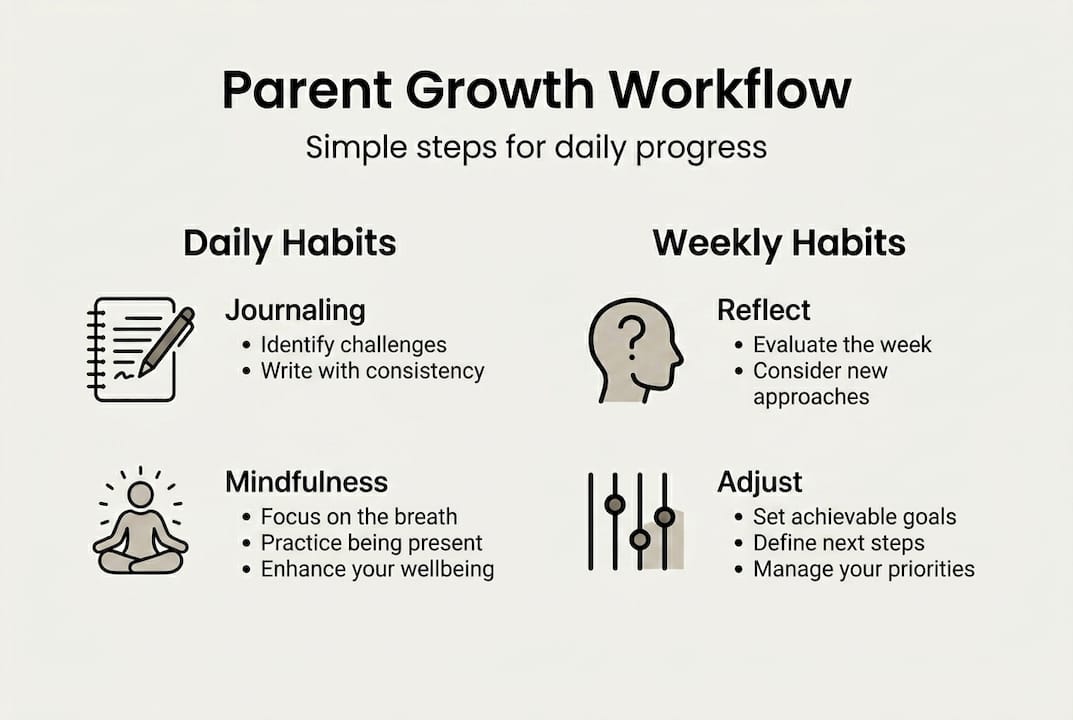
- Allocate daily personal time. Choose a consistent window, even 15 minutes, for mindfulness, journaling, or quiet reflection. The 15 to 30 minute daily window is the foundation of the entire workflow. Morning works well for many parents, but after kids' bedtime is equally powerful.
- Conduct a weekly blueprint review. Once a week, spend 10 to 15 minutes reviewing your vision, checking your habits, and adjusting your goals. Think of this as a steering check, not a performance review.
- Practice self-compassion actively. When you miss a day or fall short of a goal, write one sentence acknowledging what got in the way and one sentence about what you will try next. This is not journaling for fun. It is a skill.
- Track progress simply. Use a checklist or a simple chart to mark which days you completed your personal time. Visual tracking activates motivation in a way that mental notes never do.
| Step | Action | Time needed | When to do it |
|---|---|---|---|
| Daily personal time | Mindfulness or journaling | 15 to 30 minutes | Morning or after bedtime |
| Weekly review | Vision and habit check | 10 to 15 minutes | Sunday evening works well |
| Self-compassion practice | Write one sentence on setbacks | 2 to 3 minutes | When a day is missed |
| Progress tracking | Mark checklist or chart | 2 minutes | End of each day |
Pro Tip: Stack your new workflow onto a habit you already have. If you always make tea after the kids are asleep, that is your trigger. Personal time starts when the kettle clicks off.
Troubleshooting: Overcoming common obstacles and adapting your workflow
Even the best workflow runs into real life. Here is how to handle the most common trouble spots without abandoning the whole effort.
- Losing momentum: Shrink the habit. If you skipped three days, do not try to make up for it. Simply do two minutes today. Completion matters more than duration.
- Unsupportive environment: Name what you need. Tell your partner or older kids that your 20-minute window is important. Most resistance fades when people understand the reason.
- Guilt: Remind yourself that parental growth improves parent-child connection and models resilience. You are not taking from your family. You are investing in what you bring to them.
- Routine collapse: Life will knock the workflow over. That is not failure. That is Tuesday.
Critical reminder: A collapsed routine is not a sign that you are bad at this. It is a signal to simplify. Drop back to the single most important step, usually the daily personal time, and rebuild from there. Recovery is part of the design.
Edge cases in research show that personal time benefits are strongest for parents high in neuroticism or openness, and that structured routines are especially protective in high-risk or high-stress environments. If you feel things deeply or live in a chaotic household, your need for this workflow is even greater, not smaller.
For personality tailoring: introverted parents often need more solitude, while extroverted parents may prefer journaling in a coffee shop or pairing personal time with a brief social call. Neither is wrong. What matters is that the time is genuinely yours.
If stress feels bigger than a workflow can handle on its own, exploring stress management techniques alongside your routine can offer extra support.
Tracking results and reinforcing positive change
Here is where many parents shortchange themselves: they do the work but never pause to notice it is helping. Tracking is not about judgment. It is about giving your brain the evidence it needs to keep going.
Simple tracking methods:
- A paper checklist on the fridge showing each day you completed your personal time
- A one-line journal entry at bedtime: what you noticed, how you felt
- A simple bar chart marked weekly to show your consistency streak
Personal growth through these methods improves mental well-being, parent-child connection, and reduces stress over time. You will not always feel the shift day to day, which is exactly why tracking matters.
Signs your workflow is working:
- You recover faster from difficult parenting moments instead of ruminating for hours.
- Your patience has a longer fuse. Small annoyances stop feeling catastrophic.
- You look forward to your daily personal time instead of dreading it.
- Your kids notice. Children pick up on parental calm even when they cannot name it.
- You feel less like a reactor and more like someone making intentional choices.
Celebrate milestones with something meaningful. Seven days in a row earns a small reward. Thirty days earns something bigger. Research on mindfulness-enhanced parenting shows that consistent practice can reduce stress and improve both parenting quality and child adjustment outcomes.
Pro Tip: Ask your kids casually, "Have I seemed less stressed lately?" Their honest answers are often the most powerful feedback you will get. Children are surprisingly accurate mirrors.
The overlooked truth about personal growth for parents
Here is something most parenting content gets wrong: growth does not require intensity. It requires consistency and self-forgiveness. We are conditioned to believe that real change demands a dramatic overhaul, a 5 AM wake-up routine, a complete lifestyle transformation. That model burns parents out before month two.
What actually works is unglamorous. It is five minutes today, seven tomorrow, and choosing to start again on the days you do not. A workflow is not about control. It is about building a kind structure in a chaotic life, one that holds space for you without demanding perfection.
There is also something deeper here. When your kids watch you protect your growth time, apologize to yourself after a hard day, and get back up without self-destruction, you are teaching them the most important skill there is: how to be a resilient human. No book, lecture, or rule can do that. You modeling it can. That is not self-indulgence. That is the best parenting you will ever do.
Take the next step in your growth journey
Building a personal growth workflow is one of the most powerful investments you can make in your family's future. If this guide sparked something in you, there is much more waiting.

At Arthur Scott Publishing, Dr. Arthur Scott offers free resources designed specifically for parents navigating growth, resilience, and family empowerment. Explore parenting support resources built for the real demands of raising a family. Browse family growth guides across a range of topics that connect personal development to stronger relationships. And if you are thinking about legacy and what you pass on across generations, the resource on parent-grandparent legacy offers a perspective worth sitting with.
Frequently asked questions
How much daily personal time do parents really need for growth?
Allocating even 15 to 30 minutes daily can yield noticeable improvements in mood and stress resilience. Most-days personal time yields higher positive affect and better stress recovery compared to no structured time at all.
Can these workflows work for parents with very little free time?
Yes. Starting with even five-minute micro-routines builds real momentum, and consistency beats duration every time. Tiny regular routines are protective and beneficial even in high-stress family environments.
What if my family resists my self-care routines?
Communicate clearly that your growth benefits everyone in the household, and invite participation when it fits naturally. Parental growth measurably improves family connection and models resilience for children.
Are mindfulness practices really effective for parenting?
Evidence confirms that mindfulness-based parenting programs reduce parental stress and improve both parenting quality and child behavioral adjustment over time.