

Most people believe self-improvement is about willpower, discipline, and working harder. But feedback effect size research shows it ranks among the most powerful drivers of achievement, with a 0.73 effect size on student learning. That number is striking when you consider most educational interventions barely reach 0.40. Feedback is not a bonus tool you use occasionally. It is the engine behind real, measurable change. This guide walks you through what feedback actually is, why it matters so deeply, how to seek it with intention, and which frameworks turn raw input into lasting personal growth.
Table of Contents
- Why feedback is essential for self-improvement
- Types of feedback and how they shape growth
- Feedback-seeking behavior: The missing link for growth
- Structured frameworks: Making feedback actionable
- Overcoming challenges in using feedback for self-improvement
- Our perspective: Why true feedback mastery requires vulnerability
- Take your self-improvement further with our resources
- Frequently asked questions
Key Takeaways
| Point | Details |
|---|---|
| Feedback drives growth | Feedback is one of the most powerful factors for personal and academic improvement. |
| Actively seek feedback | Proactive feedback-seeking accelerates self-improvement and reduces blind spots. |
| Use structured frameworks | Frameworks like Feed Up/Feed Back/Feed Forward make feedback more actionable. |
| Overcome resistance | Recognize and address emotional barriers to make feedback a constructive tool. |
Why feedback is essential for self-improvement
Feedback does one thing above all else: it closes the gap between where you are and where you want to be. Without it, you are essentially navigating in the dark, relying on guesswork and assumption to measure your own progress. That is a slow and frustrating way to grow.
John Hattie's landmark Visible Learning meta-analysis synthesized over 800 studies and found that feedback ranks among the top influences on achievement, with an effect size of 0.73. To put that in perspective, simply being in a classroom has an effect size of around 0.24. Feedback is nearly three times more powerful than just showing up.
"Feedback is the most powerful single moderator that enhances achievement." — John Hattie, Visible Learning
But feedback is not just about critique. Think of it as a roadmap. A good map does not judge you for being lost. It simply shows you where you are, marks where you want to go, and outlines the best route to get there. Feedback works the same way.
Here is why feedback matters so much for personal growth:
- It fuels motivation. Knowing you are making progress, or understanding exactly what is holding you back, gives you a clear reason to keep going.
- It builds insight. You cannot fix what you cannot see. Feedback surfaces blind spots that self-reflection alone often misses.
- It creates accountability. When someone else reflects your behavior back to you, it becomes harder to ignore.
- It accelerates learning. Feedback-seeking behavior predicts stronger performance outcomes across both academic and professional settings.
For parents and educators especially, understanding this is transformative. When you give a child or student meaningful feedback, you are not criticizing them. You are handing them a tool they can use to grow faster than they ever could alone.
Types of feedback and how they shape growth
Not all feedback is created equal. Understanding the different forms helps you use each one strategically.
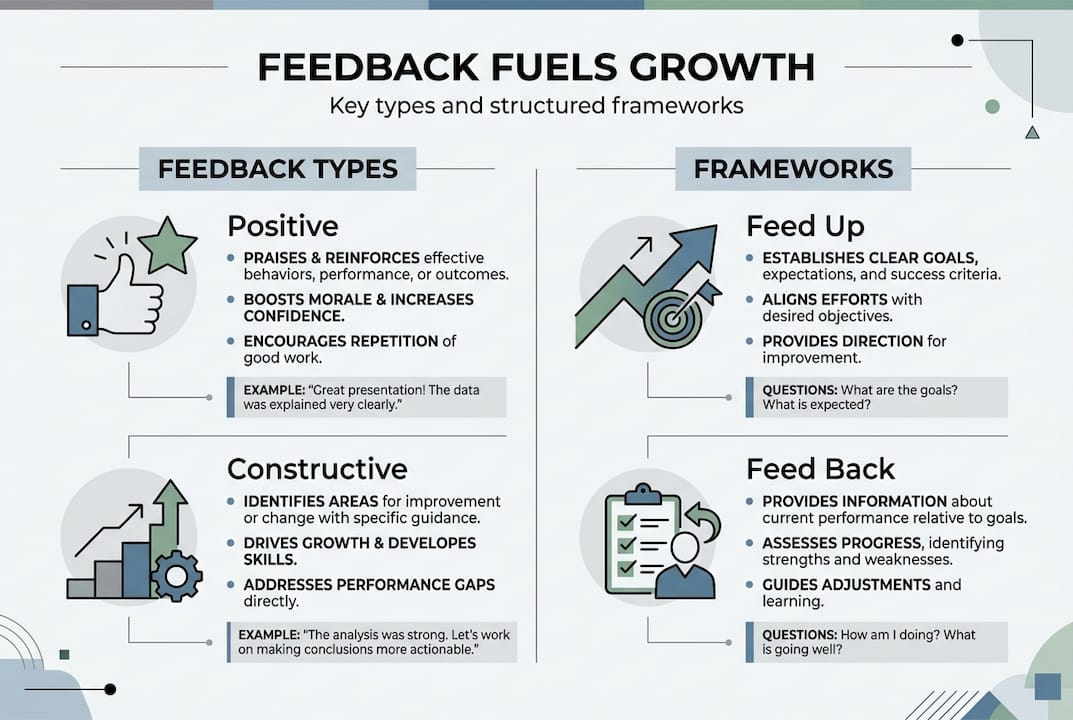
Positive vs. constructive feedback serve different purposes. Positive feedback reinforces behaviors you want to continue. Constructive feedback identifies what needs to change and how. Both are necessary. Leaning too heavily on praise without correction leaves gaps in development. Focusing only on what is wrong without acknowledging progress kills motivation.

External vs. self-feedback is another important distinction. External feedback comes from others, a teacher, a coach, a trusted friend. Self-feedback is your own honest assessment of your performance. Research supports that self-assessment, when practiced regularly, strengthens personal agency and self-regulation. The two types work best together.
One of the most practical structures for feedback comes from Hattie's Feed Up/Feed Back/Feed Forward protocol, which organizes feedback into three clear questions:
- Feed Up: Where am I going? What is the goal?
- Feed Back: How am I doing relative to that goal?
- Feed Forward: What do I do next to close the gap?
This structure removes ambiguity. Instead of vague comments like "try harder," it gives people a specific direction.
| Feedback type | Primary benefit | Best used when |
|---|---|---|
| Positive | Reinforces strengths | Behavior worth repeating |
| Constructive | Identifies improvement areas | Skill gaps are present |
| Self-assessment | Builds personal agency | Reflecting on your own progress |
| Feed Forward | Guides next steps | Planning future actions |
Pro Tip: Aim for a 3:1 ratio of encouragement to correction. This keeps motivation high while still addressing areas that need work. Balance is not just kind; it is strategically effective.
Feedback-seeking behavior: The missing link for growth
Most people wait for feedback to arrive. The ones who grow fastest go looking for it.
Feedback-seeking behavior (FSB) is defined as proactive self-regulation driven by instrumental motives. In plain terms, it means deliberately asking for input because you understand it will help you perform better. It is not passive. It is an active choice.
FSB is the missing link in most self-improvement efforts. People invest in books, courses, and routines, but skip the step of regularly checking whether any of it is working. That is like exercising every day without ever stepping on a scale or noticing whether your clothes fit differently.
Why do so many people avoid asking for feedback? A few reasons:
- Fear of judgment. Asking for feedback feels like admitting weakness.
- Assuming silence means success. If no one says anything negative, people assume they are doing fine.
- Not knowing how to ask. Without a clear method, the request feels awkward or intrusive.
- Avoiding discomfort. Honest feedback can sting, so people unconsciously avoid it.
The good news is that FSB is a skill you can build. Here is how to start:
- Ask specific questions. "What is one thing I could do better?" gets more useful answers than "How did I do?"
- Choose the right people. Seek feedback from those who will be honest, not just supportive.
- Create regular check-ins. Build feedback into your weekly or monthly routine rather than treating it as a one-time event.
- Follow up. When someone gives you feedback, act on it and then report back. This builds trust and encourages more honesty next time.
Pro Tip: Keep a simple feedback journal. After each significant interaction or project, write down what you learned from others' input. Over time, patterns will emerge that reveal your most persistent growth areas.
Structured frameworks: Making feedback actionable
Seeking feedback is only half the equation. The other half is knowing what to do with it.
Hattie's Feed Up/Feed Back/Feed Forward model is one of the most research-backed frameworks for turning feedback into action. Here is how to apply it step by step:
- Set a clear goal (Feed Up). Before any feedback conversation, define what success looks like. A parent might ask, "What behavior am I trying to encourage in my child?" An educator might ask, "What skill am I trying to develop?"
- Assess current performance (Feed Back). Gather honest input about where things stand right now. This is the reality check.
- Identify the next action (Feed Forward). Based on the gap between goal and current reality, decide on one specific next step. Not five steps. One.
- Repeat the cycle. Growth is not a single loop. It is a continuous spiral upward.
The research behind structured feedback is compelling. Relative performance feedback has been shown to accelerate graduation rates and improve academic grades in experimental settings. Structure does not just organize feedback; it amplifies its impact.
| Feedback approach | Outcome observed |
|---|---|
| Unstructured feedback | Inconsistent improvement |
| Feed Up/Feed Back/Feed Forward | Faster goal achievement |
| Relative performance feedback | Higher graduation rates, better grades |
For parents, this framework works at the dinner table. For educators, it works in the classroom. For individuals working on personal goals, it works in a journal or coaching session. The structure is flexible enough to fit any context.
Overcoming challenges in using feedback for self-improvement
Even the best frameworks hit real-world obstacles. Knowing what those obstacles are, and how to handle them, keeps your growth on track.
The most common barriers to effective feedback include:
- Defensiveness. When feedback feels like an attack, the natural response is to push back rather than listen.
- Fear of vulnerability. Admitting you need improvement requires courage that not everyone feels ready to show.
- Vague or poorly delivered feedback. "You need to do better" tells you nothing useful.
- Inconsistent follow-through. Feedback that is never acted on quickly loses its value.
Here is how to address each one:
- For defensiveness, practice pausing before responding. Take a breath. Ask one clarifying question before reacting.
- For fear, start small. Ask for feedback in low-stakes situations until the habit feels natural.
- For vague feedback, ask follow-up questions. "Can you give me a specific example?" transforms a useless comment into a useful one.
- For inconsistency, tie feedback to a system. Write it down, schedule a follow-up, and track your progress.
"Proactive feedback-seeking is essential for personal growth; goal clarity is what makes it work."
Parents and educators play a huge role here. When adults model openness to feedback, children and students learn that receiving input is safe, not shameful. A feedback-friendly environment does not happen by accident. It is built through consistent behavior and psychological safety.
Reframing feedback as a growth tool rather than a verdict changes everything. Feedback is not a judgment of who you are. It is information about what you did, and information is always something you can use.
Our perspective: Why true feedback mastery requires vulnerability
Frameworks and research are essential, but they only take you so far. The real differentiator in feedback mastery is emotional courage.
Most people know they should seek feedback. Very few actually do it consistently, because it requires being willing to hear something uncomfortable. That discomfort is not a flaw in the process. It is the process. Growth lives on the other side of an honest conversation you did not want to have.
From our experience working with families, educators, and individuals at Arthur Scott Publishing, the people who grow the most are not the ones with the best frameworks. They are the ones willing to sit with discomfort long enough to learn from it. Proactive self-regulation through feedback-seeking is a skill, but vulnerability is the foundation it rests on.
Organizations and families that treat vulnerability as a strength, not a weakness, build cultures where feedback flows naturally. That is not soft advice. It is the most practical thing we can tell you. Build the habit of asking, listening, and acting. The frameworks will follow.
Take your self-improvement further with our resources
You now have a clear picture of how feedback drives growth, from the science behind it to the frameworks that make it practical. The next step is putting it into action with the right support.

At Arthur Scott Publishing, we offer impactful guides for personal growth that go beyond theory and into real behavioral change. Whether you are working on your own development or supporting your family, our personal growth resources are designed to meet you where you are. If you are a parent navigating the challenges of raising resilient children, our parenting support content offers practical, research-informed tools to help your whole family grow together.
Frequently asked questions
What is the most effective type of feedback for personal growth?
Constructive, specific feedback that provides actionable steps is most effective. Hattie's protocol of Feed Up, Feed Back, and Feed Forward gives feedback a clear structure that makes it easier to act on.
How can I become more comfortable receiving feedback?
Focus on the opportunity to learn rather than taking it personally, and start by asking for input in low-stakes settings. Proactive feedback-seeking practiced regularly makes the process feel less threatening over time.
Does feedback help in professional as well as personal development?
Yes. Feedback's 0.73 effect size was measured in academic settings, but the same principles apply to workplace performance and personal relationships.
How do I encourage feedback in my family or team?
Model openness yourself and create regular, structured opportunities for honest input. Goal clarity helps everyone understand what the feedback is meant to improve.
What should I do if feedback feels hurtful?
Pause before reacting, reflect on the intent behind the message, and ask one clarifying question to turn a painful moment into a productive learning experience.