
Most people assume that becoming a better version of yourself is a private affair, something you figure out alone in a journal or through willpower. But peer support initiatives consistently improve mental health outcomes, recovery, and overall wellbeing, even in under-resourced settings where professional care is hard to access. That single finding challenges one of the most deeply held assumptions in the self-improvement world. Growth is not a solo sport. The right community does not just encourage you; it fundamentally changes what becomes possible for your personal development and mental wellness.
Table of Contents
- Why community matters: science behind support networks
- Methods and models: how communities foster growth
- Community vs. solo self-improvement: what's the real difference?
- Action steps: building your self-improvement community
- A fresh perspective: the hidden power of micro-communities in self-improvement
- Explore more resources for your personal growth journey
- Frequently asked questions
Key Takeaways
| Point | Details |
|---|---|
| Community boosts outcomes | Peer and community support consistently improves recovery and mental wellness beyond solo efforts. |
| Various models work | Engaged peer-led, faith-based, and online groups all help—find one that matches your needs. |
| Comparison clarifies choices | Community-driven approaches offer more accountability and better emotional support than going it alone. |
| Actionable steps available | Practical strategies and frameworks enable readers to build or join effective support networks. |
| Micro-groups accelerate progress | Smaller, tightly focused communities provide tailored feedback and accountability for lasting change. |
Why community matters: science behind support networks
The evidence connecting community involvement to personal growth is not soft or anecdotal. It is rooted in clinical research, public health data, and behavioral psychology findings that span decades and continents. When you understand why community works, you can use it more intentionally.
Community-engaged programs reduce hospitalizations, improve recovery rates, and produce measurable decreases in mental health symptoms, including depression and anxiety. These are not marginal improvements. Studies document meaningful changes in how people feel, function, and relate to others, often within weeks of joining an active support network.
Peer support, in particular, consistently outperforms isolated self-help approaches. When someone who has faced similar challenges guides you, you receive something a book or podcast cannot provide: lived credibility. That credibility lowers resistance, builds trust, and accelerates behavior change in ways that expert-driven models sometimes cannot.
Key positive outcomes documented in community-based mental health research include:
- Reduction in depression symptoms through regular group accountability and shared coping strategies
- Lower anxiety levels when individuals feel genuinely understood and not alone in their experience
- Improved overall wellbeing as measured by quality-of-life assessments after sustained peer engagement
- Better recovery outcomes from substance use, trauma, and chronic stress when community structures are in place
- Increased self-efficacy as members observe others succeeding and build belief in their own capacity to change
"Community-based mental health care is recommended by the WHO for integrating services into primary care, leveraging peer networks to expand access, support recovery, and protect human rights." WHO on community mental health
The World Health Organization's position on this is clear: shifting care and growth from isolated, institutional settings to community-based models is not just a resource decision. It is a rights-based, evidence-backed strategy for better human outcomes.
Understanding family support and growth adds another layer to this picture. When family networks function as mini-communities, they become one of the most powerful contexts for personal development that any individual can access.
Methods and models: how communities foster growth
Now that the scientific case is clear, let's move from theory to practice by breaking down how communities facilitate lasting self-improvement. Not every community model works the same way, and understanding the landscape helps you choose the right fit for your goals.

Research identifies several distinct methodologies that communities use to drive personal growth and health improvement. The model that best matches your personality, schedule, and objectives will determine how quickly you see results.
Here is an overview of the most effective models:
- Peer-led groups: Small to medium gatherings where members share lived experience, offer accountability, and provide emotional support without professional intermediaries
- Faith-based support networks: Religious and spiritual communities that combine structured teachings with deeply personalized pastoral care and a sense of transcendent purpose
- Service learning communities: Groups organized around giving back, where personal development happens as a byproduct of contributing to something larger than oneself
- Health coaching circles: Facilitator-guided groups focused on specific wellness goals, usually combining education, goal tracking, and peer accountability
- Digital and online communities: Platforms like forums, social groups, and apps that connect people around shared goals, allowing flexibility and global reach
The following table compares engagement levels and typical outcomes for each model:
| Community model | Typical engagement level | Key outcome |
|---|---|---|
| Peer-led groups | High | Recovery, accountability, reduced isolation |
| Faith-based networks | Medium to high | Sense of purpose, emotional support, resilience |
| Service learning | Medium | Self-efficacy, empathy, perspective shift |
| Health coaching circles | High | Goal achievement, behavioral change |
| Digital communities | Variable | Knowledge sharing, connection, flexibility |
One important pattern emerges from comparing these models: higher engagement reliably produces better outcomes. Passive participation, lurking in a forum or showing up occasionally, generates minimal lasting change. The members who grow the most are the ones who show up consistently, share honestly, and invest in others as well as themselves.
Pro Tip: Before committing to a community model, assess not just what it offers but how active its existing members are. A smaller, more engaged group almost always beats a large, passive one for sustainable personal growth.
Exploring community-based self-discovery can also help you identify which structure fits where you are right now. And if you are looking to sharpen your inner tools before joining a group, self-awareness improvement methods give you a strong foundation to build on.
Community vs. solo self-improvement: what's the real difference?
Not all improvement journeys look the same. Comparing solo and community paths clarifies the unique advantages and potential drawbacks of each, so you can make an informed decision rather than defaulting to one approach out of habit.
Here is a side-by-side comparison:
| Factor | Community-based growth | Solo self-improvement |
|---|---|---|
| Accountability | Built-in through peer relationships | Dependent on personal discipline alone |
| Emotional support | Readily available during setbacks | Limited to self-compassion or journaling |
| Feedback quality | Diverse, real-time, experiential | Often internal or delayed |
| Pace of progress | Typically faster due to social motivation | Can stall without external reinforcement |
| Flexibility | Sometimes constrained by group schedule | Fully flexible, self-directed |
| Risk of isolation | Low | High, especially during difficult periods |
| Depth of reflection | Can be shallow in large groups | Often deeper and more personal |
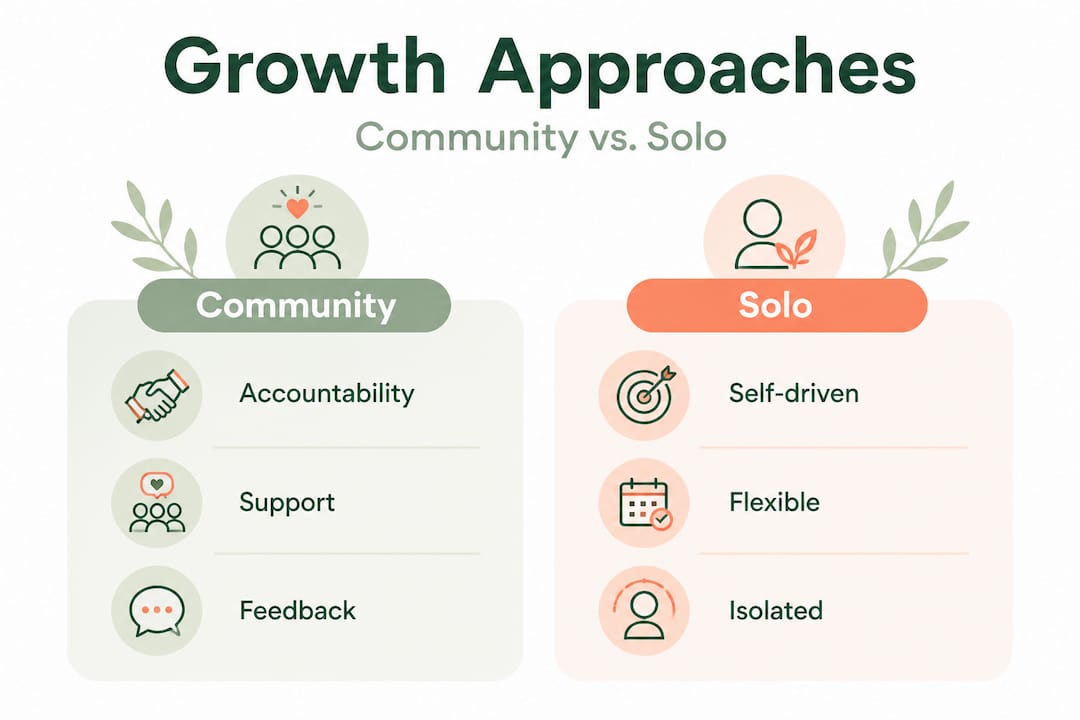
The WHO's framework reinforces that community integration closes the gap between intention and action. Isolation, even chosen isolation, often leads to stagnation because there is no external signal to recalibrate your thinking or behavior.
That said, solo work has real value. Journaling, meditation, solo reading, and personal reflection build the inner clarity you need to show up productively in community settings. The strongest growth happens when you use both.
To evaluate which approach fits your current goals, work through these steps:
- Identify your primary challenge. Is it motivation, knowledge, accountability, or emotional support? Community tends to address the first and third most effectively.
- Assess your current isolation level. If you have been working alone for months without progress, that is a strong signal to seek external support.
- Clarify your readiness for vulnerability. Community growth requires sharing honestly; if you are not ready, starting with solo reflection builds that capacity.
- Review your past patterns. Look at what has worked before. Did you grow faster when working with others or independently?
- Set a 30-day experiment. Join or create a small group for one month and measure your progress against your solo baseline.
Building practical steps for self-awareness helps you enter any community with greater clarity about your own needs. And feedback-driven self-improvement shows exactly how external input accelerates the process once you are engaged.
Pro Tip: The most resilient growth strategy blends both approaches. Use community for accountability and encouragement. Use solo time for reflection and integration. Neither alone is as powerful as both together.
Action steps: building your self-improvement community
Ready to get started? Let's move from insight to action with concrete steps for engaging with meaningful community support. Knowing the theory is valuable. Applying it is where real change happens.
Here are practical ways to find, evaluate, or start a community that supports your personal growth:
- Start with your existing relationships. You may already know two or three people committed to growth. A simple weekly check-in call can become a powerful peer group with almost no setup effort.
- Search purpose-specific platforms. Websites like Meetup, Facebook Groups, Reddit communities, and Discord servers host thousands of groups organized around specific personal development goals.
- Visit local organizations. Libraries, community centers, faith communities, and wellness clinics frequently host support groups and personal development workshops that welcome new members.
- Evaluate before committing. Attend two or three sessions before deciding. Notice whether members are engaged, whether feedback is constructive, and whether the culture feels psychologically safe.
- Start your own group if nothing fits. Identify three to five people with shared goals. Set a recurring time, a simple structure, and ground rules for honest, supportive conversation.
- Leverage digital tools. If geography limits your options, online communities provide legitimate, evidence-backed support that improves outcomes even without in-person contact.
- Engage actively, not passively. Share your goals openly, offer support to others, and follow through on commitments. Your depth of engagement directly determines the value you receive.
Maximizing your community engagement also means tracking your own progress. Keep a simple log of what changed, what you attempted, and what support you received. Over time, this log becomes a motivational resource and a guide for refining your approach.
For families working through growth together, a personal growth workflow provides a structured framework that integrates community principles at every stage. If you want to stay ahead of what is shaping this field, reviewing the latest personal development trends gives you useful context for where collective growth strategies are heading in 2026.
A fresh perspective: the hidden power of micro-communities in self-improvement
As you look to build your support network, it is worth considering not just any community, but the right type of group for your needs. Most articles will point you toward large, established communities. That is reasonable advice. But the most transformative growth experiences we see consistently happen in micro-communities, tight groups of three to eight people who share specific goals and genuinely know each other's full story.
Large communities dilute accountability. When fifty people share a forum, any individual's absence goes unnoticed. When six people are in a peer circle and one person disappears for two weeks, everyone feels it. That social weight is not pressure in a negative sense. It is the kind of healthy responsibility that keeps you moving when motivation alone would not be enough.
Micro-communities also produce far more tailored feedback. In a large group, feedback tends toward the generic because facilitators and members cannot know every individual's specific context. In a small circle, the people around you know exactly what you are working through, what has held you back before, and what kind of encouragement actually lands for you versus what feels hollow.
The hard-won lesson here is this: do not assume that bigger means better when it comes to support networks. A single mentor and two accountability partners who genuinely invest in your progress will outperform a 500-person Facebook group almost every single time. Quality of connection matters more than quantity of members.
This is especially relevant when you are working on perseverance and resilience, the long-game qualities that require consistent reinforcement over months and years. Resilience does not come from occasional inspiration. It comes from repeated, trusted relational experiences where you feel seen, challenged, and supported simultaneously.
Pro Tip: Seek out or build a tight-knit circle of three to eight people with overlapping but distinct growth goals. Progress accelerates dramatically when people truly know your challenges, celebrate your wins without envy, and hold you to your commitments with genuine care.
Explore more resources for your personal growth journey
The research and strategies in this article point toward one clear truth: growth is relational. You do not have to figure it out alone.
At Arthur Scott Publishing, Dr. Arthur Scott has spent years bringing psychology, music, and real human experience together into accessible resources designed for people who are serious about growing themselves and their families. Whether you are navigating parenthood, rebuilding after setbacks, or simply trying to become more self-aware, the free e-books and guides available through the platform meet you exactly where you are. Start with the family legacy guide for a deeply personal look at multi-generational growth, or explore the full range of personal growth and family guidance available on the site. Your next step toward real change is closer than you think.
Frequently asked questions
Can joining a community boost my self-improvement success?
Yes, community-based support consistently improves recovery and mental health outcomes over solo approaches, with documented reductions in depression, anxiety, and isolation across multiple studies.
What kinds of communities help most with self-improvement?
Peer-led groups, digital networks, service learning, and faith-based interventions all show measurable impact. Active, engaged communities consistently outperform passive or large, loosely connected groups.
How does community involvement compare with solo self-improvement?
Community involvement offers built-in accountability, emotional support, and real-time feedback that solo efforts cannot replicate. The WHO recommends community integration precisely because social connection produces better and more lasting outcomes.
What's a simple way to find or create a self-improvement community?
Identify two or three people who share your growth goals, set a recurring check-in time, and commit to honest, consistent conversation. Starting small and intentional is far more effective than joining a large, generic group.