

Most people assume that talent or raw intelligence is what separates high achievers from everyone else. That assumption is wrong, and the research proves it. Grit studies show that perseverance and passion for long-term goals predict success outcomes accounting for an average of 4% variance across educational attainment, GPA, military retention, and competitive rankings, independent of IQ and conscientiousness. That might sound small, but in a world where talent is common and sustained effort is rare, that 4% becomes a decisive edge. This article walks you through the science of perseverance, practical frameworks for building it, and clear guidance for parents, educators, and caregivers who want to foster real emotional resilience.
Table of Contents
- What is perseverance and why does it matter?
- The science behind perseverance: Grit and growth mindset
- Teaching and modeling perseverance: Roles for parents, educators, and caregivers
- The limits of perseverance: When to persist and when to pivot
- Building perseverance: Practical steps for daily growth
- Why perseverance isn't just about 'never giving up'
- Resources to support your perseverance journey
- Frequently asked questions
Key Takeaways
| Point | Details |
|---|---|
| Perseverance beats talent | Consistent effort is a stronger predictor of long-term success than natural aptitude. |
| Mindset can be learned | Grit and a growth mindset can be cultivated at any age through deliberate practice and reflection. |
| Balance effort with self-care | Persistence should be directed at healthy, meaningful goals—know when to pivot to protect your wellbeing. |
| Role models matter | Children and adults benefit when perseverance and resilience are actively modeled and supported. |
| Start with daily habits | Small, purposeful routines build the perseverance needed for major life changes over time. |
What is perseverance and why does it matter?
Perseverance is the ability to maintain sustained effort toward a long-term goal, even when progress feels slow or obstacles pile up. It is not stubbornness. It is not grinding yourself into the ground. It is the quiet, consistent decision to keep showing up for something that matters to you.
Many people confuse perseverance with raw talent or high intelligence. Talent gets you started. Intelligence helps you solve problems faster. But neither one guarantees you will finish what you started. Perseverance is the engine that keeps the whole machine moving when motivation dips and results lag behind effort.
Research on grit and long-term success shows that perseverance outperforms both talent and IQ in predicting long-term outcomes. It is also linked to greater emotional resilience, meaning people who persist through difficulty tend to recover faster from setbacks and maintain a stronger sense of self-worth over time.
| Factor | Predicts short-term performance | Predicts long-term success |
|---|---|---|
| Talent | High | Moderate |
| IQ | High | Moderate |
| Conscientiousness | Moderate | High |
| Perseverance (grit) | Moderate | Very high |
This table makes the point clearly. Over time, perseverance becomes one of the strongest tools in your personal growth toolkit, outpacing attributes that feel more fixed or inherited.
Stat callout: Grit accounts for a meaningful portion of success variance across academic, military, and competitive domains, even after controlling for IQ and personality traits.
Pro Tip: Shift your focus from outcomes to effort. Celebrate the days you showed up, not just the days you won. That mental shift alone builds the habits that sustain perseverance.
With the groundwork set about the importance of perseverance, next we look at the psychology and frameworks that foster it.
The science behind perseverance: Grit and growth mindset
Two frameworks dominate the psychology of perseverance: grit theory, developed by Dr. Angela Duckworth, and growth mindset, introduced by Dr. Carol Dweck. Understanding both gives you a much clearer picture of how perseverance actually works.
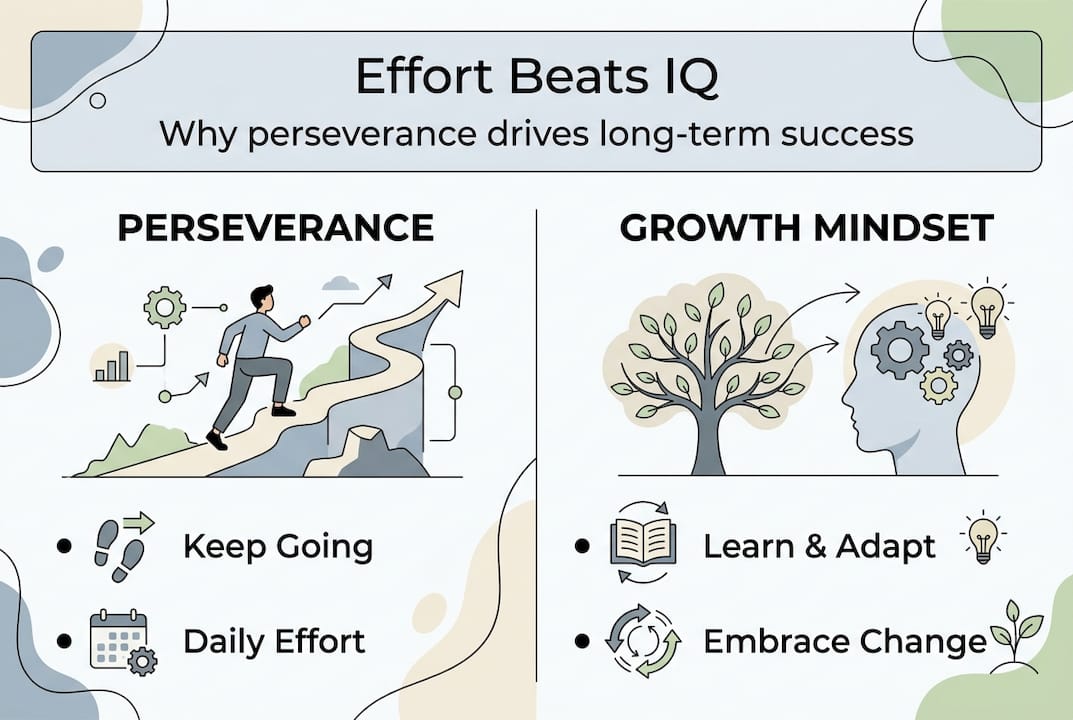
Grit combines passion and perseverance for long-term goals. It is not about talent or luck. It is about staying committed to a direction over years, not just weeks. Growth mindset is the belief that your abilities are not fixed. You can get smarter, more skilled, and more resilient through effort and experience. Together, these two ideas form the foundation of sustainable personal development.
Incorporating emotional intelligence into educational settings has shown that students who understand their own emotions and can manage setbacks learn more effectively and persist longer through challenges. That connection between emotional awareness and perseverance is not accidental.
Key behaviors that build grit in adults and children:
- Pursuing activities that spark genuine interest, not just external rewards
- Practicing deliberately, which means focusing on specific weaknesses rather than repeating what you already do well
- Connecting effort to a larger purpose beyond yourself
- Maintaining hope by remembering past progress and future possibility
- Accepting temporary failure as information, not identity
Building resilience in children requires adults to praise effort over outcome, model healthy coping, encourage problem-solving, and foster secure attachment. These behaviors are not complicated, but they require consistency.
"Children and adults who develop grit are more likely to reach long-term goals, maintain motivation through difficulty, and report higher life satisfaction than those who rely primarily on talent."
Understanding the scientific principles, we can now apply these to real-life situations for growth.
Teaching and modeling perseverance: Roles for parents, educators, and caregivers
Knowing that perseverance matters is one thing. Knowing how to actually build it in a child or young person is another. The Seven Cs framework offers a practical structure for exactly that.
The Seven Cs, developed in pediatric resilience research, are: competence (feeling capable of handling challenges), confidence (a strong sense of self-worth), connection (supportive relationships with trusted adults), character (a clear sense of right and wrong), contribution (feeling that you matter to others), coping (healthy strategies for managing stress), and control (understanding that your choices affect outcomes). Each one reinforces the others.
Strategies for parents and educators show that modeling resilience, emphasizing effort, and providing emotional support consistently produce stronger life skills and mental wellness in children over time.
Numbered techniques for building perseverance in youth:
- Praise effort specifically. Instead of "You're so smart," say "You worked really hard on that."
- Model problem-solving out loud. Let children see how you work through difficulty, not just how you succeed.
- Establish predictable routines. Structure reduces anxiety and frees mental energy for growth.
- Use setbacks as teaching moments. Ask "What did you learn?" rather than focusing on the loss.
- Encourage practical emotional intelligence strategies so young people can name and manage their feelings under pressure.
Pro Tip: When a child faces a setback, resist the urge to fix it immediately. Sit with them in the discomfort first. Ask questions. That pause is where perseverance actually grows.
Ways to encourage secure attachment and growth mindset:
- Be present and consistent, even when you do not have all the answers
- Normalize struggle by sharing your own learning experiences
- Celebrate progress, not just achievement
- Create space for honest conversation about fear and frustration
Having concrete strategies, it is vital to recognize where perseverance can be misapplied, and why balance is necessary.
The limits of perseverance: When to persist and when to pivot
Perseverance is powerful. But it is not always the right answer. One of the most misunderstood truths in personal growth is that knowing when to stop is just as important as knowing how to keep going.

When perseverance becomes toxic, it looks like grinding through a goal that no longer serves you, ignoring your health, your relationships, or your values, because stopping feels like failure. That is not grit. That is stubbornness wearing a motivational mask.
Warning signs that your perseverance may be misdirected:
- Chronic stress or physical exhaustion with no recovery in sight
- A goal that has lost its meaning but you keep chasing out of fear or ego
- High opportunity cost, meaning the time and energy you are spending here is preventing something more valuable
- Repeated failure without any new information or adjusted approach
- A growing sense of dread rather than challenge when you think about your goal
Grit research on edge cases shows that perseverance can be harmful when misdirected toward toxic goals or unsustainable paces. The key variables are self-efficacy (your belief that you can succeed), the actual value of the goal, and the perceived cost of continuing. When those three factors fall out of alignment, flexible adjustment is not giving up. It is wisdom.
"True perseverance is not about never changing direction. It is about staying committed to your values while being honest about which path actually leads there."
Ask yourself two questions regularly: Is this goal still meaningful to me? Do the benefits of continuing outweigh the costs to my health, relationships, and time? If your honest answers concern you, that is worth paying attention to.
With a clear understanding of perseverance and its context, let's look at real-world examples and practical tips for building this skill.
Building perseverance: Practical steps for daily growth
Perseverance is not something you either have or you do not. It is a skill, and like any skill, it responds to consistent practice. The good news is that the daily habits required are simple, even if they are not always easy.
Cultivating perseverance happens through four core pathways: developing genuine interest in what you are doing, practicing deliberately and intentionally, connecting your work to a larger purpose, and maintaining hope even when results feel distant.
Daily habits to build perseverance:
- Set micro-goals each morning. Break your larger aim into one specific thing you will accomplish today. Small wins accumulate into lasting momentum.
- Reflect for five minutes at the end of each day. Ask: What did I learn? What would I do differently? This is not criticism. It is data collection.
- Practice one difficult thing deliberately. Target a specific weakness, not a comfortable routine. Growth lives at the edge of your current ability.
- Build in one act of fostering critical thinking each week, whether you analyze a decision you made or explore a new perspective on a challenge you face.
- Recall past progress when hope dips. Keep a brief log of obstacles you have already overcome. Evidence of your own resilience is the most powerful motivator available.
Pro Tip: Track your progress visually. A simple chart or journal where you mark each day of effort creates a chain you will not want to break. Progress you can see feels real in a way that abstract goals never do.
Sustaining perseverance also means building confidence through repeated small successes. Every time you follow through on a commitment, even a minor one, you reinforce the identity of someone who does not quit. That identity compounds.
Now that you have explored hands-on methods, how do experts and those with experience view the role of perseverance in authentic growth?
Why perseverance isn't just about 'never giving up'
The phrase "never give up" sounds motivating. In practice, it can be one of the most misleading pieces of advice in the personal development space. From our work supporting individuals and families through genuine growth challenges, the most persistent people we have encountered are not the ones who ignored failure. They are the ones who stayed honest with themselves about what their effort was actually producing.
Real perseverance requires three things that motivational posters rarely mention: self-awareness, adaptability, and alignment with your core values. Without self-awareness, you cannot tell the difference between a meaningful struggle and a harmful one. Without adaptability, you confuse changing your approach with abandoning your commitment. Without values alignment, you can spend years achieving a goal that leaves you empty.
We have seen this pattern with parents, educators, and individuals who come to us exhausted by effort that felt purposeless. The shift that changed everything for them was not trying harder. It was getting clearer. Clearer about why the goal mattered, what success would actually feel like, and whether the path they were on still led there. That clarity is what makes perseverance sustainable, and what separates genuine growth from sheer exhaustion.
Resources to support your perseverance journey
Building perseverance is a long-term investment, and you do not have to make it alone. Arthur Scott Publishing was created specifically to support individuals, parents, and caregivers who are committed to meaningful personal and family growth.

From free e-books on behavioral health and emotional resilience to audio resources you can access anywhere, we make the tools for growth genuinely accessible. Explore Arthur Scott Publishing's impact to see how others have used these resources to create real change. If you are a parent or caregiver, our parenting support resources offer practical, psychology-backed guidance for building resilience in the people you love. Visit our personal growth programs to find your starting point today.
Frequently asked questions
What is the difference between perseverance, grit, and a growth mindset?
Perseverance is sustained effort toward goals, grit adds passion to that perseverance, and growth mindset is the belief that your abilities can improve with effort. Grit predicts success outcomes independently of IQ, making it one of the most practical tools for long-term achievement.
How can parents help children develop perseverance?
Parents can praise effort instead of results, model healthy coping, and use setbacks as learning conversations rather than failures. Consistent routines and resilience modeling are among the most effective strategies for building a growth mindset in children.
Can perseverance ever be harmful?
Yes. When directed toward toxic goals or pursued without self-reflection, perseverance can lead to burnout and harm. Flexible adjustment is not failure. It is what keeps perseverance healthy and sustainable over time.
What are some daily habits to build perseverance?
Set one small goal each day, reflect on what you learned, and practice one deliberately difficult task. Deliberate practice and purpose are two of the most evidence-backed pathways to developing lasting perseverance.