
Millions of people buy self-help books, courses, and apps every year hoping for transformation. Yet research published in Nature found that self-help product usage showed no meaningful association with personality or well-being changes over two years. That gap between what the self-help industry promises and what science actually confirms is exactly what this article addresses. You will learn what genuine personal growth looks like, which strategies actually work, and how to build a self-improvement practice grounded in evidence rather than enthusiasm alone.
Table of Contents
- What self-improvement really means
- Core benefits of self-improvement: Mind, relationships, and resilience
- Limitations and pitfalls: What self-improvement is not
- Practical strategies: How to leverage self-improvement for real change
- Why evidence, not hype, should drive your self-improvement journey
- Level up your growth journey with trusted resources
- Frequently asked questions
Key Takeaways
| Point | Details |
|---|---|
| Lasting growth needs evidence | Commercial products rarely create deep change; research-backed habits are key. |
| Emotional and social benefits | Self-improvement can increase resilience, self-compassion, and improve relationships. |
| Avoid common traps | Relying on hype or quick fixes without true practice limits progress. |
| Small steps build confidence | Consistent assessment and feedback grow self-efficacy over time. |
What self-improvement really means
With the myths addressed, it is crucial to clarify what self-improvement actually is. Too many people mistake buying a book or downloading a wellness app for the act of growth itself. Ownership is not practice. Reading is not application. Real self-improvement is an ongoing cycle of honest assessment, deliberate practice, and thoughtful adjustment based on what you learn along the way.
Think of it less like a destination and more like a skill you are always refining. A musician does not become better simply by purchasing a new instrument. Progress comes from consistent repetition, identifying weak spots, adjusting technique, and returning to practice with fresh awareness. The same logic applies to personal growth.
What actually drives lasting change? Research points to three key factors:
- Iterative mindsets. Iterative mindsets that involve repeating, practicing, and assessing are positively linked to higher self-efficacy, greater well-being, and even measurable weight-loss success.
- Self-efficacy. This means your belief in your own ability to handle challenges. When you practice and succeed at small goals, that confidence compounds over time.
- Honest self-reflection. Growth stalls when you avoid uncomfortable truths. Genuine self-assessment, even when it is hard, is the engine of real progress.
"Real self-improvement is not a product you purchase. It is a process you commit to, one small and honest step at a time."
Taking practical self-improvement steps grounded in self-awareness helps you move from vague intentions to measurable forward motion.

Pro Tip: Start a weekly five-minute journal check-in where you answer three questions: What did I practice this week? What worked? What will I adjust next week? This simple habit builds the iterative mindset research links to lasting results.
Core benefits of self-improvement: Mind, relationships, and resilience
Once we frame what self-improvement is, the advantages become clearer when grounded in evidence. The benefits are not abstract. They show up in how you think, how you relate to the people you love, and how you bounce back from setbacks.
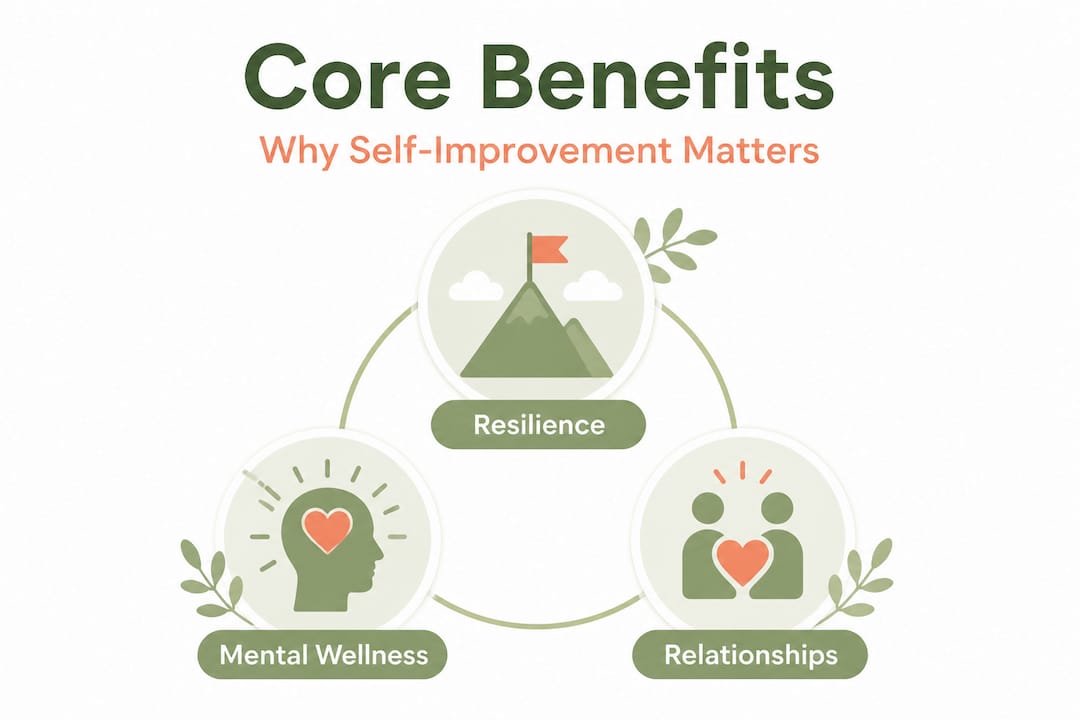
One of the most well-documented paths to these benefits is mindfulness-based stress reduction, or MBSR. This is a structured program, typically eight weeks, that uses meditation, body awareness, and gentle movement to reduce psychological stress. Mindfulness-based stress reduction (MBSR) significantly improves self-compassion, reduces stress, and enhances parent-child relationships in caregivers. For parents and caregivers especially, this is powerful. When you manage your own stress more effectively, your children feel it.
Here is a snapshot of the documented benefits across several life domains:
| Domain | Evidence-based benefit | Who benefits most |
|---|---|---|
| Mental wellness | Reduced anxiety, improved self-compassion | Adults, caregivers |
| Parenting | Stronger parent-child connection | Parents with high stress |
| Resilience | Better recovery from setbacks | Anyone using iterative practices |
| Behavior change | Greater follow-through on goals | Those with structured plans |
| Social connection | Richer relationships, less isolation | Families, communities |
Beyond the table, there are some concrete examples worth noting. A parent who practices MBSR is less likely to react with frustration during difficult moments and more likely to respond with patience. A person building an iterative mindset around fitness does not give up after a bad week. They assess, adjust, and continue.
Key emotional and behavioral gains include:
- Reduced reactivity in high-stress moments
- Greater capacity for empathy in family relationships
- Improved sleep quality linked to lower rumination
- Higher motivation through small, recognized wins
- Stronger sense of personal identity and purpose
Exploring self-improvement for families shows how these benefits ripple outward. When one person in a household grows, the entire family system often shifts in positive ways. And when growth is supported by others, as explored in resources on community support and personal growth, the pace and depth of change increase significantly.
Limitations and pitfalls: What self-improvement is not
Recognizing the benefits, it is equally important to understand where self-improvement falls short. This matters especially because the wellness industry generates billions of dollars annually by overpromising results. Knowing what does not work saves you time, money, and the emotional toll of repeated disappointment.
Here is a clear comparison of effective versus ineffective approaches:
| Method | Effectiveness | Why |
|---|---|---|
| Iterative practice with feedback | High | Builds real skill and self-efficacy |
| MBSR and evidence-based programs | High | Documented in peer-reviewed research |
| Commercial self-help products alone | Low | Not associated with well-being changes over two years |
| Daily affirmations for low self-esteem | Risky | Can increase negative self-focus and backfire |
| Passive reading without application | Very low | No behavior change without practice |
The affirmation trap deserves special attention. Telling yourself "I am confident and successful" when you do not yet feel that way can deepen the gap between your current state and your desired self. For people with low self-esteem, this contrast can actually increase distress rather than reduce it. Affirmations work best when they are grounded in actions you are already taking, not vague wishes you repeat in the mirror.
Toxic positivity, the insistence that everything is fine or that you just need to think more positively, is similarly harmful. It shuts down genuine emotional processing. You cannot resolve grief, fear, or anger by smiling over it. Honest acknowledgment of difficult emotions is not weakness. It is the foundation of real resilience.
Watch out for these common pitfalls:
- Buying self-help products as a substitute for doing the work
- Measuring growth only by mood rather than behavior changes
- Setting goals so large they cause paralysis rather than motivation
- Avoiding feedback because it might confirm something uncomfortable
- Confusing inspiration with transformation
Digging into personal growth and self-discovery can help you build a more honest, grounded picture of where you are and where you genuinely want to go.
Pro Tip: If you catch yourself saying "I've read so much about this," ask yourself what you have actually done differently. Reading is a beginning, not an endpoint. Track behavior changes, not just insights gained.
Practical strategies: How to leverage self-improvement for real change
Now that limitations are clear, here is how to make self-improvement work powerfully in daily life. The goal is not perfection. The goal is a reliable system of small, repeatable actions that compound into something meaningful over weeks and months.
Step-by-step framework for building a real growth practice:
- Define one specific behavior to change. Not "be more patient" but "take three slow breaths before responding when I feel frustrated." Specific is actionable. Vague is forgettable.
- Set a baseline. Track where you are right now before making any changes. This creates honest data to compare against later and prevents the illusion of progress.
- Practice deliberately. Apply your chosen behavior daily, even in small doses. Frequency beats intensity in the early stages of habit formation.
- Assess weekly. Use your journal or a simple notes app to record what happened, what worked, and what needs adjustment. This is where the iterative mindset becomes your greatest asset.
- Seek feedback from trusted people. Family members, close friends, or a mentor can reflect back what they actually observe in your behavior. This is often more accurate than your internal self-assessment alone.
- Revise your approach. If something is not working after two or three weeks, change the method, not just the effort level. More force rarely fixes a flawed strategy.
- Celebrate small wins genuinely. Not with empty praise but with honest acknowledgment that you followed through. That acknowledgment is what builds self-efficacy over time.
Solid habits are also strengthened by the people around you. Accountability partners, support groups, and family involvement all amplify results because they create external structure when internal motivation dips. Explore how feedback for growth can transform your awareness in ways solo effort rarely achieves.
Other practical habits worth building:
- Morning intention setting (two sentences, written down, not just thought)
- End-of-day reflection on one moment when you acted according to your values
- Monthly review of your personal growth plan steps to see what needs updating
- Physical movement as a mood regulation tool, not just a fitness goal
- Reading applied to practice, meaning you only continue reading when you have tested the last idea you encountered
And when the process gets hard, which it will, that is precisely when perseverance and growth matter most. The research is clear: people who treat challenges as expected parts of growth rather than signs of failure tend to persist longer and achieve more meaningful outcomes.
Pro Tip: Pair each new self-improvement habit with an existing routine. After your morning coffee, write your daily intention. After dinner, spend two minutes reflecting on your day. This "habit stacking" method lowers resistance and dramatically improves follow-through rates.
Why evidence, not hype, should drive your self-improvement journey
Here is an uncomfortable truth most of the self-help industry does not want you to hear: the majority of the growth content sold to you is optimized for sales, not outcomes. Bright covers, bold promises, and transformation stories are designed to make you feel hopeful enough to click "buy." They are rarely designed to make you actually change.
The research is consistent. Iterative, practice-based methods outperform passive consumption every single time. Yet passive consumption is easier to sell because it feels like progress without requiring any effort. You can buy a book in thirty seconds. Building a feedback loop takes weeks of discomfort.
What separates people who genuinely grow from people who collect self-help resources is the willingness to be wrong, to get feedback, and to try again differently. That process is unglamorous. It rarely fits into a motivational quote. But it is what actually changes lives.
Another angle worth challenging: the assumption that more is better. More books, more courses, more podcasts. In reality, doing less more consistently produces better outcomes than doing more inconsistently. One solid habit practiced daily for three months will reshape your life more than twenty half-started programs.
The development trends for 2026 reflect this shift. More people are moving away from passive self-help consumption toward structured, community-supported, evidence-based growth. That is a healthy correction after decades of overhyped promises.
Slow, repeated, honest effort is not a consolation prize. It is the actual prize. If you are tired of buying tools that do not work, stop looking for better tools and start building a better practice.
Level up your growth journey with trusted resources
You have just worked through what real self-improvement looks like, where it delivers results, and where it falls short. Now the question becomes: where do you go from here with guidance you can actually trust?
At Arthur Scott Publishing, Dr. Arthur Scott combines his background in psychology and decades of experience to create resources that meet you where you are. Whether you are a parent looking for parenting resources that actually respect the difficulty of caregiving, or someone ready to build a stronger personal foundation using personal growth materials grounded in behavioral health, you will find practical, evidence-informed tools here. Read our impact story to see how these resources have moved people from stuck to growing. Free e-books, audio formats, and community support are waiting for you.
Frequently asked questions
What is the biggest benefit of self-improvement?
The greatest benefit is increased self-efficacy: your confidence in handling challenges and adapting to change, which iterative practice consistently builds over time.
How long does it take to see real results from self-improvement?
Results develop gradually, with weeks or months of consistent practice needed for sustainable change, since self-help product usage alone shows no meaningful gains even over two years.
Are self-help books effective for changing personality?
Evidence shows self-help usage rarely creates lasting personality changes; effectiveness depends on pairing reading with deliberate, evidence-based practice.
Does self-improvement benefit families?
Yes, especially approaches like mindfulness-based stress reduction, which boost parent-child connections and measurably lower caregiver stress.
What are common mistakes in self-improvement?
Relying only on commercial self-help or repeated affirmations without feedback, practice, or structure limits growth, as research consistently shows these approaches fail to produce lasting behavioral or personality shifts.