

You want to grow. You've probably read the motivational quotes, downloaded the apps, maybe even bought the journals. But six weeks later, you're back to square one, wondering why nothing sticks. The problem isn't your commitment. It's that most personal growth advice skips the structure that actually makes change happen. A science-backed framework built around your real life, your specific goals, and your emotional starting point makes a measurable difference. This guide walks you through a step-by-step personal growth plan designed for parents, caregivers, and anyone ready to move past vague intentions and into real, lasting self-improvement.
Table of Contents
- Clarifying your growth goals and motivations
- Assessing your current state: Honest self-awareness
- Designing your action plan: Routines, boundaries, and growth habits
- Monitoring progress and troubleshooting setbacks
- A reality check: What most personal growth advice gets wrong
- Take the next step with evidence-based resources
- Frequently asked questions
Key Takeaways
| Point | Details |
|---|---|
| Clarify real goals | Start with personalized motivations for growth so that your plan is meaningful and sustainable. |
| Practice honest self-assessment | Regular reflection and assessment create a solid baseline for genuine improvement. |
| Build routines and boundaries | Consistent habits and boundaries protect your time and fuel lasting change. |
| Monitor and adjust | Track your progress, troubleshoot setbacks, and revise your plan for ongoing success. |
Clarifying your growth goals and motivations
Most people start the self-improvement process with a feeling, not a plan. They feel stuck, burned out, or like they're falling short somewhere. That feeling is valid. But feelings alone don't create change. You need to translate that emotional signal into a specific target.
The first thing to understand is the difference between intrinsic and extrinsic motivation. Intrinsic motivation comes from inside you: wanting to be more patient with your kids, feeling more at peace, or developing a skill that genuinely excites you. Extrinsic motivation comes from outside: wanting approval, avoiding judgment, or chasing a status symbol. Research consistently shows that intrinsic motivation leads to longer-lasting behavior change. If your goal is driven purely by external pressure, it tends to fade the moment that pressure lifts.
Here's a simple table to illustrate the difference and help you identify where your goals land:
| Motivation type | Example goal | Sustainability |
|---|---|---|
| Intrinsic | Build patience as a parent | High |
| Intrinsic | Develop daily mindfulness habit | High |
| Extrinsic | Lose weight for a reunion | Moderate |
| Extrinsic | Read books to impress others | Low |
Once you've pinpointed your motivation type, narrow your focus. Many people try to overhaul every area of life at once: work performance, parenting, fitness, sleep, and relationships, all simultaneously. That's a fast path to burnout. Instead, choose one domain that most needs your attention right now.
Common life areas to consider:
- Emotional regulation: Managing reactions under stress
- Parenting and family dynamics: Understanding parenting struggles and solutions more deeply
- Work and productivity: Setting better boundaries or focusing habits
- Self-care and physical health: Sleep, nutrition, and stress recovery
- Relationships: Communication and connection skills
The payoff for getting this step right is significant. Self-care practices lower cortisol by 25 to 30% and reduce child behavioral issues by 32%, which means your personal growth directly benefits the people around you.
Pro Tip: Pick just one area to focus on for the next 60 days. Narrowing your focus dramatically increases your odds of real progress and shields you from the mental fatigue of trying to fix everything at once.
Assessing your current state: Honest self-awareness
Once you know your goals, it's time to take an honest inventory of where you're starting from. This step feels uncomfortable for most people, and that discomfort is actually a good sign. It means you're being real with yourself.
Self-awareness is the foundation of every meaningful growth plan. Without it, you're guessing. You might be working hard on the wrong things or repeating patterns you haven't even noticed yet. Why self-assessment matters becomes clearer when you see how often people skip this step and then wonder why their efforts don't stick.
Here's a straightforward self-audit process you can do in about 30 minutes:
- Write down your current reality. For your chosen focus area, describe where things actually stand today, not where you wish they were.
- Rate yourself honestly. On a scale of 1 to 10, how satisfied are you with this area of your life? What's pulling the number down?
- Identify your triggers. What situations, people, or times of day tend to derail you or bring out behaviors you want to change?
- Note your strengths. What's already working? Growth doesn't mean starting from zero. Build on what's there.
- Name one honest obstacle. Not a generic one. A specific thing that has stopped you before.
To choose the right self-assessment tool, it helps to know the difference between subjective and objective approaches:
| Tool type | Examples | Best used for |
|---|---|---|
| Subjective | Journaling, self-ratings, reflection prompts | Emotional insight and patterns |
| Objective | Habit trackers, checklists, feedback from others | Behavioral consistency and accountability |
Many people assume that lasting change requires a personality transplant. It doesn't. Resiliency strategies like gratitude and mindfulness gradually build emotional well-being in ways that feel manageable and real.
"Resiliency is made, not born." The capacity to grow and adapt is a skill you build through repeated, small actions, not a trait you either have or don't.
The evidence-based approaches most likely to help you are the ones that match your actual starting point, not a generic template.
Designing your action plan: Routines, boundaries, and growth habits
After you've identified where you stand, the next stage is transforming goals and insights into daily action. This is where most plans go from good intentions to real momentum.
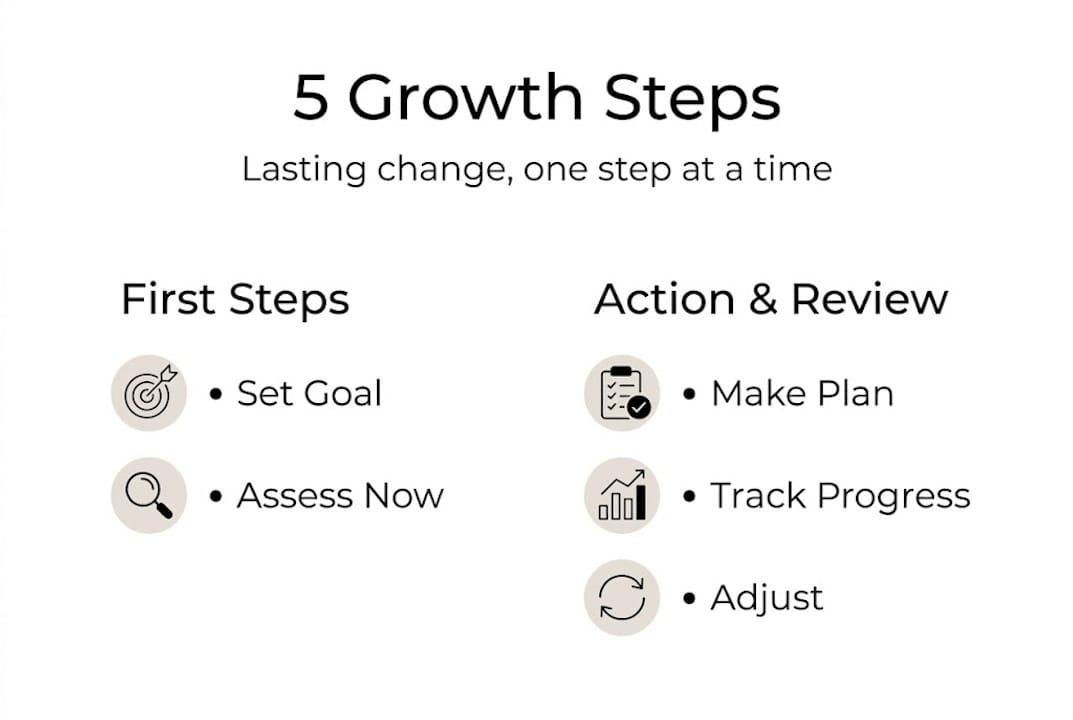
Here's how to build your action plan:
- Choose your primary habit. Based on your self-audit, select one behavior to develop first. Keep it small enough to do consistently.
- Set a daily or weekly time block. Assign a specific time for your growth practice. Vague plans don't survive busy days.
- Define what success looks like weekly. Not a distant, abstract outcome. A specific, observable behavior you can tick off each week.
- Identify your accountability method. A journal, a trusted friend, or a community can all work. The key is that someone or something keeps you honest.
- Build in review time. Schedule 15 minutes each week to assess what's working and what needs adjusting.
Key growth habits worth integrating:
- Daily gratitude practice: Three specific things you're grateful for each morning
- Mindfulness check-ins: Even two minutes of intentional breathing changes your nervous system response
- Consistent sleep schedule: Sleep is the single most underrated growth tool
- Clear personal boundaries: Protect the time and energy your growth plan requires
- Weekly reflection: Review your week without judgment, just observation
Building resilience involves developing a concrete action plan, solving for real stressors, and establishing routines that hold even when motivation wavers.

Growth mindset research shows that the mindset alone isn't enough. What predicts real progress is behavior change, and behavior change comes from systems, not inspiration.
Pro Tip: Anchor a new habit to something you already do automatically, like your morning coffee or brushing your teeth. This is called habit stacking, and it reduces the mental effort required to stay consistent. Small wins compound fast when they're attached to existing routines.
And don't underestimate the power of protecting your growth time. Setting a clear boundary around your practice, whether that means 20 quiet minutes before the kids wake up or a phone-free lunch break, is itself a growth act. The personal growth strategies that stick long term are the ones woven into the fabric of your actual day.
Monitoring progress and troubleshooting setbacks
Even the best plans require adjustment, so let's look at how to track your progress and what to do when you hit a snag.
Measurement matters, even for goals that feel soft or internal. If you can't see your progress, you can't sustain it. Here are practical tracking methods that don't require complicated systems:
- A simple paper journal with a daily one-sentence entry
- A habit-tracking app like Habitica or Streaks
- Weekly reflection questions: What worked? What didn't? What one thing would I change?
- A monthly self-rating compared to your baseline from the self-audit
Setbacks are not failure. They're information. Here's how to troubleshoot the most common ones:
- Identify the specific point of breakdown. Was it a trigger? A schedule disruption? An emotional response? Get precise.
- Reduce the size of your commitment temporarily. If the habit feels too demanding, shrink it until it's almost impossible to skip.
- Check your motivation again. Sometimes a plateau means the goal has shifted and your plan needs to catch up.
- Reach out for perspective. Isolation tends to amplify setbacks. A conversation with someone you trust can reset your thinking fast.
- Give yourself a structured restart. A reset isn't quitting. Set a new start date, update your plan, and go again with what you've learned.
One important warning: resiliency troubleshooting requires honest effort, and not all tools are equal. Self-help usage alone predicts no measurable trait change over two years. Popular products may feel motivating in the short term, but they don't substitute for structured, evidence-based habits. Choose your tools wisely and lean toward approaches grounded in research. You can also reflect and troubleshoot your plan regularly to make sure it's still serving your real goals.
A reality check: What most personal growth advice gets wrong
Here's the uncomfortable truth: most personal growth content sells optimism and underdelivers on results. That's not cynicism. It's what the data shows.
People want fast, dramatic transformation. The advice industry serves that desire. But real growth is slow, cumulative, and often invisible until one day you realize you've actually changed. Growth mindset attitudes correlate with grit at only r=0.19 to 0.24, and self-help products show no proven personality change over two years. The mindset is a starting point, not a finish line.
What does predict change? Repeated behavior, honest reflection, and a willingness to keep going even when progress feels invisible. The people who grow consistently are rarely the most inspired. They're the most disciplined about small, daily actions.
"Most change happens not in inspiration, but in daily discipline."
We at Arthur Scott Publishing have seen this pattern clearly through years of working with parents, caregivers, and individuals serious about growth. The ones who use practical growth truths as their compass rather than chasing the next motivational high are the ones who actually report lasting shifts in how they feel, behave, and relate to the people they love most.
Expect slowness. Accept imperfection. Trust the process more than the feeling.
Take the next step with evidence-based resources
If you're ready to move from advice to concrete action, here are resources that can help deepen your journey.
At Arthur Scott Publishing, Dr. Arthur Scott has developed free digital resources specifically for parents, caregivers, and individuals working on emotional well-being and family growth. Whether you're navigating parenting resources or looking to understand our impact through real stories and evidence-based frameworks, there's a resource waiting for you. The platform offers downloadable e-books, audio formats, and community spaces where growth is treated as a serious, supported process. Explore personal growth content tailored to your real life and start building the habits that compound into lasting change.
Frequently asked questions
What is a personal growth plan?
A personal growth plan is a structured, step-by-step approach to improving self-awareness, emotional health, and life satisfaction by setting clear, actionable goals. Structured approaches make this process more achievable by giving you a reliable system to follow.
Can parents and caregivers benefit from personal growth plans?
Yes, tailored growth plans help parents and caregivers reduce stress and model positive habits for their children and families. Self-care practices lower cortisol by 25 to 30% and reduce child behavioral issues by 32%, making parental growth directly impactful.
How often should I update my personal growth plan?
Check your progress every few weeks and update your plan to stay on track and adjust for new challenges. Monitoring and adjusting regularly is essential for overcoming common setbacks and maintaining momentum.
Are self-help products effective for personal growth?
Most self-help products don't lead to long-term personality changes; sustainable growth requires evidence-based habit changes. Self-help usage predicts no measurable trait change over two years, so prioritize structured, evidence-backed approaches.
What habits promote emotional well-being in a growth plan?
Daily gratitude, mindfulness, healthy sleep, and clear personal boundaries are shown to boost emotional well-being. Resiliency strategies like these build a foundation that supports lasting growth over time.
Recommended
- Arthur Scott Publishing's Impact
- Personal Growth Family Children recovery grace forgiveness freedom rule to law
- Boost SEO & AEO with Geo-targeted Blogs
- Parenting is a Tough 24/7 Job.
- Step by Step Astrological Forecasting for Personal Growth | Lunaris
- Build a trauma-informed self-care workflow: 5 steps