
Most people have read at least one self-help book, felt inspired for a week, and then watched that energy quietly fade. That cycle isn't a character flaw; it's what happens when motivation replaces method. Psychology provides core methodologies for self-help through evidence-based therapies like CBT, ACT, bibliotherapy, and structured exercises, turning vague intentions into measurable growth. For parents and caregivers especially, understanding how these tools work, what they can realistically deliver, and where their limits lie is the difference between real family change and another half-finished journal sitting on a nightstand.
Table of Contents
- Why psychology is the backbone of self-help
- What the evidence says: Real benefits and real limits
- Psychology-based tools and methods that work
- Risks, blind spots, and when self-help isn't enough
- How parents and families can leverage psychology for lasting growth
- Why most self-help fails, and how to get it right
- Ready to turn insights into action for your family?
- Frequently asked questions
Key Takeaways
| Point | Details |
|---|---|
| Evidence-based is essential | Psychology-driven self-help works best when rooted in structured, proven methods like CBT and ACT. |
| Active participation matters | Practicing exercises, reflection, and accountability lead to real growth—passive reading is not enough. |
| Know the limits | Self-help is most useful for mild challenges and life transitions; severe issues need professional care. |
| Families gain most together | Parents and caregivers using psychological tools can improve communication, resilience, and family wellness. |
| Track and adapt | Monitoring progress and adjusting practices maximize the benefits of self-help strategies. |
Why psychology is the backbone of self-help
Now that you've seen why passive reading rarely works, let's explore what really makes self-help effective: the role of psychology.
Pop self-help often promises transformation through attitude shifts or morning routines. Psychology goes deeper. It studies how thoughts, emotions, and behaviors interact, and it builds tools based on that understanding. Two approaches stand out for their strong research base.
Cognitive behavioral therapy (CBT) works by identifying negative thought patterns and replacing them with more accurate, useful ones. You don't just "think positive." You challenge specific distortions, test them against evidence, and practice new responses. Acceptance and commitment therapy (ACT) takes a different angle: rather than changing your thoughts, you learn to observe them without letting them drive your behavior. You then commit to actions aligned with your values. Evidence-based therapies like CBT and ACT, plus bibliotherapy and psychological apps, form the foundation of effective self-help.
Here's what separates psychology-based self-help from pop advice:
- It gives you a structured process, not just inspiration
- It teaches you to track your own patterns, not just reflect vaguely
- It uses exercises, worksheets, and real-world practice
- It builds skills through repetition, the same way learning an instrument does
- It develops self-awareness in families rather than relying on willpower
"The real value of psychology-informed self-help isn't the insight you gain from reading. It's the behavioral shift that comes from applying those insights repeatedly in real situations."
For parents, these tools are especially valuable. Managing your own emotional reactivity when a child is melting down is a skill you build through practice, not willpower. Learning family empowerment strategies grounded in psychological principles gives caregivers a genuine framework, not just reassurance that they're doing their best.
What the evidence says: Real benefits and real limits

With a solid grasp of the psychology behind self-help, it's important to weigh what the research actually reveals about its effectiveness.
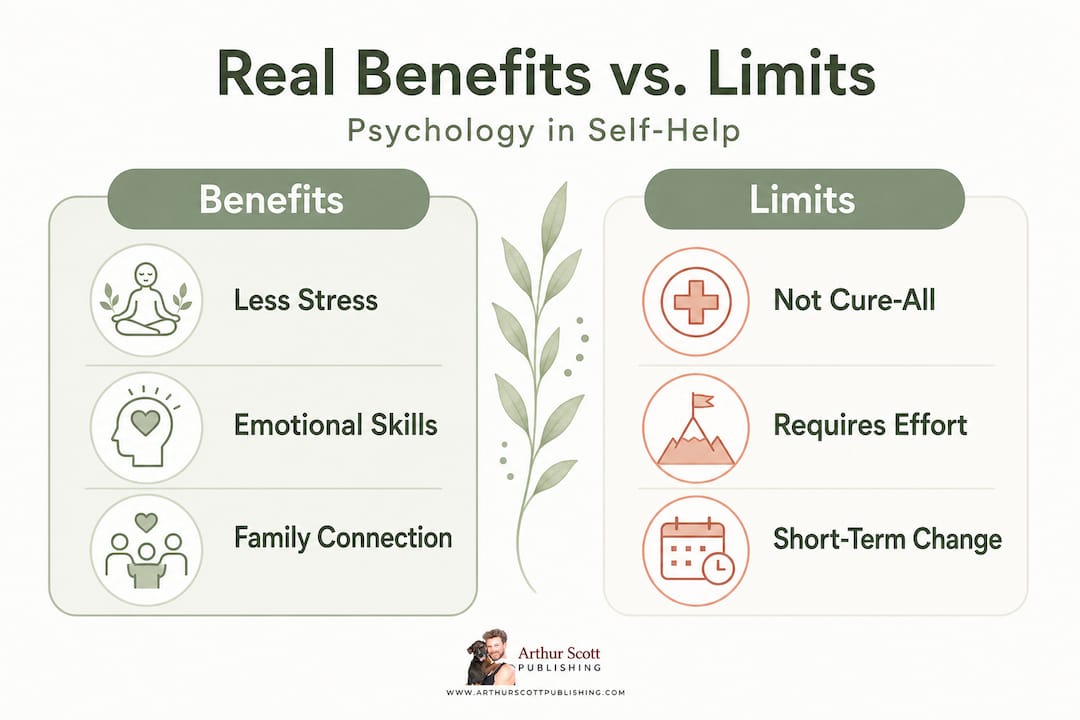
Self-help through psychology works, but within boundaries. Meta-analyses show small to moderate improvements in depression and anxiety from self-help, with benefits strongest when people actively practice the techniques rather than simply reading about them. That distinction matters more than most people realize.
On the other side, no association was found between self-help use and long-term personality change or sustained improvements in overall well-being. Self-help is most effective for mild to moderate distress, not as a replacement for professional care when symptoms are severe.
| Condition | Self-help effectiveness | Notes |
|---|---|---|
| Mild anxiety | Moderate benefit | Active practice required |
| Mild depression | Small to moderate benefit | CBT-based tools most effective |
| Parenting stress | Moderate benefit | Self-compassion and ACT show promise |
| Severe depression | Low benefit alone | Professional support is essential |
| Personality change | Minimal to none | No strong evidence base |
What this means practically: If you're a parent managing everyday stress, emotional reactivity, or anxiety related to caregiving, psychology-based self-help can make a meaningful difference. If you're experiencing persistent, severe symptoms, empirically supported self-help should supplement, not replace, professional therapy.
Pro Tip: Track your engagement with self-help methods, not just your feelings about them. Log which exercises you actually completed each week. Research shows that effort and consistency predict outcomes far better than the quality of the material you read.
The honest takeaway is that psychology-based self-help is a powerful tool in the right context. It won't rewire your personality or solve deep-rooted clinical issues on its own. But for growth, resilience, and healthier family dynamics? The evidence is genuinely encouraging.
Psychology-based tools and methods that work
So which evidence-based techniques actually work, especially for families? Here's what the best research and real-life experience show.
CBT self-help reduces depressive symptoms in parents, especially for those caring for children with special needs or chronic illness, and mobile app use shows particularly strong effects. That's not just a statistic. It means a parent who is stretched thin can access structured support on their phone between school pickups and work calls.
Here are the top four psychology-based tools, explained practically:
-
CBT worksheets: These guide you through identifying a triggering situation, the thought that followed, how it made you feel, and what a more balanced thought might look like. Example: Your child talks back during homework time. The automatic thought is "I'm failing as a parent." A CBT worksheet helps you test that thought, notice what evidence contradicts it, and replace it with something more accurate like "This is a hard moment, not a verdict on my parenting."
-
ACT exercises: One popular ACT technique is the "leaves on a stream" visualization, where you imagine placing each anxious thought on a leaf and watching it float past. This builds distance from thoughts without trying to suppress them. For caregivers who feel overwhelmed by racing thoughts at night, this tool is surprisingly effective.
-
Self-compassion practice: Self-compassion aids recovery from stress and helps break negative cycles in family life. This isn't about letting yourself off the hook; it's about responding to your own struggles with the same kindness you'd offer a good friend. Research by Dr. Kristin Neff shows this approach reduces emotional exhaustion in parents significantly.
-
Mood and behavior tracking apps: Apps that use CBT or mindfulness frameworks offer real-time exercises, symptom tracking, and journaling prompts. Short, focused sessions of around four hours of total practice have been shown to produce meaningful outcomes for mild symptoms.
| Tool | Time investment | Best for | Evidence strength |
|---|---|---|---|
| CBT worksheets | 15-20 min/session | Negative thoughts, anxiety | Strong |
| ACT visualization | 10-15 min/day | Overwhelm, rumination | Moderate-strong |
| Self-compassion practice | 5-10 min/day | Burnout, parenting stress | Moderate-strong |
| Tracking apps | Varies | Habit building, mood awareness | Moderate |
Take self-awareness steps seriously as part of this process. Knowing your own emotional triggers before practicing any of these tools makes them dramatically more effective. And when you build this into thriving family strategies, the whole household benefits, not just the caregiver.
Pro Tip: Start with one tool for 21 days before adding another. Stacking too many new habits at once is one of the most common reasons psychological self-help stalls out. Small, consistent wins build the neural pathways that make change stick.
Risks, blind spots, and when self-help isn't enough
With the tools and potential benefits in mind, it's just as important to know the boundaries and risks of self-help through psychology.
No tool is neutral. Used incorrectly, some self-help approaches can backfire. Self-help is best for mild distress or life transitions; it is not a substitute for therapy in severe cases. Real risks exist for people with very low self-esteem or those who struggle with reality-testing, where self-directed exercises can deepen confusion or shame rather than reduce it.
Here are the red flags that signal you need professional support, not a workbook:
- Symptoms persist or worsen after two to four weeks of consistent effort
- You're experiencing thoughts of self-harm or hopelessness
- Daily functioning at work, school, or home is significantly disrupted
- You have a history of an eating disorder, psychosis, or severe trauma
- Your child shows signs of serious mental health struggles that affect daily life
"Self-help is not a moral virtue. Choosing professional support when you need it is not a failure. It's an accurate read of what the situation actually requires."
The role of family support also matters here. A caregiver trying to manage everything alone, including their own mental health, is working against the science. Community and professional connection are not extras; they are part of what the research identifies as essential to lasting wellness.
Populations most at risk from unsupervised self-help include people with active eating disorders, where self-compassion exercises can sometimes reinforce avoidance behaviors, and individuals with very low self-esteem, who may misuse CBT worksheets to confirm negative beliefs rather than challenge them. Knowing your situation honestly is the first skill psychology asks of you.
How parents and families can leverage psychology for lasting growth
Knowing what works and the risks, let's drill down into how you can use these insights at home for real, sustainable growth.
Parenting self-help via psychology improves family dynamics through self-compassion, breaking negative cycles, and self-regulation. But applying this in real family life takes intentionality. Here's a practical framework:
-
Start a parenting journal: After a difficult moment with your child, write down what happened, what you felt, what you did, and what you wish you'd done instead. This debrief process is a core CBT technique. Over time it reveals your patterns with remarkable clarity.
-
Practice emotion coaching with your children: Developed by psychologist Dr. John Gottman, this approach teaches children to name and accept their emotions rather than suppress them. It begins with you modeling the same behavior. When you say "I'm feeling frustrated right now and I'm going to take three deep breaths," you're doing two things: regulating yourself and teaching your child how to do the same.
-
Set realistic, time-bound goals: Vague goals like "be a calmer parent" don't drive change. Psychology-based goal setting is specific: "I will practice a two-minute breathing exercise before responding to my child's tantrums, three times this week." The specificity creates accountability.
-
Use brief daily mindfulness: Even five minutes of intentional breathing or body-scan practice in the morning reduces cortisol, the primary stress hormone, before your day begins. This isn't a luxury. It's a physical preparation for the emotional demands of caregiving.
-
Debrief after family conflict: Rather than letting tension linger, designate a short window later in the day or evening to reflect together on what happened and what could go better. This models psychological reflection for children and reinforces family cohesion.
Pro Tip: Let your children see you learning. When you say "I've been practicing not reacting so fast when I'm frustrated," you normalize growth and show them that behavior can be changed on purpose. This single modeling habit supports your child's own emotional development more than most formal interventions.
The parental growth workflow matters here: consistency, reflection, and progressive skill-building are the actual ingredients. Reading about psychology helps you understand. Practicing it is what changes you.
Why most self-help fails, and how to get it right
Let's look honestly at why self-help so often underdelivers, and what you can do differently.
Here's the uncomfortable truth: most people who read psychology-based self-help don't apply it. They highlight passages, feel understood, and move on. That feels productive. It isn't. Understanding a CBT thought record and completing one are entirely different cognitive and behavioral acts. The first is passive; the second is where change happens.
The other common failure mode is inconsistency. Growth through psychological methods isn't dramatic. It's quiet and cumulative. A parent who practices self-compassion for seven days won't feel transformed. One who practices for six months, tracking small wins and setbacks along the way, will likely look back and barely recognize their old reactive patterns.
Tracking is the secret most self-help programs undervalue. When you log not just what you did but what you noticed, where you slipped, and what helped you recover, you build genuine self-knowledge. That knowledge is the raw material of lasting change strategies. Without it, you're working from memory and optimism, two notoriously unreliable guides.
For families specifically, the goal isn't perfection. It's creating a home environment where psychological growth is an ongoing, visible practice. Children don't need to see you succeed every time. They need to see you try, reflect, and try again. That pattern is what raises emotionally resilient kids.
Ready to turn insights into action for your family?
If you're ready to move from learning to lasting change, here are proven next steps.
Understanding the science behind self-help is a powerful starting point, but the real work begins with the resources you choose and how consistently you use them. Dr. Arthur Scott's platform offers practical, psychology-informed guides built specifically for families navigating growth, stress, and empowerment.
Whether you're a parent looking to strengthen your family's emotional foundation or a caregiver managing your own wellbeing alongside others', two resources are especially worth exploring. The life skills for families guide offers a structured journey through the skills that make families genuinely resilient. For those navigating the overlapping roles of parent and grandparent, the parenting and legacy guide offers deeply practical wisdom grounded in real experience. Both are available as free e-books, designed to be used actively, not just read once and shelved.
Frequently asked questions
How does CBT differ from traditional self-help methods?
CBT provides structured activities and reflection showing evidence for improvements in depression and anxiety, while traditional self-help typically relies on motivational content without structured skill-building exercises.
Is self-help enough for managing severe depression or anxiety?
No. Self-help works best for mild distress and life transitions; severe depression or anxiety requires professional therapeutic support to address root causes safely.
What are the safest ways to use psychological self-help methods?
Stick to evidence-based techniques, practice regularly, and consult a professional if symptoms persist or worsen. Effective self-help requires engagement, accountability, and consistent reflection, not just reading.
Can parents use self-help psychology to improve family relationships?
Yes. Evidence shows that self-compassion and self-regulation skills developed through psychology-based self-help significantly support healthier family dynamics and break negative interaction cycles.