
Personal growth is not about becoming a perfect version of yourself. A lot of people carry that belief without realizing it, and it quietly causes them to quit the moment things feel hard. Personal growth is an ongoing process of improving self-awareness, emotional well-being, skills, and mindset, and it never really stops. This article walks you through the psychology behind real growth, the frameworks researchers have actually tested, and the practical strategies that stick for parents, educators, and caregivers who want lasting change without the burnout.
Table of Contents
- Understanding personal growth: More than self-improvement
- Scientific frameworks: Self-determination theory (SDT) and personal growth-and-personal-growth)
- Real-world strategies: How behavior change supports personal growth
- Reflection practices: Journaling and CBT for self-awareness
- The uncomfortable truth most guides miss about personal growth
- Next steps: Connect your family or classroom with practical support
- Frequently asked questions
Key Takeaways
| Point | Details |
|---|---|
| Personal growth is lifelong | Growth is an ongoing process focused on self-awareness and emotional wellness, not a single achievement. |
| Evidence guides actions | Science-backed frameworks like SDT help shape more sustainable personal growth strategies. |
| Incremental change wins | Behavior changes are most effective when goals are broken down and progress is made one step at a time. |
| Reflection fuels insight | Journaling and CBT practices support deeper self-awareness and long-term growth. |
| Support systems matter | Accountability and community raise the chances of lasting change in families and classrooms. |
Understanding personal growth: More than self-improvement
Here is where the confusion usually starts. Most people use "personal growth" and "self-improvement" as if they mean the same thing. They do not. Self-improvement is often about a specific outcome, a better body, a higher salary, a new skill. Personal growth is something broader and more honest. It asks not just what you are doing, but who you are becoming.
Learning from experience and developing emotional self-knowledge over time is at the core of personal growth, not achieving perfection in a single outcome. That reframing matters enormously. It means every stumble, every rough parenting moment, every class that did not land the way you hoped, is actually data. It is part of the process, not proof that you are failing at it.
Personal growth, understood this way, rests on several key foundations:
- Self-awareness: Recognizing your patterns, emotional triggers, and habitual responses
- Emotional well-being: Developing the capacity to sit with difficult feelings and move through them
- Skill development: Growing competencies that genuinely serve your life, not just your resume
- Mindset evolution: Shifting from fixed thinking to a more flexible, curious orientation
"Growth is not an event. It is a practice. The people who change most profoundly are not those who try hardest once, but those who return to the work consistently."
For parents, this shift in thinking is especially important. When your child sees you modeling curiosity over certainty, they internalize the same orientation. For educators, understanding that emotional learning runs underneath academic performance changes what you pay attention to in the classroom. This self-discovery guide from Arthur Scott Publishing explores this intersection in much more depth, and it is worth spending time with if you are working in a family or caregiving context.
The psychological case for building self-awareness as a foundation, rather than chasing outcomes, is strong. People who develop emotional self-knowledge tend to make more aligned decisions, experience fewer relationship conflicts, and recover from setbacks faster. That is not a coincidence. It reflects what the research consistently shows: inner clarity precedes outer change.
Scientific frameworks: Self-determination theory (SDT) and personal growth
If you want to understand why some growth efforts stick and others evaporate after two weeks, self-determination theory (SDT) gives you one of the clearest answers available in psychological research today. SDT explains motivation and well-being through three core psychological needs: autonomy, competence, and relatedness.
Let's break those down plainly:
- Autonomy means feeling like you are the author of your own actions. You do things because they genuinely matter to you, not because someone is watching or pressuring you.
- Competence means feeling effective. When you have the skills and the challenges are the right size, you feel capable and motivated to keep going.
- Relatedness means feeling connected to others who care about you and whom you care about. Growth does not happen well in isolation.
When all three needs are met, psychological well-being rises noticeably. When even one is chronically unmet, motivation drops, stress rises, and people often abandon their goals entirely. This is why so many well-intentioned self-improvement plans collapse. They are heavy on external pressure and light on genuine choice.
| SDT need | What blocks it | Mental wellness impact when met |
|---|---|---|
| Autonomy | Coercion, rigid rules, external pressure | Higher motivation, reduced anxiety |
| Competence | Unrealistic goals, lack of feedback | Increased confidence, sustained effort |
| Relatedness | Isolation, unsupportive environments | Lower depression risk, better resilience |
For families and classrooms, this table tells a story. Children and adults alike need to feel that their choices matter, that they are growing in real skills, and that they belong somewhere. When all three are in place, growth becomes almost self-sustaining.
Understanding practical self-awareness steps through the SDT lens means asking yourself regularly: do I feel in control of this goal, or does it feel like something I have to do? That one question alone can reveal a lot about why your energy is high or low on any given day.
Pro Tip: Start each week by picking one small action that feels genuinely chosen, not obligated. Maybe it is a ten-minute walk, a page of reading, or a single conversation you have been putting off. That act of self-chosen movement builds the autonomy muscle over time. Feedback for growth also plays a critical role here. Seeking honest input from people you trust strengthens your competence need and accelerates learning.
Real-world strategies: How behavior change supports personal growth
Theory is only useful when it connects to your actual Tuesday morning. So let's get practical. Evidence-backed personal growth practices consistently point to a few core mechanisms: setting realistic goals, making one change at a time, and building accountability and support structures around yourself.
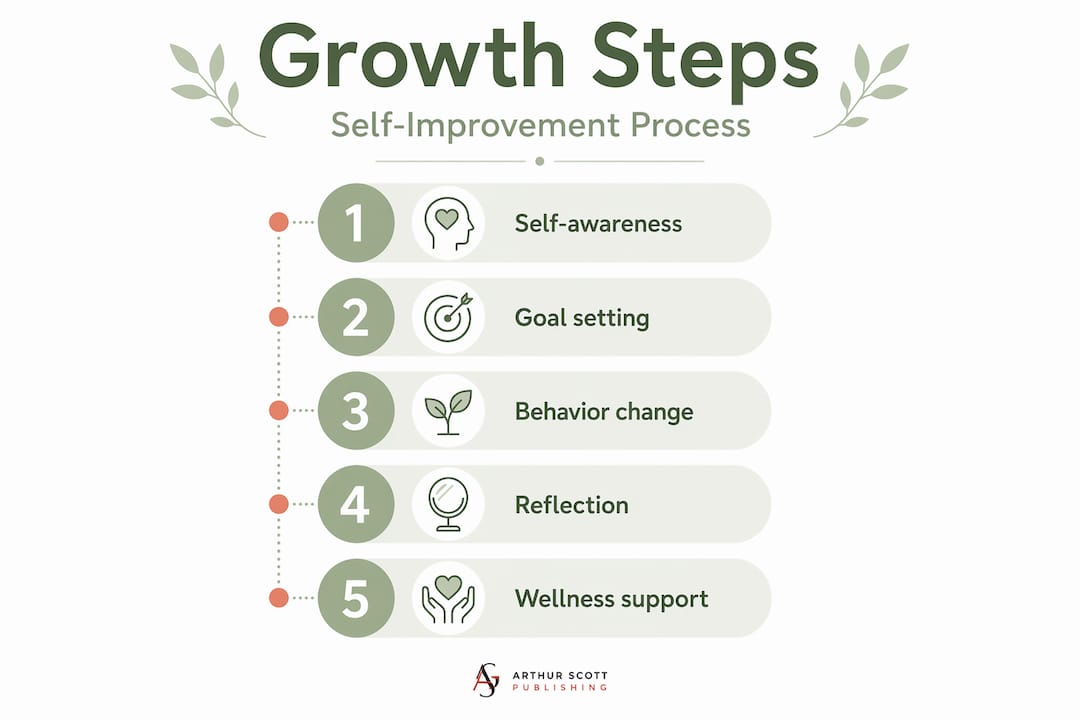
The instinct for most people is to overhaul everything at once. New diet, new routine, new attitude, new boundaries, all starting Monday. That approach feels motivating for about five days and then it collapses under the weight of its own ambition. The research is clear and consistent on this: incremental change wins over time.
Here is a simple step-by-step approach that actually works:
- Identify one specific area where you want to grow. Not a category, a specific behavior. Not "be a better parent" but "respond calmly when my child melts down before school."
- Set a realistic, measurable goal for that behavior. How often? In what situations? What does success look like this week, not this year?
- Remove friction from the start. Make the new behavior easier to do than not to do. Set out the journal the night before. Put the book on your pillow. Change your environment before you try to change your willpower.
- Build in accountability. Tell someone, track it somewhere, or check in with yourself at the end of each day with one honest question: did I do the thing or not?
- Review and adjust weekly. Growth is not a straight line. Weekly check-ins let you catch what is not working before you feel demoralized.
| Approach | Success rate over 3 months | Burnout risk | Flexibility |
|---|---|---|---|
| All-at-once change | Low | Very high | Very low |
| Incremental change | High | Low | High |
| No structure | Unpredictable | Moderate | High |
Accountability is one of the most underused tools in personal growth, especially for caregivers who spend most of their energy holding others accountable. These effective growth strategies show you exactly how to build a sustainable approach rather than a dramatic one.
Pro Tip: You do not need a formal coach or therapist to build accountability, though both are valuable. A trusted friend who asks you one honest question once a week can make a remarkable difference. If you are a parent trying to grow alongside your children, consider creating a family growth action plan so growth becomes a shared, visible commitment in your home, not just a private struggle.
Reflection practices: Journaling and CBT for self-awareness
Some of the most powerful personal growth work does not happen in a gym or a seminar. It happens in a quiet notebook. CBT thought records are one of the most well-studied structured reflection tools available, and they are accessible to almost anyone willing to spend ten minutes a day writing.

Cognitive-behavioral journaling, which draws from cognitive-behavioral therapy (CBT), is the practice of writing down your thoughts, identifying patterns, challenging distorted thinking, and replacing unhelpful beliefs with more accurate ones. It is not about writing how you feel. It is about examining why you feel it and whether the thoughts driving those feelings are actually true.
For parents and educators especially, this practice is powerful. When you write down "I snapped at my kid because I was overwhelmed," you can then ask: what thought was present before I snapped? Was it "I can't handle this"? And is that thought fully accurate, or is it a catastrophic version of a real but manageable situation? That kind of reflection builds emotional intelligence faster than most people expect.
"Structured reflection changes the relationship between you and your own thinking. You stop being ruled by thoughts you never examine."
Here are some journaling prompts that work well for personal growth, especially in family and caregiving contexts:
- What did I do well today, and what made it possible?
- What triggered my biggest emotional reaction this week, and what thought was underneath it?
- What am I avoiding, and what belief is keeping me stuck?
- What would I tell a close friend who was struggling with what I am struggling with?
- What is one small thing I could do differently tomorrow?
The beauty of these prompts is that they are not heavy or clinical. They are just honest questions. Personal growth planning that incorporates regular reflection like this tends to produce much more durable results than action plans alone. And when you combine reflection with community support for growth, you create the full loop: internal insight connected to external encouragement.
The uncomfortable truth most guides miss about personal growth
Most personal growth content is secretly about success. The language is warm and inclusive, but the underlying message is: fix yourself, achieve things, become better. That framing is not neutral. It carries a quiet implication that who you are right now is not quite enough, and that growth is what happens when you finally get it together.
That belief causes real harm, especially for parents under pressure, educators stretched thin, and caregivers who give so much they have almost nothing left for themselves.
Here is what the research and genuine experience both show: growth often happens most in moments of failure, not success. The relationship rupture you repair teaches you more about yourself than ten smooth interactions. The parenting moment you handled badly, reflected on honestly, and apologized for, that is not a failure. That is actually some of the deepest developmental work available to you.
The other thing most guides skip is the nonlinear nature of genuine progress. You will grow steadily for a while and then plateau. You will make a breakthrough in one area and regress in another. You will have weeks where the journaling does not happen, the patience runs thin, and the goals feel distant. That is not a sign you have lost your way. It is just what growth actually looks like in a real life with real demands.
Embracing that truth, rather than fighting it, is where family and educational contexts become especially valuable. When children see adults model imperfection alongside accountability, they learn that growth is safe. That it does not require pretending. Explore the real benefits of self-improvement when it is grounded in honesty rather than performance, and you will find a very different kind of motivation waiting for you.
Next steps: Connect your family or classroom with practical support
Knowing the psychology is one thing. Having tools, resources, and a community around you makes it sustainable.
Arthur Scott Publishing offers a growing library of free e-books, audio resources, and practical guides built specifically for parents, educators, and caregivers navigating personal growth in real life. Whether you are looking for parenting support during a challenging season, or exploring Dr. Scott's broader personal growth resources that blend psychology with lived experience, there is something here for where you are right now. You can also explore the full scope of family empowerment programs available through the platform. These are not abstract ideas. They are practical tools designed to meet you in the middle of your actual life.
Frequently asked questions
How is personal growth different from self-improvement?
Personal growth focuses on ongoing emotional learning and self-knowledge over time, while self-improvement typically aims at achieving specific outcomes or milestones. Growth is a process; improvement is often a destination.
What are the three key needs in self-determination theory?
SDT identifies three needs: autonomy, the freedom to act from genuine choice; competence, the feeling of being effective; and relatedness, meaningful connection with others. All three are essential for lasting well-being.
What is a simple starting point for personal growth?
Pick one specific behavior to change, set a realistic and measurable goal around it, and build accountability by telling someone or tracking your progress daily. Starting small is not settling. It is how sustainable change actually works.
How does journaling enhance personal growth?
CBT-based journaling helps you identify the thoughts driving your emotional reactions, challenge the ones that are not accurate, and develop greater self-awareness over time. Even ten minutes a day can create meaningful insight within a few weeks.