
Most people assume self-awareness means thinking deeply about who you are. Sit quietly, reflect on your choices, maybe journal for a few minutes, and you're done. But that picture leaves out something essential. Emerging research shows that real self-awareness involves actively observing your inner experience with attention and without judgment, and this process drives measurable changes in emotion regulation, mental flexibility, and long-term behavior. The difference between shallow self-reflection and true self-awareness is exactly what separates people who talk about growth from those who actually experience it.
Table of Contents
- What is self-awareness and why does it matter?
- The science behind self-awareness: Growth mechanisms explained
- Self-awareness pitfalls: When does it backfire?
- Practical self-awareness exercises for growth
- Our perspective: The uncomfortable truth about self-awareness for growth
- Next steps: Empower your growth journey
- Frequently asked questions
Key Takeaways
| Point | Details |
|---|---|
| Not all self-awareness is helpful | Self-awareness is only growth-supportive when it avoids ego-threatening and defensive biases. |
| Structured practice drives lasting change | Regular, feedback-rich self-awareness exercises support transformation better than one-off interventions. |
| Practical exercises boost meaning | Nonjudgmental daily awareness activities are linked to increased meaning in life and improved emotional regulation. |
| State vs. trait awareness matters | Momentary mindfulness doesn't always translate to durable growth; connecting state awareness to traits is key. |
| Empirical effects are modest | Awareness interventions generally achieve modest to medium outcomes, calling for realistic expectations. |
What is self-awareness and why does it matter?
Self-awareness is not the same as thinking about yourself. You can spend hours mentally replaying a difficult conversation and never gain an ounce of genuine insight. True self-awareness means noticing what is happening inside you, your thoughts, emotions, physical sensations, and behavioral impulses, without immediately reacting to or judging those experiences. Think of it as being the observer of your own mind rather than the person swept away by it.
Researchers break this down into three key components that work together:
- Attentional regulation: The ability to direct and hold your focus on your present inner experience, rather than drifting into automatic thought patterns
- Emotional awareness: Accurately recognizing and naming feelings as they arise, which reduces the grip those feelings have over your decisions
- Behavioral integration: Using what you notice internally to guide how you act, closing the gap between intention and behavior
When all three work together, the benefits are real and backed by solid evidence. Self-awareness supports growth through improved emotion regulation, reduced rumination (the habit of replaying negative thoughts on a loop), and increased cognitive flexibility, which is your brain's ability to consider new perspectives and shift strategies when the old ones aren't working.
Key mechanism: Attentional regulation paired with non-reactive observation is what allows people to disengage from habitual reactions. Without this specific combination, self-reflection can actually reinforce old patterns rather than break them.
This is why building self-awareness requires more than reading about yourself or casually journaling. It requires repeated, intentional practice of noticing without judgment. Once you understand what it truly involves, the path to growth becomes a lot clearer.
The science behind self-awareness: Growth mechanisms explained
Understanding why self-awareness drives growth means looking at the mechanisms underneath it. Scientists have identified several distinct pathways through which awareness creates change, and knowing these mechanisms helps you use your practice more strategically.

Here is a clear summary of the core mindfulness-based mechanisms and what they produce:
| Mechanism | What it involves | Growth outcome |
|---|---|---|
| Attentional regulation | Redirecting focus to present experience | Reduced reactivity, stronger impulse control |
| Cognitive restructuring | Observing thoughts without treating them as facts | Less catastrophizing, greater mental flexibility |
| Behavioral integration | Applying inner insight to real choices | More consistent, values-aligned behavior |
| Interoceptive awareness | Noticing body-based signals (tension, fatigue) | Faster recognition of emotional states |
| Non-judgmental stance | Observing experience with curiosity, not criticism | Reduced self-criticism, higher self-compassion |
The numbered models below reflect how scientists actually categorize self-awareness for research purposes:
- State awareness: Heightened noticing during a specific practice session or mindfulness exercise. This is what happens in the moment.
- Trait awareness: The stable, lasting tendency to notice your inner experience across many different situations over time.
- Interoceptive benchmarking: Using physical body signals as real-time data points about your emotional and mental state.
Here is where the science gets genuinely surprising. State mindfulness during interventions does not automatically predict lasting trait change. In other words, feeling very aware during a meditation class does not guarantee you will carry that awareness into everyday life. Growth requires bridging the gap between state and trait, which means deliberate repetition and structured practice over time, not just occasional moments of insight.
Additionally, empirical benchmarks for internal awareness show modest to medium effects on related processes like interoceptive awareness. Large, dramatic transformations from a single retreat or practice are more myth than reality. Meaningful growth happens incrementally, through accumulated small shifts.
Pro Tip: Connect your state awareness sessions (like a morning breathing exercise) to specific real-life situations where you want to respond differently. Naming the target behavior in advance, such as "I want to notice when I get defensive in feedback conversations," bridges the gap between state and trait change more effectively than open-ended practice.
Explore effective improvement methods that support this kind of structured, incremental approach, especially for families navigating growth together. And if you're building a broader plan, lasting change steps provide a solid framework for turning awareness into sustained transformation.
Self-awareness pitfalls: When does it backfire?
Self-awareness has a shadow side that most personal development content simply ignores. Under certain conditions, increased self-focus can make things worse, not better. Knowing when awareness becomes a trap is just as important as knowing how to develop it.
The critical variable is the focus of your awareness. Growth-focused self-awareness turns inward with curiosity and openness. Ego-threatening self-awareness turns inward with fear, judgment, or defensiveness. These two modes look similar on the surface but produce radically different outcomes.
| Feature | Growth-focused self-awareness | Ego-threatening self-awareness |
|---|---|---|
| Primary motivation | Learning and improvement | Protecting self-image |
| Emotional tone | Curious, open, grounded | Anxious, defensive, reactive |
| Response to mistakes | Accountability and adjustment | Denial or self-attack |
| Effect on knowledge | Integrative, nuanced understanding | Fragmented, biased reasoning |
| Long-term outcome | Greater flexibility and resilience | Moral disengagement, avoidance |
The maladaptive patterns that emerge from ego-threatening awareness include:
- Rumination: Replaying failures or criticisms in a loop without gaining new insight, which amplifies anxiety and depression
- Moral disengagement: Rationalizing poor choices or behaviors to protect self-concept, rather than taking accountability
- Defensive interpretation: Filtering feedback through a bias that preserves your existing self-image, even when that image is inaccurate
- Overcorrection: Becoming so hyperaware of your flaws that you freeze and avoid situations where you might fail
Research finding: Self-awareness becomes maladaptive when it targets ego-threatening or defensive interpretations, leading to lower integrative knowledge and increased moral disengagement. The very tool meant to help you grow can reinforce the patterns that hold you back.
This is why the stance of your awareness matters more than the amount of your awareness. A person who spends three hours a day in anxious self-scrutiny will often experience worse mental health than someone who practices 15 minutes of nonjudgmental observation. Quantity without quality is counterproductive.
Understanding feedback and self-improvement is especially relevant here, since external feedback helps you calibrate whether your self-awareness is growth-focused or ego-protective. Honest feedback from trusted sources interrupts the echo chamber of self-focused rumination.
Practical self-awareness exercises for growth
Knowing the theory matters, but daily practice is where growth actually happens. The following exercises are grounded in evidence from wellness and mindfulness research. They are designed to build the growth-focused, nonjudgmental awareness that drives real change, not the anxious self-scrutiny that backfires.
Wellness-based self-awareness practices consistently emphasize nonjudgmental noticing, emotion and physical awareness, and small, consistent increments over time. Here are five exercises you can start immediately:
-
Mindful breathing (5 minutes daily): Sit comfortably and focus entirely on your breath. When your mind wanders, gently bring attention back without criticizing yourself. This trains attentional regulation, the foundational skill for all other awareness work.
-
Daily emotion check-ins: Three times per day, pause for 60 seconds and ask, "What am I feeling right now, and where do I feel it in my body?" Name the emotion specifically. "Uncomfortable" is too vague. "Frustrated and slightly anxious" is far more useful. Specificity builds emotional literacy.
-
Nonjudgmental body scan: Before bed, slowly scan from your feet to your head, noticing tension, warmth, or discomfort without trying to fix anything. This builds interoceptive awareness, your ability to read body-based emotional signals before they become overwhelming reactions.
-
Structured journaling: Write for 10 minutes on a single question each day. Good prompts include: "Where did I act from my values today?" or "What triggered me, and what need was underneath that reaction?" Journaling creates the reflective distance that separates observation from rumination.
-
Soliciting structured feedback: Once a week, ask one trusted person (a partner, colleague, or friend) for specific feedback on one behavior. Keep it focused: "Did I seem present during our conversation yesterday?" This grounds your self-image in observable reality rather than internal assumption.
Mindfulness practices are associated with better self-relational outcomes, including reduced self-objectification and increased meaning in life. When you consistently notice your experience with curiosity rather than judgment, you naturally begin to feel more connected to what matters to you. That sense of meaning becomes a powerful motivator for sustained growth.
Pro Tip: Parents and educators should think of these exercises as modeling opportunities. When children see adults practice nonjudgmental self-noticing openly, they learn that emotions are data, not threats. Even a simple "I notice I'm feeling frustrated right now, so I'm going to take a breath" models the entire self-awareness sequence in real time.
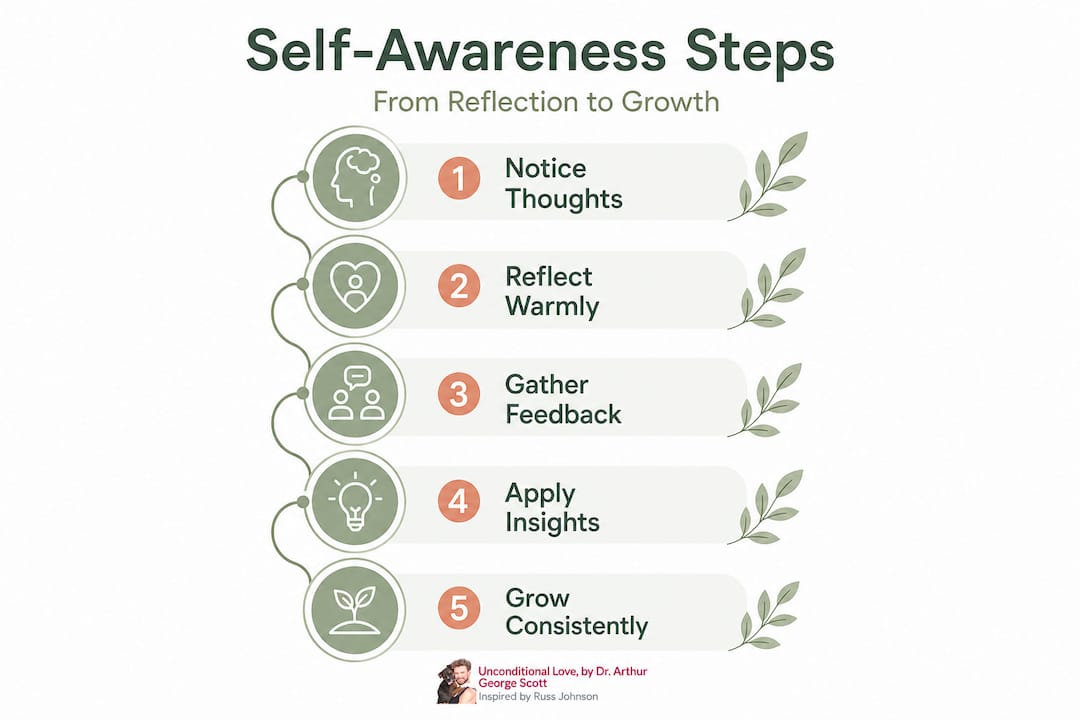
For families looking to apply these practices together, the self-discovery guide offers structured approaches tailored to family dynamics. You can also build these practices into a family growth action plan to create shared accountability and shared progress.
Our perspective: The uncomfortable truth about self-awareness for growth
Here is something you will rarely hear in mainstream personal development content: most self-awareness advice is structurally incomplete. It tells you to notice your thoughts and feelings, which is good advice as far as it goes. But it stops there. And stopping there is exactly where most people get stuck.
Growth-supportive self-awareness requires helping people notice internal experiences while maintaining a non-judgmental stance and integrating that noticing into everyday behavior. Interventions that only increase state awareness are insufficient for long-term trait change. The research is clear on this point.
What this means practically: A weekend workshop on mindfulness, a single coaching session focused on "knowing yourself better," or even a month of solo journaling without feedback will not produce the lasting behavioral change most people are hoping for. Awareness without integration is just information. Integration requires repetition, structured reflection, and honest feedback loops.
The contrarian truth we have come to understand through years of working in behavioral health and personal development is this: self-awareness is not a destination. It is a practice architecture. You need regular exposure to your inner experience, structured ways to make sense of what you notice, and trusted people who will tell you when your self-perception is drifting from reality. Remove any one of those three elements, and growth slows dramatically.
Pro Tip: Build a simple feedback loop into your self-awareness practice. After two weeks of daily emotion check-ins or journaling, share your observations with someone you trust and ask whether what you're noticing matches what they observe in you. This is the fastest way to close the gap between self-perception and reality.
This is especially important for parents modeling self-awareness for children and educators building awareness into their classroom culture. The environment you create around self-awareness matters as much as the practice itself. A safe, non-shaming environment where awareness is welcomed, not weaponized, makes the entire process effective rather than threatening. The growth workflow for parents offers a step-by-step structure for creating exactly that kind of environment at home.
Next steps: Empower your growth journey
If this article sparked something in you, whether it's clarity about what self-awareness actually involves, recognition of a pattern you've been stuck in, or new ideas for your daily practice, the next step is to keep building. Self-awareness does not grow from a single article. It grows from consistent engagement with the right tools, resources, and community over time.

At Arthur Scott Publishing, Dr. Arthur Scott's free e-books and audio resources are designed specifically for individuals, parents, and educators who want to move from awareness to genuine transformation. Whether you are working on your own behavioral patterns or trying to build a growth-oriented family environment, the resources available through Arthur Scott Publishing connect psychological insight with practical, everyday application. For parents and grandparents especially, the parent and grandparent legacy guide provides a deeply personal roadmap for modeling the kind of self-aware, values-driven life your family deserves to inherit.
Frequently asked questions
Can self-awareness really prevent anxiety and depression?
Evidence shows self-awareness reduces rumination, a core mechanism in both anxiety and depression, but it is most protective when paired with attentional regulation and behavioral integration, not practiced in isolation.
How often should mindfulness exercises be practiced?
Brief daily practice with small, consistent increments is far more effective for lasting integration than occasional long sessions. Even five to ten minutes daily builds meaningful habit.
Does self-awareness help children and teens grow?
Yes, growth-supportive self-awareness helps young people notice internal states without judgment, which supports better emotion regulation, stronger behavioral choices, and greater resilience over time.
Can self-awareness ever make things worse?
Absolutely. Ego-threatening self-awareness focused on protecting self-image rather than learning leads to poorer self-regulation, increased defensiveness, and even moral disengagement in both adults and adolescents.
What are the measurable effects of internal awareness programs?
Internal awareness programs show modest to medium effects on processes like interoceptive awareness, meaningful and real progress, but not the dramatic overnight transformation that popular culture often promises.