
Most people think personal development means reading more books, listening to podcasts, or repeating positive affirmations in the mirror. That mindset leads to a frustrating cycle: you consume, feel inspired, and then nothing actually changes. Real growth happens differently. It's built on small, consistent actions supported by mental wellness habits that reinforce who you're becoming. Whether you're a parent trying to model healthy behavior, an educator shaping young minds, or a caregiver pouring yourself into others, this guide will cut through the noise and give you a practical, grounded path forward.
Table of Contents
- What are personal development basics?
- Mental wellness: The foundation for growth
- Skill-building over wishful thinking
- From insight to action: Avoiding the personal development trap
- What most personal development guides miss
- Resources for your family's personal growth journey
- Frequently asked questions
Key Takeaways
| Point | Details |
|---|---|
| Focus on core skills | Self-awareness, empathy, and decision-making are the building blocks of personal growth. |
| Wellness fuels growth | Sleep, nutrition, and support systems are essential foundations for development. |
| Action beats intention | Small, consistent steps drive change—not just reading or planning. |
| Integrate into daily life | Skill-building works best when woven into regular routines at home and school. |
What are personal development basics?
With the confusion around what personal development is, let's clarify what actually forms the foundation for lasting growth.
"Personal development basics" is not a productivity system or a self-help genre. At its core, personal development is the ongoing process of building practical skills that improve how you understand yourself, manage your emotions, relate to others, and make decisions. These are learnable skills, not personality traits you either have or don't.
Here's where many people go wrong. They assume growth comes from inspiration alone. You read something powerful, feel motivated for a few days, and then life takes over. This is not a willpower problem. It's a structure problem. Growth without skill-building is like building a house on sand. It looks good at first, but it won't hold.
Research in social-emotional learning (SEL) shows that skill-building strategies like emotion management, empathy, healthy relationships, and good decision-making need to be woven into everyday culture, not treated as isolated add-ons. This applies at home and school just as much as in formal programs.
Common myths vs. evidence-based basics
| Myth | Evidence-based reality |
|---|---|
| Growth = positive thinking | Growth = consistent skill practice |
| Personal development is for adults | Development starts in childhood and continues throughout life |
| Reading more creates change | Acting on what you read creates change |
| Big breakthroughs drive progress | Small, daily habits move the needle |
| You need a lot of time | Minutes a day, applied consistently, is enough |
The good news is that practical self-awareness steps are something anyone can begin practicing today, at any age or stage of life. You don't need a therapist or a life coach to start. You need a realistic framework.
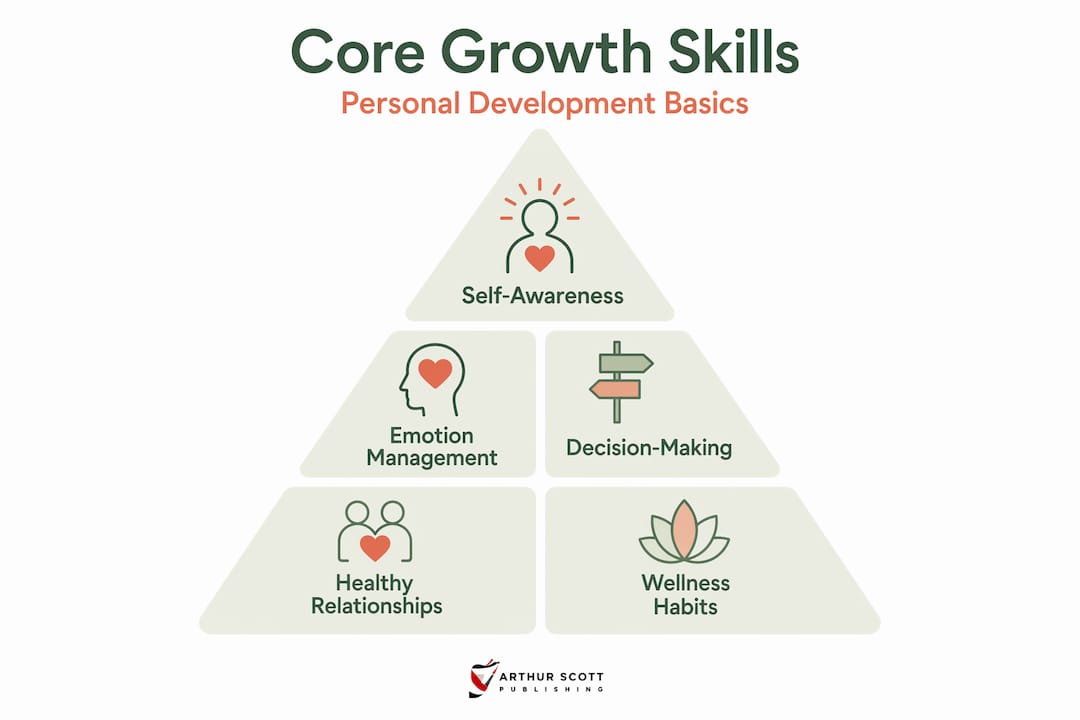
Here are the core elements that make up genuine personal development basics:
- Self-awareness: Knowing your emotional triggers, values, strengths, and blind spots
- Emotion management: Recognizing feelings before they drive your decisions
- Healthy relationship skills: Communicating clearly, setting boundaries, and practicing empathy
- Decision-making: Pausing before reacting and evaluating options with clarity
- Daily integration: Embedding these skills into regular routines rather than scheduling them as special events
"True personal development is not something you do when you have extra time. It's how you show up when life is hard, unpredictable, and full of competing demands."
When educators, parents, and caregivers integrate these elements into their daily lives, they model the exact behaviors children and communities need to thrive. Exploring personal growth strategies that are grounded in real life, not theory, makes all the difference.
Mental wellness: The foundation for growth
Knowing what to focus on, now see why health fundamentals are the bedrock of real growth, for you and those you support.
You cannot build strong personal development skills on a depleted foundation. This is the part most self-improvement content completely skips over. Before you can work on empathy or decision-making or any higher-level skill, your body and nervous system need to be supported.
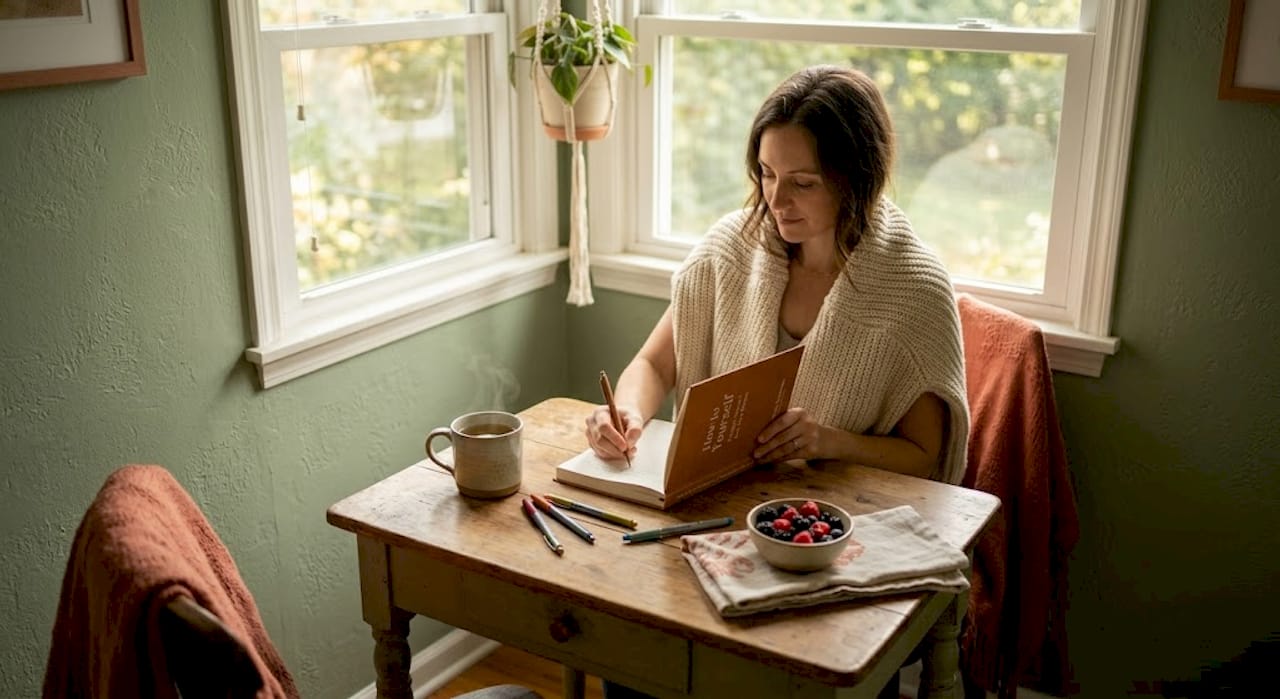
Research consistently shows that caregiver mental wellness depends on five enabling conditions: sleep, nutrition, social connection, relaxation, and access to professional guidance when needed. These are not luxuries. They are prerequisites.
Why these five conditions matter so much
| Enabling condition | Impact on personal growth |
|---|---|
| Sleep (7-9 hours for adults) | Regulates mood, memory, and emotional control |
| Balanced nutrition | Supports brain function and stress resilience |
| Social connection | Reduces isolation and builds emotional safety |
| Regular relaxation | Lowers cortisol and creates space for reflection |
| Access to help | Prevents burnout and supports problem-solving |
When any of these is missing, your ability to practice self-awareness or manage emotions shrinks significantly. A parent running on four hours of sleep cannot be expected to model calm, thoughtful responses under pressure. A caregiver without social support cannot pour endlessly into others without eventually running dry.
Here is a practical framework for building these habits into your week:
- Protect your sleep. Set a consistent bedtime and limit screen use 30 minutes before bed, even on weekends.
- Eat with intention. Prioritize protein, whole foods, and regular meals rather than skipping food during busy days.
- Schedule connection. Put one real social interaction on your calendar each week, a walk, a coffee, a call.
- Build in quiet. Even five minutes of intentional stillness after a demanding task helps reset your nervous system.
- Know when to ask. Seeking support from a counselor, a mentor, or a trusted community is a sign of strength, not weakness.
Pro Tip: Make one wellness habit a family ritual rather than a solo effort. Eating dinner together without devices, for example, covers nutrition, social connection, and relaxation all at once. Small rituals like this become the scaffolding for growth.
Understanding family support and mental health is especially useful here. The family system either supports or undermines individual development. When adults in the home model healthy wellness habits, children internalize those patterns naturally.
Improving self-awareness for families as a unit, rather than just as individuals, creates a home environment where growth feels normal and expected.
Skill-building over wishful thinking
With wellness as the baseline, let's see why developing actionable skills is where change really happens.
Here is a hard truth: feeling motivated is not the same as growing. Motivation is a feeling. Skills are capacities. Feelings fade. Capacities, once built, stay with you.
The most impactful personal development work happens in ordinary moments. It's the pause before responding when you're frustrated. It's the decision to listen fully before offering your opinion. It's recognizing your emotional state before it colors your judgment. None of these require special equipment or extra time. They require consistent practice.
According to SEL research, the most effective approach weaves skill development into everyday environments rather than treating it as a special curriculum. The same principle applies at home and in your personal life.
Core skill categories to develop:
- Self-awareness: Journaling, regular check-ins on emotional state, reflecting on patterns in your reactions
- Empathy: Practicing perspective-taking during family disagreements, asking questions before assuming
- Relationship skills: Learning to express needs clearly, repairing conflict constructively
- Decision-making: Using a "pause and consider" habit before responding to stressful situations
- Emotional regulation: Using breath-based techniques, naming emotions aloud to reduce their intensity
"Skills grow through repetition in real contexts. A child who practices empathy at the dinner table is learning the same skill an adult practices in a workplace meeting."
This is why seeing real-life self-improvement benefits is not about grand transformations. It's about noticing that you handled a difficult conversation better than you would have six months ago. That's real progress.
Using a guide to self-discovery can also help you identify which skill areas need the most attention for your specific situation as a parent, educator, or caregiver.
Pro Tip: Pick one skill category per month. Focus on practicing it in at least one small, specific situation each day. At the end of the month, reflect on what shifted. Progress becomes visible when you narrow your focus rather than trying to improve everything at once.
From insight to action: Avoiding the personal development trap
With practical skills in mind, let's tackle the number one reason people stay stuck: learning without doing.
There is a specific trap that catches many thoughtful, well-meaning people. You read an article. You feel understood and inspired. You buy the book. You highlight passages. And then, nothing changes in your daily life. This is insight without implementation, and it's more common than most personal development content admits.
The trap works like this: consuming growth content feels productive. It triggers a sense of progress without requiring the discomfort of actual behavioral change. The brain gets a small reward from learning, and that reward can substitute for the larger reward of real growth.
The solution is not to stop learning. It's to design action into every learning experience.
A simple framework to move from insight to real change:
- Capture the insight. Write down the one key idea you took from something you read or heard.
- Translate it into a small action. Ask yourself: "What is one thing I can do differently today or this week based on this?"
- Set a specific time. Not "I'll try to do this sometime." Choose a specific context: "At dinner tonight, I will ask my child one open-ended question instead of jumping to advice."
- Do it. Keep the action small enough that you can't reasonably avoid it.
- Reflect briefly. After trying it, spend two minutes noting what you noticed. Did it feel awkward? Did anything shift?
- Repeat and adjust. Use what you learned to refine the next attempt.
Practical mini steps anyone can try this week:
- Spend three minutes each morning writing one sentence about how you're feeling and why
- During one conversation today, focus entirely on listening before responding
- After a conflict, ask yourself: "What was I feeling, and what did I need in that moment?"
- Share one thing you're working on with someone you trust
- Set a 10-minute timer and do nothing but breathe and sit quietly
Using a personal growth workflow for parents gives structure to this process specifically for those managing the demands of family life. And if you want a more complete structure, following a lasting growth plan built around consistent action and reflection is one of the most reliable paths forward.
What most personal development guides miss
Before we wrap up, here's a hard-earned lesson that reframes how to approach growth authentically.
Most personal development guides miss something foundational. They treat growth as primarily a knowledge problem. If you just understand the right concepts, change will follow. That's not accurate, and for many people, it becomes quietly discouraging.
Real change is a behavioral, relational, and biological process. It requires your nervous system to feel safe enough to try something new. It requires enough sleep, enough social support, and enough realistic self-compassion to tolerate imperfection along the way. The reason people burn out on self-improvement is not laziness. It's that the conditions for growth were never established to begin with.
Here is what I've seen over many years of working in psychology and education: the people who grow the most consistently are not the ones consuming the most content. They are the ones who have stabilized their wellness basics, identified two or three specific skills to develop, and built tiny repeated actions into their existing routines. No dramatic overhauls. No productivity systems with 14 steps. Just stable conditions, specific skills, and honest reflection.
Staying connected to current personal development trends can be useful for discovering new approaches, but the fundamentals haven't changed. You still need sleep. You still need community. You still need to act on what you learn.
Start smaller than you think you need to. Protect your wellness conditions first. Then pick one skill and practice it in the real moments of your actual life. That is where growth lives.
Resources for your family's personal growth journey
Ready to take the next step? If you're seeking practical resources for real-world growth, these can help.
At Arthur Scott Publishing, we believe growth should be accessible to every family, not just those with the time and budget for expensive programs. Dr. Arthur Scott's collection of free digital books and guides is designed specifically for parents, caregivers, educators, and anyone navigating the everyday challenges of personal and family life.
If you're raising children while managing your own growth, the parenting resource speaks directly to the realities of that demanding role. For those supporting multiple generations, the parenting and grandparenting guide addresses the beautifully complex experience of holding two roles at once. These resources are practical, grounded in behavioral health, and available to you right now. Growth is a journey worth supporting at every stage.
Frequently asked questions
What are the core basics of personal development?
The basics are self-awareness, emotion management, healthy relationships, decision-making, and wellness habits like sleep and nutrition, all of which are skill-building practices rather than one-time events.
How can I help my children start with personal development?
Encourage daily skill-building using simple steps at home, like reflecting on feelings together, practicing problem-solving during conflicts, and supporting consistent sleep and nutrition routines, since everyday skill development is far more effective than isolated lessons.
Why doesn't reading about personal growth always create change?
Without turning insight into action, growth stalls because insight without implementation creates the feeling of progress without the reality of it, and designing a small, time-limited action plan is the most reliable bridge between learning and change.
Which wellness habits should be prioritized for caregivers and families?
Focus first on regular sleep, balanced nutrition, relaxation, and social connection, since caregiver well-being depends on these five enabling conditions before any higher-level personal development work can take lasting hold.