
Most people treat music the way they treat wallpaper: pleasant, forgettable, and mostly invisible. It plays in the background while you cook, commute, or scroll through your phone. But research is reframing what music actually does inside your mind and body. Everyday music use can intentionally regulate emotional states, meaning the songs you choose are shaping your internal world whether you realize it or not. This guide breaks down the science, the practical steps, and the honest caveats for anyone ready to use music as a real tool for self-awareness and personal growth.
Table of Contents
- How music influences emotion and self-awareness
- Mechanisms: How music supports emotional regulation and growth
- Intentional music use: From passive listening to structured reflection
- Caveats and the individual fit: When music helps and when it can harm
- Applying music for personal growth: Practical frameworks and next steps
- What most people miss about music and personal growth
- Explore more on your personal growth journey
- Frequently asked questions
Key Takeaways
| Point | Details |
|---|---|
| Intentional listening matters | Choosing music to fit emotional goals enhances personal growth more than passive listening. |
| Reflection deepens self-awareness | Pairing music with structured journaling improves insight and empathy. |
| Personal fit is crucial | The best results come from music aligned with your preferences and readiness. |
| Not all music helps | Mismatched music can trigger negative emotions—always assess your response. |
| Frameworks guide safe growth | Following step-by-step practices maximizes benefits while reducing risks. |
How music influences emotion and self-awareness
Music emotion regulation, or MER, is the practice of intentionally selecting, listening to, or creating music to manage your emotional states. MER in daily life is something most people already do intuitively, but without awareness of the process or its power. The difference between accidental and intentional use is enormous when it comes to personal development.
Three core elements drive how music shapes your inner experience:
- Musical structure: Tempo, key, rhythm, and dynamics all trigger distinct physical and emotional responses in listeners.
- Emotional response: Your brain reads musical patterns as emotional signals, often bypassing conscious thought entirely.
- Regulatory outcomes: What you do with that emotional response determines whether the experience builds self-knowledge or just passes through you unnoticed.
Intentional listening means you choose music with a purpose in mind, whether that is calming down after a stressful meeting, processing grief, or energizing yourself before a challenge. Passive listening, by contrast, is ambient and reactive. Both have their place, but only intentional listening connects music to self-awareness and personal growth in a meaningful way.
When you start paying attention to your emotional reactions to specific songs, genres, or tempos, you are essentially building a map of your inner life. That map is the foundation of self-awareness.
"Music gives a soul to the universe, wings to the mind, flight to the imagination, and life to everything." — Often attributed to Plato, this quote captures what researchers are only now quantifying.
Pro Tip: Keep a simple music journal for one full day. Every time you put on music, write down what you chose, why you chose it, and how you felt afterward. Patterns will surprise you.
Mechanisms: How music supports emotional regulation and growth
Understanding that music affects your emotions is one thing. Understanding why it works gives you the power to use it more precisely.
Music-based interventions target emotion regulation through specific mechanisms, including rhythm-linked therapeutic functions and developmental emotion regulation. In other words, the beat of a song is not just aesthetic. It physically entrains your nervous system, meaning your heartbeat and breathing patterns begin to synchronize with the tempo you are listening to.
Here is how this process breaks down in practical terms:
- Tempo and arousal: Fast-paced, high-energy music elevates heart rate and cortisol, priming your body for action or heightened alertness.
- Slow rhythms and recovery: Slower tempos below 60 beats per minute can activate your parasympathetic nervous system, the part responsible for rest and digestion.
- Rhythmic predictability and safety: Regular, predictable rhythms signal safety to the brain, lowering anxiety and creating mental space for reflection.
- Melody and memory: Melodic phrases trigger episodic memories and the emotions tied to them, which is why certain songs instantly bring back vivid moments from your past.
- Lyrics and meaning-making: Songs with personal relevance activate language and meaning-processing centers in the brain, adding a cognitive layer to the emotional experience.
| Music element | Primary effect | Best used for |
|---|---|---|
| Fast tempo (120+ BPM) | Increased energy and alertness | Motivation, exercise, focus |
| Slow tempo (50-70 BPM) | Calming, nervous system regulation | Stress relief, sleep prep, reflection |
| Minor key | Emotional depth, introspection | Processing sadness or difficulty |
| Major key | Elevated mood, openness | Creativity, social connection |
| Repetitive rhythm | Grounding, focus | Anxiety reduction, meditation |
The key takeaway here is that structured listening, where you match your musical choices to your specific psychological need in that moment, produces far better results than hitting shuffle on a generic playlist. Random playlists can offer enjoyment, but they rarely build emotional intelligence or lasting self-knowledge.
Intentional music use: From passive listening to structured reflection
Science is clear that combining music with reflection produces the deepest personal growth. Linking music listening to structured reflection through journaling and metacognitive inquiry is a key mechanism for growth and even partially mediates the development of empathy. Metacognition simply means thinking about your own thinking, and music is a surprisingly efficient way to access it.

Here is how passive listening compares to reflective practice:
| Approach | Emotional impact | Self-awareness gain | Empathy development |
|---|---|---|---|
| Passive background listening | Low to moderate | Minimal | Unlikely |
| Intentional listening (no journaling) | Moderate | Moderate | Possible |
| Intentional listening + journaling | High | Significant | Likely |
| Guided group music reflection | High | Significant | Strong |
The numbers tell a clear story: adding even five minutes of written reflection after a focused listening session transforms the experience from entertainment to genuine self-development practice.
Here is how to run a simple reflective music session at home:
- Choose your intention. Ask yourself what emotional state you want to explore, release, or build before you press play.
- Select music that matches or gently challenges that state. If you are anxious, try music slightly calmer than your current mood rather than jarring silence or chaotic sound.
- Listen without multitasking. Give the music your full attention for at least 10 to 15 minutes. Close your eyes if that helps.
- Write immediately after. Jot down what emotions arose, what memories surfaced, and any insights about your current state of mind. These practical self-awareness steps can be done in under five minutes.
- Identify one insight to carry forward. What did this session reveal about your inner world that you can act on today?
Pro Tip: Create a simple journal template with three prompts: "What I felt during the music," "What memory or thought arose," and "What this tells me about where I am right now." Use it consistently for four weeks and compare your entries. The growth in self-discovery guidance will become tangible and measurable.
Caveats and the individual fit: When music helps and when it can harm
No growth tool works for everyone in every situation, and music is no exception. Honest self-awareness practice means knowing when to use a tool and when to put it down.
Music can backfire when it is mismatched to your preferences or needs, and not all music-based interventions are universally benign. This is worth taking seriously. Several specific risks deserve attention:
- The cheerful playlist fallacy: Forcing upbeat, positive music when you are deeply sad or grieving can feel invalidating and increase emotional suppression rather than regulation.
- Emotional flooding: Highly evocative music during a vulnerable state can trigger overwhelming feelings that you are not ready to process, particularly for people with trauma histories.
- Distraction versus reflection: Using music to avoid difficult emotions rather than process them creates a temporary comfort that delays growth.
- Social exclusion: Not everyone finds meaning or healing in music, and people who do not connect with musical experiences can feel marginalized in group music-based settings.
- Irritation and overstimulation: For some individuals, particularly those with sensory sensitivities, certain music is physiologically distressing rather than calming.
Music therapy research shows it can improve depressive symptoms, but benefits are uncertain due to study bias and context specificity. In plain terms, the research is promising but not conclusive, and what works in a structured clinical setting may not translate directly to self-directed practice at home.
The most important question to ask after any music session is this: Do I feel more connected to myself, or less? If the answer is consistently "less," something needs to change.
Understanding how feedback and readiness affect growth is just as important with music as with any other personal development approach. Check in with yourself honestly after each session. If a particular approach is consistently leaving you feeling worse or stuck, explore effective self-awareness strategies that might complement or replace it.
Applying music for personal growth: Practical frameworks and next steps
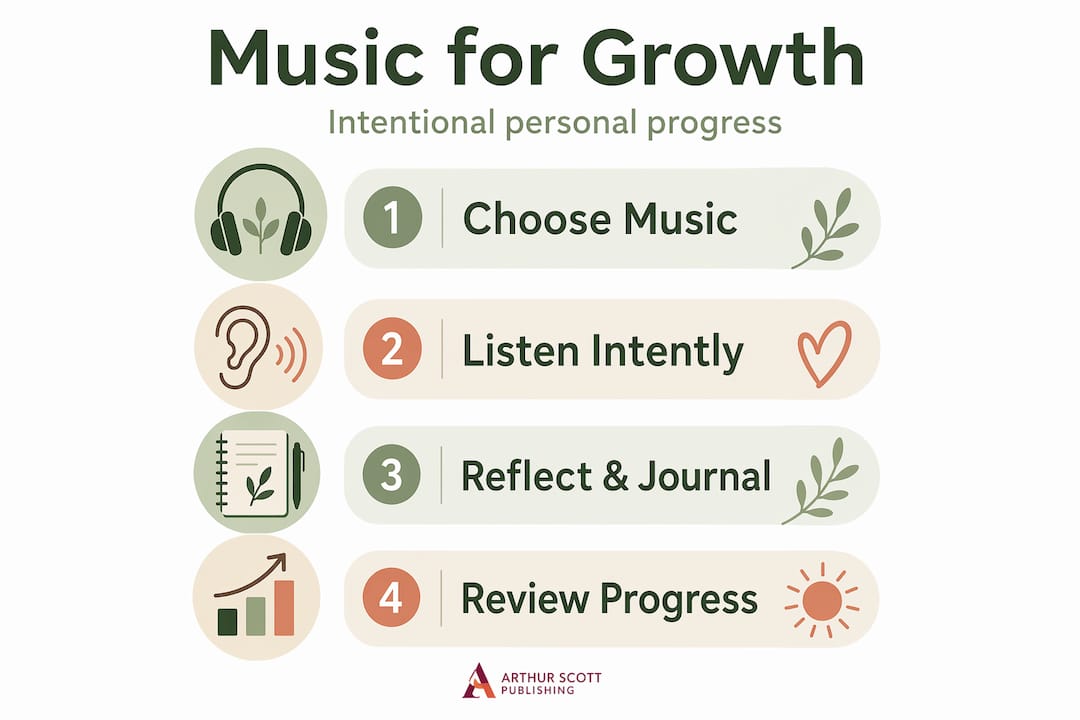
With the science and the caveats in mind, here is a research-aligned framework you can begin using this week. Intentional listening plus reflection, rather than passive background music, is what the research consistently points to for meaningful self-directed growth.
Follow these steps to build your personal music growth practice:
- Assess your current emotional baseline. Before each session, rate your mood on a simple 1 to 10 scale and write one sentence about how you are feeling.
- Set a growth intention. Are you working on stress management, processing a difficult relationship, building confidence, or developing empathy? Name it clearly.
- Choose music that serves that intention. Research your genre and tempo options. Slow instrumental music works well for reflection. Rhythmically driven music supports energy and motivation.
- Listen actively for 10 to 20 minutes. No screens, no chores. Just the music and your awareness of what it brings up.
- Journal for five to ten minutes immediately after. Use the three-prompt template from the previous section.
- Identify one behavioral action. How can what you just learned about yourself change one thing you do today?
- Track your progress weekly. Note what approaches feel generative and which feel flat or draining.
Tailoring your music choices to your readiness matters enormously. If you are in a low-resilience period, stay with gentle, grounding music. When you feel stronger and more resourced, you can afford to use music that challenges you emotionally and stretches your capacity for self-reflection. Explore lasting personal growth strategies to layer music practice alongside other development tools for the most durable results.
Pro Tip: Once a month, review your music journal entries and rate how each type of session affected your mood, insight, and emotional resilience. Adjust your approach based on what the data from your own experience tells you, not what a playlist algorithm recommends.
What most people miss about music and personal growth
Here is an uncomfortable truth from years of working at the intersection of psychology and music: most people either over-trust music or completely underuse it.
The over-trusters believe that simply listening to the "right" music will fix their anxiety, elevate their confidence, or accelerate their growth. They consume curated playlists the way someone might take a vitamin, hoping the benefits accumulate passively. They rarely do, at least not in any lasting way.
The underusers dismiss music as too soft, too subjective, or too unserious to count as a real personal development practice. They want frameworks, strategies, and measurable outcomes. What they miss is that music, when used intentionally, is all of those things.
Research confirms that outcomes depend on personal fit, including your preferences, your autonomy in the process, and your current readiness, and that benefits are context-specific. What this means practically is that a growth-oriented music practice is not one-size-fits-all. It requires the same kind of honest, ongoing self-assessment that any serious development work demands.
In building self-awareness programs, we have seen people make dramatic breakthroughs using music they would have dismissed as too simple or too emotional. We have also seen people get stuck in loops of melancholy, using music to wallow rather than to grow. The difference between those two outcomes is almost always awareness and intention.
The most effective practitioners treat their music practice the way an athlete treats training: with purpose, adjustment, and honest evaluation. They are not attached to any particular song or style. They are attached to the outcome, which is a clearer, more resilient, more self-aware version of themselves. Following 2026 self-growth trends shows that integrating music with mindfulness, journaling, and behavioral tracking is moving from niche practice to mainstream personal development.
The real power of music in self-growth is not in the music itself. It is in what the music reveals about you.
Explore more on your personal growth journey
If this article sparked something in you, there is more where it came from. Arthur Scott Publishing was built on the belief that real growth requires both the right knowledge and the right tools, and that access to both should never be a barrier.
Dr. Arthur Scott's background in psychology and music makes this platform uniquely positioned to bridge the science of emotional wellness with the lived experience of personal development. From free downloadable e-books to audio formats designed for accessibility, Arthur Scott Publishing's impact is built around meeting you where you are. Browse the full library of personal growth resources and find the tools that match your next step. Whether you are just starting or deepening an existing practice, the right guide can make all the difference.
Frequently asked questions
Can music really help improve my mood or emotional regulation?
Yes, research shows that intentionally chosen music can help regulate emotions and boost mood, especially when paired with active reflection rather than passive listening.
What is the best way to use music for personal growth?
The most effective approach combines structured listening with journaling, since linking music to reflection and metacognitive inquiry is the key mechanism that drives empathy and self-insight.
Are there risks to using music for mental wellness?
Yes, mismatched music can cause distress or emotional flooding, which is why personalizing your approach based on your current emotional state and readiness is essential.
Is music therapy more effective than self-directed music use?
Therapist-guided sessions can help with depressive symptoms, but benefits vary by context and individual fit, meaning self-directed practice with the right structure can be equally impactful.
How do I know if music for growth is working for me?
Track your mood and insight levels before and after sessions each week and honestly evaluate whether you feel more self-aware over time. If you consistently feel worse or stuck, adjust your music choices, your reflection practice, or both.