
Most parents who come to me with a "problem child" have actually brought me a problem system. The behavior that worries them most, whether it's a teen who shuts down or a younger child who acts out at school, rarely lives in that child alone. It lives in the space between family members, shaped by old patterns, unspoken rules, and feedback loops that everyone participates in without realizing it. Understanding family dynamics explained through a systems lens changes everything about how you respond, what you try to fix, and where real change actually happens.
Table of Contents
- Understanding family systems theory and its core concepts
- The impact of parenting styles on child and adolescent development
- Family roles, boundaries, and enmeshment: healthy versus problematic dynamics
- How family therapy strengthens relationships and supports mental well-being
- Practical strategies for parents to nurture healthy family dynamics
- Why typical views on family closeness can undermine healthy autonomy
- Supporting your journey to stronger family connections with Arthur Scott Publishing
- Frequently asked questions
Key Takeaways
| Point | Details |
|---|---|
| Family as a system | Family members influence one another through complex interdependent relationships and feedback loops. |
| Parenting style impact | Authoritative parenting supports the strongest emotional and academic outcomes in children. |
| Boundaries matter | Balanced family boundaries promote autonomy and health, while enmeshment harms individual growth. |
| Family therapy benefits | Therapy improves communication and resilience by addressing family dynamics as a whole. |
| Practical strategies | Consistent boundaries and screen-free time build trust and emotional connection in families. |
Understanding family systems theory and its core concepts
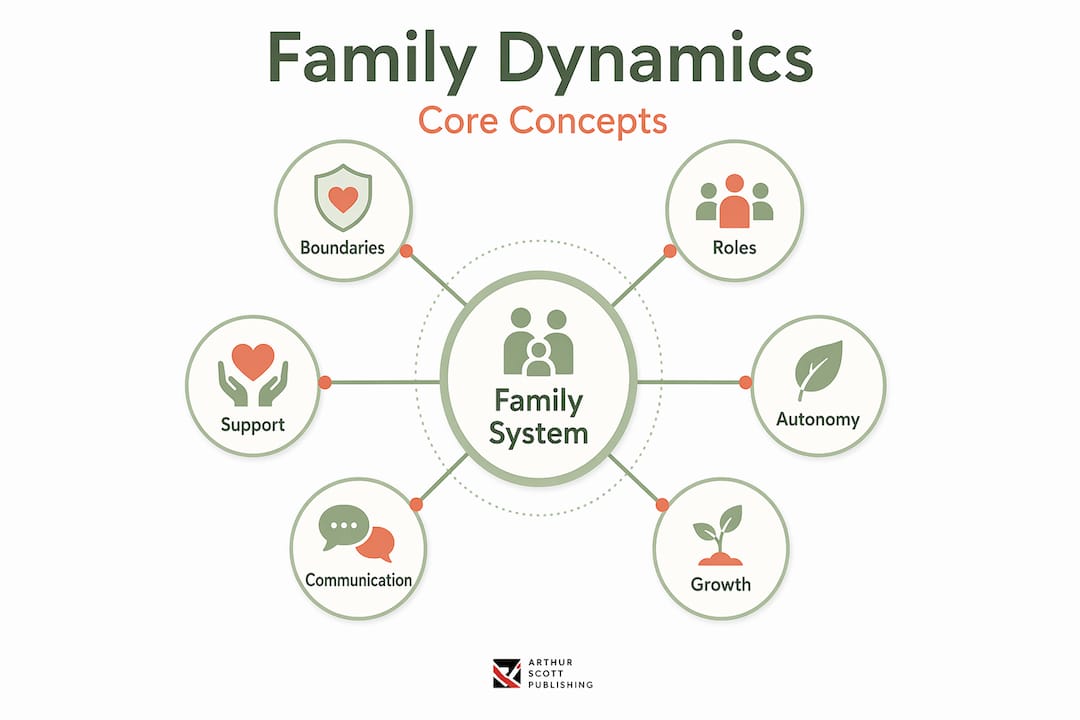
Family systems theory, developed largely by psychiatrist Murray Bowen, reframes how we think about behavior inside a household. Instead of asking "what is wrong with this person," it asks "what is this person's behavior communicating about the whole group?" Families function as emotional units with interdependent behaviors and feedback loops, where one member's anxiety, withdrawal, or outburst sends ripples through everyone else.
Here is what makes this so practical for parents: a four-member family does not have four individual personalities operating in parallel. It has six or more distinct dyadic relationships (parent to parent, each parent to each child, sibling to sibling) plus group-level dynamics that shift based on who is in the room. That is a complex social organism, not a collection of separate people.
Key principles every parent should know:
- Feedback loops keep the family emotionally stable, but they can also lock in dysfunction. If a child's tantrum consistently ends conflict between parents, that behavior gets rewarded and repeated.
- Subsystems within families each carry distinct functions. The spousal subsystem sets the emotional tone. The parental subsystem enforces structure. The sibling subsystem is where children first learn negotiation and rivalry.
- Boundaries between subsystems determine how much a parent involves a child in adult problems, or how much siblings are allowed to resolve conflicts without parental interference.
- Anxiety is contagious. When one parent is chronically stressed, that stress transmits through tone, body language, and indirect communication to every member of the family.
Understanding family support and mental health through this lens helps parents stop personalizing behavior and start reading it as information about the whole system. That shift alone reduces reactivity and increases the chance of real change.
The impact of parenting styles on child and adolescent development
Few things shape family dynamics more consistently than parenting style. Researchers Diana Baumrind, and later Maccoby and Martin, categorized parenting along two axes: how demanding a parent is and how responsive they are. Where you land on those two scales determines a great deal about your child's emotional development, self-regulation, and even academic trajectory.
| Parenting style | Demandingness | Responsiveness | Common child outcomes |
|---|---|---|---|
| Authoritative | High | High | Confidence, emotional regulation, academic success |
| Authoritarian | High | Low | Rule compliance, anxiety, lower self-esteem in many cultures |
| Permissive | Low | High | Warmth without limits, impulsivity, difficulty with authority |
| Neglectful | Low | Low | Broad negative outcomes across emotional and academic domains |
Authoritative parenting leads to higher academic achievement and social competence, while neglectful parenting produces the most broadly negative outcomes. These are not small differences. They show up in long-term mental health trajectories, peer relationships, and even adult earning potential.

One thing the research makes clear is the role of emotional regulation. Authoritative parenting is consistently linked to better emotional resilience and self-regulation in adolescents, largely because it combines clear expectations with genuine explanations. Children learn why rules exist, not just that they must obey them.
A few important nuances:
- Authoritarian parenting, though associated with anxiety in Western contexts, can function protectively in collectivistic cultures where firm parental authority is a cultural signal of love and security.
- Child temperament modifies outcomes too. A highly sensitive child may struggle more under authoritarian parenting than a child with a naturally resilient, easygoing temperament.
- Permissive parenting is often mistaken for authoritative because it feels warm and connected. The distinction is follow-through. Permissive parents set limits, then abandon them under pressure.
Pro Tip: If your parenting style has shifted toward permissive under stress, the fastest correction is not becoming stricter. It is becoming more consistent. Pick two or three non-negotiable rules and hold them without drama. That predictability builds security faster than new consequences ever will. Explore how authoritative parenting benefits align with family empowerment goals for a deeper look at this connection.
Family roles, boundaries, and enmeshment: healthy versus problematic dynamics
Every family develops a cast of informal roles over time. Some are healthy and functional. Others are survival strategies that mask deeper dysfunction. The roles family members play are shaped by cultural expectations, economic pressures, birth order, and the unspoken negotiations that happen every day.
In families under chronic stress or dealing with issues like addiction, mental illness, or unresolved grief, children often take on defined roles that protect the family system at personal cost:
- The Hero: overachieves to make the family look healthy from the outside
- The Scapegoat: absorbs the family's blame and becomes the "identified problem"
- The Lost Child: withdraws quietly to avoid adding to family tension
- The Mascot: uses humor to defuse tension and distract from pain
- The Caretaker: manages everyone else's emotions at the expense of their own needs
Recognizing these patterns matters enormously when considering how family dynamics affect children. A child labeled as "the difficult one" may simply be the member most willing to act out what everyone else is feeling.
Boundaries are the invisible lines that define where one person's emotional space ends and another's begins. Healthy boundaries allow closeness without losing individuality. They let a child be upset without the parent becoming equally upset. They allow disagreement without it threatening the relationship.
| Boundary type | Characteristics | Associated outcomes |
|---|---|---|
| Rigid | Too much distance, low warmth | Emotional disconnection, loneliness |
| Healthy | Clear but flexible, emotionally safe | Strong attachment, individual autonomy |
| Diffuse (enmeshed) | Blurred roles, shared emotions without separation | Anxiety, dependence, low self-esteem |
High enmeshment leads to negative child outcomes associated with diffuse boundaries, while cohesive families with clear but flexible limits actively promote well-being. Read more about family boundaries and mental health and practical strategies for healthy boundaries to put these ideas into action.
Pro Tip: When a teenager becomes defiant, validate the emotion before addressing the behavior. "I can see you're frustrated, and we still need to talk about what happened" builds far more trust over time than immediate punishment. Consistent validation and consistent limits, together, are what healthy boundaries feel like in practice.
How family therapy strengthens relationships and supports mental well-being
Family therapy treats the family as the client, not the individual presenting the problem. That reframe alone changes the direction of every conversation in the room. Rather than identifying who caused the issue, a skilled therapist helps every member see how their patterns contribute to and sustain it.
Common evidence-based models include:
- Structural family therapy (Salvador Minuchin): Examines and reshapes the boundaries and hierarchies within subsystems.
- Bowenian therapy: Focuses on differentiation of self and reducing anxiety transmission across generations.
- Emotionally focused therapy (EFT): Addresses attachment needs and rebuilds emotional bonds between family members.
- Cognitive behavioral family therapy: Targets specific dysfunctional thought patterns and communication habits.
- Narrative therapy: Helps families rewrite the stories they tell about themselves and each other.
"Family therapy improves communication, reduces symptoms, and supports families through transitions, with over 98% client satisfaction in outcome studies."
Therapy typically runs 8 to 20 sessions, though families in crisis or navigating major transitions often benefit from longer engagement. Children whose behavioral problems seem purely individual almost always improve faster when the whole family participates in treatment. The behavior was a signal from the system; fixing the system quiets it.
Explore how family therapy and self-awareness work together, and how psychology fuels family growth to deepen your understanding of these approaches.
Practical strategies for parents to nurture healthy family dynamics
Knowing the theory matters far less than knowing what to do Tuesday morning when the household is in chaos. Here are steps grounded in research and real clinical practice:
- Set boundaries with validation, not just consequences. Saying "I understand you want to stay up later, and bedtime is still 9:00" communicates that both the child's desire and the parent's rule are real. This is how trust gets built.
- Co-create the rules. Sit down with your children and ask what they think is fair. Children who help build the rules feel ownership over them. Compliance goes up and power struggles go down.
- Protect daily screen-free time. Screen-free family time builds closeness and actively counters adolescent withdrawal. Even 20 minutes of undivided attention, no phones, direct eye contact, active listening, sends a message that cannot be replicated by any other strategy.
- Name the family roles you see. If you recognize that one child is consistently playing the scapegoat, say it gently out loud. "I've noticed we often blame you first, and I want to change that." Naming the pattern is the first step to disrupting it.
- Practice authoritative parenting daily. High warmth plus high expectations. Ask about your child's reasoning. Explain yours. Negotiate the small things so you can hold firm on the important ones.
Watch for these warning signs in your family system:
- One child consistently receives more negative attention than others
- Parents regularly disagree in front of children without resolution
- A child is expected to manage a parent's emotional state
- Family members cannot express disagreement without someone shutting down or escalating
Explore a full thriving family strategies guide and build out a personal growth action plan to support the changes you are ready to make.
Why typical views on family closeness can undermine healthy autonomy
Here is something most parenting content gets wrong: closeness is not the goal. Connection with individuation is the goal. These are different things, and collapsing them causes real harm.
Families that prize closeness above all else often drift into enmeshment without recognizing it. They look healthy from the outside. Everyone knows everyone's business. There is constant contact. Holidays are elaborate and non-negotiable. But beneath that warmth, members cannot form their own opinions without guilt, cannot make independent choices without family fallout, and cannot set a limit without being accused of abandonment.
Enmeshment sacrifices individual autonomy for family closeness and amplifies negative outcomes. Healing requires tolerating guilt and taking gradual steps toward independent boundary setting. That last part is critical. The guilt is not a sign that something is wrong. It is the system resisting change.
What I tell parents who grew up in enmeshed families is this: your discomfort with setting limits is not evidence that limits are wrong. It is evidence that you were taught to confuse connection with merger. Those are not the same thing.
Family support and autonomy are not opposing forces. A child who knows they can differentiate from the family without losing love is a child who actually wants to come home. That is the counterintuitive truth most families never reach because they equate togetherness with never needing space.
Challenge the cultural narratives in your own household. The goal is not a family that always agrees, always calls, and always stays close. The goal is a family where each member grows into themselves fully and chooses connection freely.
Supporting your journey to stronger family connections with Arthur Scott Publishing
Understanding family dynamics is one thing. Having the right resources to support real change is another.

Arthur Scott Publishing offers free e-books and resources designed specifically for parents and caregivers navigating the complexities of family relationships. Authored and curated by Dr. Arthur Scott, a psychologist with deep experience in behavioral health and family empowerment, these materials address the exact patterns covered in this article, from setting healthy boundaries to fostering forgiveness, grace, and resilient family rules. You can explore Arthur Scott Publishing's impact to see how real families have transformed through these resources. Visit the full library of personal growth resources and take the next step toward the family relationships you want to build.
Frequently asked questions
What is family systems theory and why is it important?
Family systems theory views the family as an interconnected emotional unit where each member's behavior affects everyone else, helping parents understand relationship patterns instead of simply blaming one person for household problems.
Which parenting style leads to the best child outcomes?
Authoritative parenting, characterized by warmth and clear expectations, consistently results in better academic achievement and social competence, outperforming permissive, authoritarian, and neglectful approaches across most cultural contexts.
How can family therapy help my family?
Family therapy treats the whole household as one system, improving communication and strengthening bonds. Studies report over 98% client satisfaction with outcomes that extend beyond crisis resolution to long-term resilience.
What are enmeshed family dynamics and why are they harmful?
Enmeshed families have blurred boundaries where closeness crowds out individual autonomy, resulting in negative child outcomes including anxiety, low self-esteem, and difficulty forming an independent identity.
What practical steps can I take to improve my family's dynamics?
Set consistent boundaries with emotional validation, co-create family rules, and commit to daily screen-free time for real connection. These steps, applied consistently, shift the entire system over time.