
Most people treat feedback like a trip to the dentist. They know it's good for them, but they avoid it anyway. The role of feedback in growth is one of the most misunderstood forces in personal and professional development. It gets labeled as criticism, judgment, or worse. But feedback done right is the exact opposite. It's the most direct path from where you are now to where you want to be. This guide breaks down what feedback actually is, why so many people get it wrong, and how you can use it to accelerate your growth in ways that feel real and sustainable.
Table of Contents
- Key takeaways
- The role of feedback in growth: what it really means
- Why most people resist feedback (and what's actually going on)
- How to give and receive feedback for real growth
- Structured feedback systems that accelerate sustained growth
- Making feedback a daily habit
- My honest take on feedback after years of working with it
- Continue your growth with Arthurscottpublishing
- FAQ
Key takeaways
| Point | Details |
|---|---|
| Feedback accelerates growth | Structured feedback can nearly double team growth rates and drive measurable gains in satisfaction and retention. |
| Emotional barriers are the main obstacle | Reframing feedback as information, not judgment, removes the resistance that stops most people from using it. |
| Specificity and timing matter most | Immediate, behavior-focused feedback produces far better results than delayed, vague reviews. |
| Feed-forward beats looking backward | Shifting the focus to future actions reduces defensiveness and makes feedback easier to act on. |
| Consistency creates the biggest gains | Short, frequent feedback sessions normalize growth and build the kind of trust that makes honest input possible. |
The role of feedback in growth: what it really means
Feedback is not a performance review. It's not a scorecard or a verdict on your worth. At its core, feedback is information. Specifically, it's information about the gap between your current performance and where you want to be. That reframe changes everything.
The research backs this up in a big way. Teams using structured feedback grow nearly twice as fast as those that don't, and companies that integrate customer feedback into their decisions see revenue grow ten times faster. These aren't marginal gains. They're transformational differences that trace directly back to one habit: paying attention to feedback and acting on it.
Feedback works through what's called a feedback loop, a repeatable cycle that connects what you did to what you should do differently next time. Think of it like a GPS recalculating your route. The system doesn't shame you for making a wrong turn. It simply gives you the most direct path forward based on where you are right now. That's exactly how productive feedback operates.
Here's what effective feedback does for your growth:
- Closes the gap between intention and actual results
- Reveals blind spots you genuinely cannot see on your own
- Accelerates learning by shortening the time between trial and correction
- Builds self-awareness, which is the foundation of real behavioral change
- Creates accountability by making progress visible to both you and others
Understanding feedback's effect size on growth helps explain why high performers in every field, from elite athletes to top executives, treat input from others as a competitive advantage rather than a source of discomfort.
Why most people resist feedback (and what's actually going on)
Here's a truth most growth articles skip: the biggest barrier to feedback isn't lack of access. It's emotional resistance. And that resistance is completely understandable, because it's wired into how your brain processes perceived threat.
When someone offers a critique, your brain often interprets it as a social threat, similar to rejection or loss of status. The result? Defensiveness, shutdown, or avoidance. None of those responses produce growth.
The misconception driving this cycle is that feedback reflects who you are. It doesn't. Feedback reflects a behavior, a result, or a pattern. The moment you separate your identity from your performance, feedback stops feeling like an attack and starts feeling like a tool.
"Feedback should be viewed as calling someone up, not calling them out. The goal is mentorship and empowerment, not judgment." (Emotionally Intelligent Feedback)
Emotional intelligence skills like self-regulation and empathy play a direct role in your ability to give and receive feedback without damaging relationships or shutting down growth. Leaders and teammates who develop these skills turn potentially uncomfortable conversations into genuine learning moments.
Psychological safety is the other critical factor. When people trust that honest feedback won't be used against them, they share more, ask more, and grow faster. Building that trust takes time, but it starts with one consistent choice: responding to feedback with curiosity instead of defensiveness.

Pro Tip: The next time you receive feedback that stings, try asking one question before responding: "What specific behavior are they pointing to?" Shifting to specifics immediately moves you out of emotional reaction and into problem-solving mode.
How to give and receive feedback for real growth
Knowing feedback matters isn't enough. You need a method. Here's a practical framework that works whether you're on the giving or receiving end.
Asking for feedback the right way
Most people ask for feedback too broadly and too late. "How am I doing?" is not a useful question. It's vague, it puts the other person on the spot, and it rarely produces information you can actually use.
Instead, try the "catch me in the act" approach. Seeking feedback immediately after a specific event, such as a presentation, a difficult conversation, or a project milestone, produces far more accurate and useful input than waiting for a quarterly review. The details are fresher, the behaviors are easier to reference, and the feedback is directly tied to what you can adjust.
A better question sounds like this: "In that meeting, what was one thing I could have done differently to make my point land more clearly?" Specific. Behavioral. Tied to a moment both of you just experienced.
Giving feedback that actually lands
When you're the one offering input, these steps make the difference between feedback that motivates and feedback that alienates:
- Focus on behavior, not character. Say "I noticed you interrupted three times during the debrief" rather than "You're not a good listener." One is changeable. The other feels like a verdict.
- Be specific about the impact. Explain what happened as a result of the behavior, not just the behavior itself. This helps the person connect the dots between their actions and the outcomes.
- Use feed-forward instead of just feedback. Rather than rehashing past mistakes, point toward future options. Feed-forward framing reduces defensiveness and keeps the conversation focused on what's possible.
- Ask, don't only tell. End with a question like "What do you think would work better next time?" This turns the conversation into a collaboration rather than a lecture.
- Pick the right moment. Feedback lands best when the other person is calm and ready to hear it, not when they're stressed or already overwhelmed.
Pro Tip: Before giving feedback, ask yourself: "Is this about helping them improve, or about expressing my frustration?" If it's the latter, wait until you can answer yes to the first.
Structured feedback systems that accelerate sustained growth
There's a meaningful difference between giving and receiving feedback casually and building it into a repeatable system. The latter is where the biggest growth gains happen.
Formal feedback loops are linked to 85% higher customer satisfaction rates, and organizations using feedback-driven strategies report profit increases between 25% and 95%. Those numbers reflect what happens when feedback stops being an occasional event and becomes a built-in process.
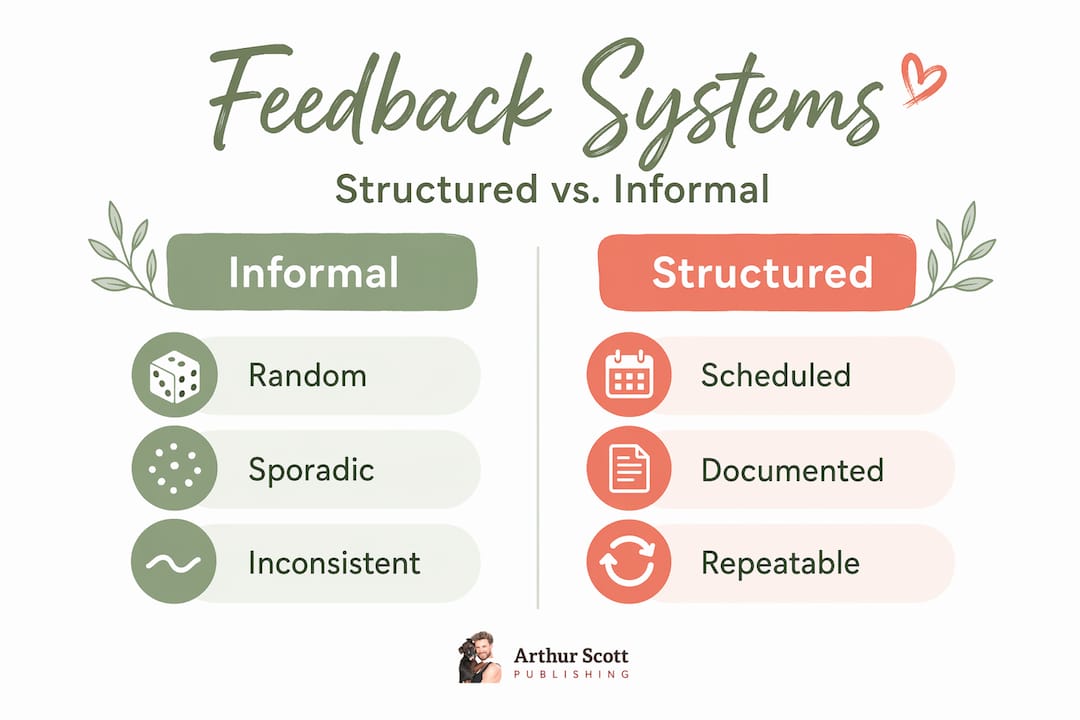
Here's a clear look at what separates informal feedback from a structured feedback system:
| Element | Informal feedback | Structured feedback system |
|---|---|---|
| Frequency | Random or infrequent | Scheduled and consistent |
| Format | Vague or conversational | Specific, documented, behavioral |
| Follow-up | Rarely tracked | Systematically reviewed |
| Impact on retention | Minimal | Up to 14% higher retention |
| Outcome focus | Reactive | Proactive and improvement-driven |
One area where structured feedback is producing measurable results right now is human-AI collaboration. Actionable, precise feedback in AI workflows increased task success rates by 26 percentage points in recent studies. The principle applies directly to your own growth: the more specific and consistent your feedback system, the faster your improvement.
Organizations that embed feedback into their culture, through weekly check-ins, peer review cycles, or regular retrospectives, create environments where growth isn't an annual event. It's a daily practice. You can apply the same principle to your personal life by treating every meaningful interaction as a chance to gather data on how you're doing and where you can grow.
Making feedback a daily habit
The gap between people who grow steadily and those who plateau often comes down to frequency. Waiting for feedback to arrive on its own is a passive strategy with passive results.
Weekly feedback sessions, even short ones, normalize the process, reduce the anxiety that builds up around bigger reviews, and help you develop a more personalized understanding of how you're coming across to the people around you. Here's how to build feedback into your regular routine:
- Identify two or three people in your life whose perspective you genuinely trust. These are your feedback partners. Check in with them regularly, not just when something goes wrong.
- After every significant event, ask one specific question about your performance. Write the answer down. Pattern recognition takes time, and your notes will show you things you'd otherwise miss.
- Act on what you hear, then report back. Acting on feedback rapidly builds trust with the people giving it, which means they'll invest more honestly in future input.
- Work with a coach or mentor who will give you structured, consistent feedback rather than only encouragement. Encouragement feels good. Honest coaching changes behavior.
- Treat silence as data too. If no one is giving you feedback, ask yourself whether you're creating the conditions for honesty, or whether the people around you have learned it's safer to stay quiet.
Pro Tip: Keep a weekly growth journal with two entries: one thing you heard this week that you're going to act on, and one behavior you're watching in yourself. This simple practice turns feedback into self-awareness, which is the most durable form of development.
Self-awareness is the link between receiving feedback and actually changing. Arthurscottpublishing's work on family self-awareness methods explores this connection in depth, showing how feedback shapes identity and behavior across every area of life.
My honest take on feedback after years of working with it
I'll be direct about something: most of the feedback advice out there is too clean. It assumes both parties are emotionally regulated, the relationship is trusting, and the feedback is well-intentioned. Real life is messier than that.
What I've learned is that the people who grow fastest aren't the ones who get the best feedback. They're the ones who are best at extracting useful signal from imperfect input. Feedback delivered clumsily, even rudely, still contains information. The skill is learning to separate the delivery from the data.
I've also found that the moment I stopped treating feedback as a verdict on my character, I started hearing things I previously would have dismissed. That shift didn't happen overnight. It took real practice and a lot of discomfort. But it changed the trajectory of my growth more than almost anything else.
One more thing I'll say: asking for feedback is an act of courage that most people underestimate. It signals to the people around you that you're serious about getting better, not just about looking good. That signal, on its own, changes the dynamic of every relationship you're in.
— Art
Continue your growth with Arthurscottpublishing

If this article helped you see feedback differently, you're ready to go deeper. Arthurscottpublishing offers free e-books and resources created by Dr. Arthur Scott, a psychologist with decades of experience in behavioral health and personal development. These materials are built for people who are serious about growth and want tools grounded in real psychology, not generic motivation.
Whether you're working on your own development or supporting someone in your family, the resources at Arthurscottpublishing connect the kind of feedback principles covered here to practical strategies you can apply right away. You can also explore the broader Arthurscottpublishing library for books and guides on self-awareness, perseverance, and family empowerment. Growth is not a solo effort, and the right resources make the path considerably clearer.
FAQ
What is the role of feedback in personal growth?
Feedback gives you accurate information about the gap between your current behavior and your goals. Without it, personal growth relies on guesswork rather than real data.
How does feedback drive professional growth?
Feedback in professional growth works by accelerating learning, identifying blind spots, and aligning your efforts with what actually produces results. Structured feedback systems are linked to up to 95% higher profitability in organizations that use them consistently.
Why do people struggle to accept feedback?
Most resistance to feedback comes from the brain interpreting critique as a social or identity threat. Reframing feedback as behavioral information rather than personal judgment is the most effective way to reduce that resistance.
How often should you ask for feedback?
Short, frequent sessions work better than infrequent formal reviews. Weekly feedback check-ins normalize the process and improve communication over time.
What is feed-forward and why does it matter?
Feed-forward focuses on future behaviors rather than past mistakes. This framing lowers defensiveness and makes feedback conversations more productive and easier to act on.