

Reading with your child is one of the most effective parenting habits backed by developmental science, yet it still loses ground to screens in most American households. The advantages of family reading time reach far beyond teaching kids to decode words. From building emotional security to reducing stress for the whole family, shared reading does things no app can replicate. This article breaks down the research, the methods that actually work, and the practical steps you can take starting tonight, whether your child is four or fourteen.
Table of Contents
- Key takeaways
- 1. The advantages of family reading time for language and literacy
- 2. Emotional and social benefits that go deeper than you think
- 3. How shared reading reduces screen time naturally
- 4. Reading approaches that work for every age and family
- 5. Practical tips for building a lasting family reading habit
- My take on what family reading really does
- Resources to help your family go further
- FAQ
Key takeaways
| Point | Details |
|---|---|
| Language gap is real | Children read to daily hear 1.5 million more words by age five than those who are not. |
| Short sessions work best | Daily reading of 15 to 20 minutes builds emotional regulation and outperforms occasional long sessions. |
| Emotional bonds deepen | Shared reading strengthens secure attachment, which predicts better mental health across a child's life. |
| Screen time drops naturally | Families who read together regularly show a measurable negative correlation with screen time. |
| Every reading style counts | Both interactive and straight-through reading produce strong social and emotional outcomes for children. |
1. The advantages of family reading time for language and literacy
The vocabulary gap between children who are read to and those who are not is staggering. Young children heard nearly 1.5 million more words by age five when their parents read to them daily. That is not a marginal difference. It compounds year after year, shaping how confidently a child speaks, reads, and learns in school.
Books expose kids to words they would never encounter in everyday conversation. Think about words like "majestic," "reluctant," or "ancient." A parent might say "big" or "old" in daily speech. A picture book says "enormous" and "centuries-old." That consistent exposure builds a richer mental vocabulary that carries directly into reading comprehension and writing.
The academic stakes are equally serious. Children who are not reading proficiently by third grade are four times less likely to graduate from high school. Early reading ability is not just about books. It is about long-term opportunity.
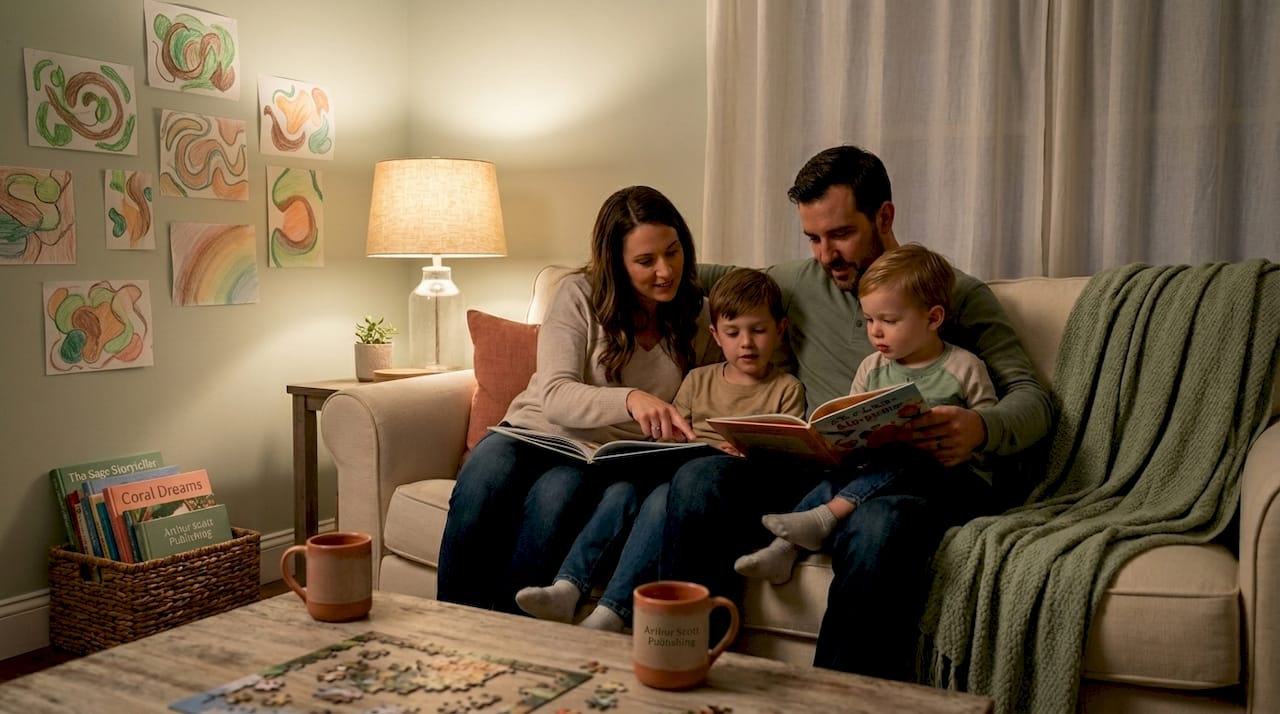
Here is a quick look at how family reading stacks up against other literacy-building activities:
| Activity | Vocabulary exposure | Emotional engagement | Academic impact |
|---|---|---|---|
| Family reading aloud | Very high | Very high | Strong |
| Educational apps | Moderate | Moderate | Limited |
| Solo silent reading | High | Low | Moderate |
| Paired reading with parent | Very high | Very high | Very strong |
Structured paired reading can accelerate a child's reading progress by roughly two months compared to children who read independently without parental support. That kind of gain from a free, daily habit is hard to match with any tutoring program or educational product.
Key literacy benefits of regular family reading include:
- Richer vocabulary across multiple subject areas
- Stronger phonological awareness in younger children
- Better reading comprehension and inferencing skills
- Improved attention span and focus during learning tasks
- A positive association with books that motivates independent reading later
2. Emotional and social benefits that go deeper than you think
Reading together does something that homework help and structured activities cannot. It creates consistent moments of closeness that build secure attachment between parent and child. The American Academy of Pediatrics identifies shared reading as a positive parenting practice that directly supports secure attachment, and that matters because secure attachment predicts better mental health and stronger social relationships throughout life.
When a child hears a story about a character who feels scared, left out, or misunderstood, they process those emotions safely. They start to recognize feelings in themselves and others. This is the foundation of empathy, and it develops naturally through repeated shared reading experiences, without any formal lesson.
"Reading builds neural pathways for narrative comprehension and empathy that support children across every academic subject, not just language arts."
Stories also build resilience. A child who watches a character overcome fear, loss, or failure learns that hard things are survivable. That is a mental health resource tucked inside every good book.
The stress-reduction angle is often overlooked. Reading together calms the nervous system more effectively than music or light exercise, making it a genuine de-stress tool for the whole family, not just the child. Parents who struggle with finding connection at the end of a long day often find that a shared book removes the pressure to "talk" while still building closeness.
The social benefits extend beyond the family, too. Research shows that both interactive and straight-through reading improve social skills and empathy equally well. You do not have to turn every reading session into a quiz or discussion. Just reading together is enough.
Pro Tip: Pick books that feature characters your child already cares about. When kids are emotionally invested in a character, they absorb the social and emotional lessons in the story without realizing it.
How reading strengthens families emotionally:
- Creates predictable, calm moments that reduce anxiety in children
- Builds emotional vocabulary so kids can name and discuss feelings
- Strengthens the parent-child relationship through shared experience
- Gives older children a low-pressure way to explore complex emotions
- Supports empathy development that carries into peer relationships
3. How shared reading reduces screen time naturally
Here is something worth knowing. You do not have to fight your child to put down a screen if you replace it with something genuinely engaging. A 2025 Pediatric Research study found a clear negative correlation between shared storybook reading frequency and screen time. Families that read together more tend to watch and scroll less, and not because they set strict rules about it.
The mechanism makes sense. Children seek stimulation and connection. Screens deliver stimulation. Family reading delivers both stimulation and connection, which makes it the stronger draw when it becomes a real routine.
Reading also supports healthier sleep. When reading replaces screen time in the hour before bed, children fall asleep faster and wake less frequently. The blue light from screens delays melatonin production. A book does the opposite. It signals the brain to wind down.
Here is how to build a reading routine that naturally crowds out passive screen use:
- Anchor reading to an existing habit. Pair it with bedtime, after dinner, or the ten minutes after school pickup. The habit stacks more easily when it connects to something already automatic.
- Make the physical space inviting. A reading corner with a lamp, a soft blanket, and a small bookshelf sends a clear signal to a child's brain that this is a comfort zone, not a chore zone.
- Let children choose the book. Autonomy increases buy-in. A child who picked the book is far more likely to sit with it.
- Start short. Ten minutes beats zero minutes. Build the habit before you extend the duration.
- Be consistent rather than perfect. Consistency in reading routines is more impactful than any single long session. Showing up daily at the same time builds the routine into your child's sense of security.
Pro Tip: If your child resists sitting still, try audiobooks or digital read-aloud formats during car rides. The family reading benefits still apply, and it meets kids where they already are.
4. Reading approaches that work for every age and family
One of the most common reasons families stop reading together is that they assume it only works for young children, or they feel pressure to do it "correctly." Neither is true. The benefits of reading aloud extend well into the teen years. Reading aloud to teenagers keeps connection alive and opens conversations about complex topics that would feel awkward to bring up directly.
Different families will find different approaches work best. Here is a comparison of the most common formats:
| Format | Best for | Primary benefit |
|---|---|---|
| Parent reads aloud | All ages, especially under 10 | Vocabulary, bonding, comprehension |
| Paired reading | Ages 6 to 12 | Fluency, confidence, shared progress |
| Family book club | Ages 10 and up | Critical thinking, discussion, connection |
| Audiobook together | All ages, especially on the go | Accessibility, inclusion, engagement |
| Silent reading side by side | Ages 8 and up | Independent habits, shared space |
The paired reading format deserves extra attention because it delivers two months of additional reading progress with minimal preparation. The child reads aloud while the parent follows along, correcting gently and praising consistently. It feels collaborative, not corrective.
Choosing the right books matters as much as choosing the right format. Look for stories that feature characters navigating real emotions and challenges. Books that reflect your child's experiences build recognition and investment. Books that stretch beyond their experience build empathy. Both are worth including. You can explore how e-books support children's development if your family prefers digital formats, since the cognitive and emotional benefits transfer across print and screen-based reading when the experience is shared.
5. Practical tips for building a lasting family reading habit
The families who sustain reading time long-term are not the ones with the most books or the most structured schedules. They are the ones who keep it enjoyable and low-pressure.
Start with time, not books. Commit to 15 to 20 minutes at the same time each day. The book matters less than the ritual. Once the ritual is solid, the books almost choose themselves.
Discussion does not have to feel like homework. You do not need a list of comprehension questions. A simple "What did you think of that?" after a chapter is enough. Research confirms that reading style flexibility makes family reading more sustainable for parents and more enjoyable for kids, without reducing the benefits.
Keep expectations flexible. Some nights you will read one page before someone falls asleep. That still counts. The emotional signal is what matters. Your child learns that reading together is something your family does, and that identity shapes behavior more than any reward chart.
Do not stop reading aloud when your child learns to read independently. That is the most common mistake families make. Reading aloud to teens maintains connection and gives you both a shared reference point for discussing complex themes, from friendship and identity to loss and ambition, without it feeling like a heavy conversation. For more on this, the Arthurscottpublishing guide on family growth strategies covers how shared habits like reading fit into a broader framework for raising emotionally healthy kids.
Pro Tip: Rotate who picks the book. When parents choose titles they genuinely love, that enthusiasm is contagious. Kids pick up on authentic excitement in a way they never do with assigned reading.
Key habits to build and protect:
- Same time, same place builds automatic behavior
- Let enjoyment be the standard, not comprehension
- Keep a shared reading list the whole family contributes to
- Celebrate finishing a book without making it a performance
My take on what family reading really does
I have spent years working with families navigating everything from behavioral challenges to grief, and the families who read together consistently stand out to me in a specific way. They have a shared vocabulary for talking about hard things. They use characters from books the way other families use shared memories. "Remember what happened to that character?" becomes a way to approach a real conversation without either person feeling put on the spot.
What I have learned is that parents put too much pressure on doing this "right." They worry about which books to choose, whether to ask questions or just read, and whether ten minutes is enough. That worry gets in the way of just sitting down and starting.
The research is clear that there is no single correct method. What matters is showing up. A parent who reads to their child every night, even imperfectly, even when they are tired, is doing something that compounds over years into a deeper relationship and a more emotionally resilient child. I have seen this in families across every background and income level. The mental health and family connection built through shared reading is something no structured program can fully replicate. It grows in the ordinary, quiet moments.
— Art
Resources to help your family go further
If this article gave you a clearer picture of why family reading matters, Arthurscottpublishing has resources designed to meet you exactly where you are as a parent. Dr. Arthur Scott's work as a psychologist and author centers on the belief that families grow strongest through intentional, consistent habits, and reading together is one of the most powerful of those habits.
Whether you are just starting to build a reading routine or looking to deepen the emotional connection you already have with your children, the parenting resources at Arthurscottpublishing offer practical, psychology-backed support. You can also explore the publishing impact page to see how these efforts have shaped real families. Free digital books, audio formats, and community stories are all available to help you take the next step with confidence.
FAQ
What are the main advantages of family reading time?
Family reading time builds vocabulary, strengthens emotional bonds, supports empathy development, and reduces screen time. Research links it to better mental health, higher academic achievement, and stronger parent-child attachment.
How long should we read together each day?
Fifteen to twenty minutes of daily reading is enough to produce measurable benefits. Consistency matters more than duration, so a short daily session beats an occasional long one.
Is reading aloud still beneficial for older children?
Yes. Reading aloud to children well into their teen years maintains family connection and creates space for discussing complex emotions and life topics in a natural, low-pressure way.
Does it matter which reading style we use?
No. Both interactive reading with questions and straight-through reading without interruption produce strong social skill and empathy outcomes, so use whichever approach your family enjoys most.
Can digital books and audiobooks count as family reading?
Absolutely. The cognitive and emotional benefits of shared reading apply across formats. What matters is that the experience is shared, not whether the book is printed or digital.