
Screen time warnings flood every parenting forum, yet some of the most meaningful reading breakthroughs happening in classrooms right now involve a tablet, not a paperback. That contradiction is worth sitting with. E-books are not a monolith. Some are little more than PDFs dressed up with a cover image, while others are richly interactive environments that speak words aloud, respond to a child's touch, and adapt to their pace. The research is starting to catch up with what many educators already sense: when chosen wisely and used with intention, e-books can move the needle on reading motivation, language development, and inclusion in ways that print alone sometimes cannot.
Table of Contents
- How e-books change reading and learning for children
- The difference interactivity makes: Print vs. e-books
- Motivating reluctant readers: E-books as a tool for engagement
- Balancing benefits and risks: The screen time debate
- E-books and inclusion: Accessibility for diverse learners
- A balanced approach: E-books as part of a healthy learning ecosystem
- Explore supportive resources for your family's learning journey
- Frequently asked questions
Key Takeaways
| Point | Details |
|---|---|
| Interactivity boosts learning | Interactive e-books can significantly improve language skills and motivation, especially for reluctant readers. |
| Balance is crucial | E-books and print each offer unique benefits; using both supports the widest range of learning needs. |
| Accessibility drives inclusion | E-books with adaptive features help struggling learners and those from underserved backgrounds. |
| Screen time needs smart limits | Moderation and thoughtful e-book selection are essential to minimize risks to attention and well-being. |
How e-books change reading and learning for children
With curiosity and confusion rising over the use of screens, let's start by understanding how e-books actually impact learning compared to conventional approaches.
The headline finding from recent research is striking. Interactive e-books show a medium positive effect on language learning outcomes compared to print books, with an effect size of 0.5. In educational research, an effect size of 0.5 is considered meaningful and practically significant. It means the average child using an interactive e-book performs better than roughly 69 percent of children using only print. That is not a marginal gain.
What drives this? Interactive features such as embedded audio narration, animated illustrations, vocabulary pop-ups, and comprehension questions give children multiple entry points into a story. A child who struggles to decode a word can tap it, hear it spoken, and see a definition, all without breaking the flow of reading. That kind of scaffolding is difficult to replicate with a static page.

Motivation is the other major factor. E-books access positively impacts children's reading motivation and skills, especially for boys and reluctant readers. Children who previously avoided books often find digital formats less intimidating and more engaging. The novelty factor plays a role early on, but the sustained gains suggest something deeper is happening.
Here is a snapshot of reading progress data comparing e-book users with peers using conventional methods over a four-month period:
| Group | Reading gain (months) | Method |
|---|---|---|
| Boys using e-books | 8.4 months | Interactive e-books |
| Girls using e-books | 7.2 months | Interactive e-books |
| Boys, conventional | 4.2 months | Print/standard instruction |
| Girls, conventional | 4.8 months | Print/standard instruction |
The gap is notable. Boys using e-books gained nearly twice as many reading months as their peers in conventional settings over the same period. That kind of acceleration matters enormously for families and educators trying to close persistent literacy gaps.
Key benefits observed across multiple studies include:
- Increased time spent reading voluntarily
- Stronger vocabulary retention through audio and visual support
- Improved phonological awareness in early readers
- Greater confidence among children who previously avoided reading
- Trackable progress data that helps educators adjust instruction
The difference interactivity makes: Print vs. e-books
Understanding the broad effects, it's crucial to unpack what makes some e-books transformative, starting with interactivity.
Not all digital reading is created equal. A scanned PDF of a picture book offers almost none of the benefits described above. The magic lies in the design. Interactive learning benefits are most pronounced when learners can engage with content rather than passively consume it. E-books that include quizzes, read-aloud options, touch-responsive illustrations, and embedded notes create a fundamentally different cognitive experience than turning pages.
Here is how the three main formats compare:
| Feature | Print books | Static e-books | Interactive e-books |
|---|---|---|---|
| Comprehension support | Low | Low | High |
| Vocabulary scaffolding | Low | Low | High |
| Engagement for reluctant readers | Variable | Low | High |
| Accessibility for diverse learners | Low | Moderate | High |
| Deep reading and reflection | High | Moderate | Moderate |
| Parental or teacher control | High | Moderate | High (with right platform) |
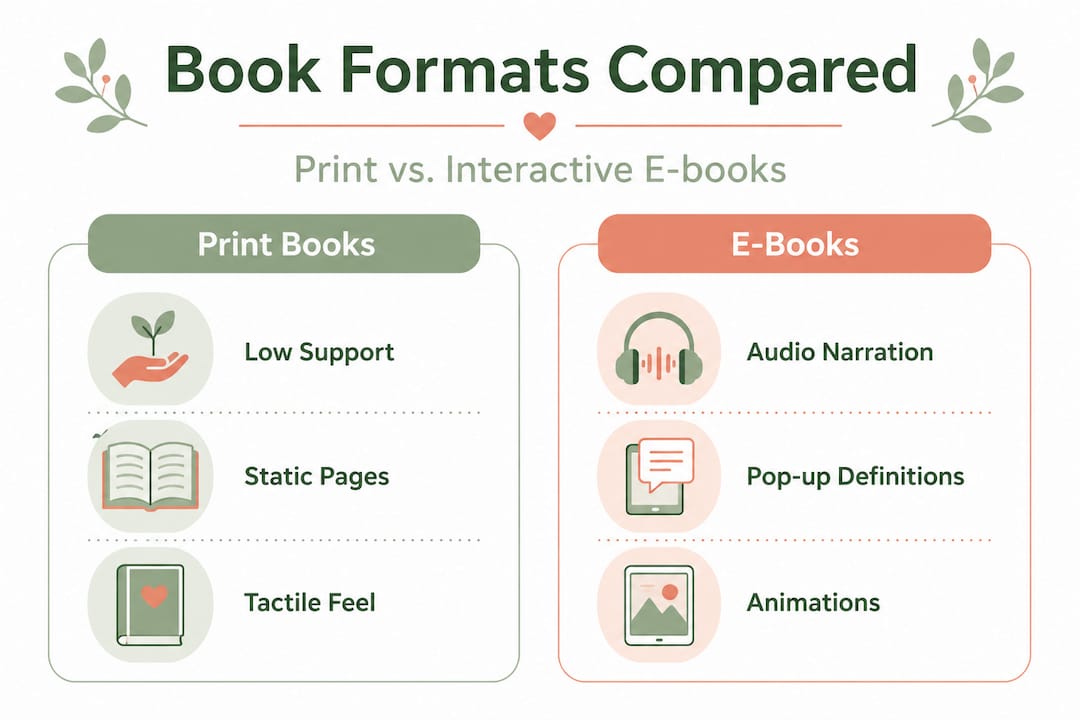
Print still holds a meaningful edge in one area: deep reading and sustained reflection. When children need to sit with complex ideas, annotate, and think critically, the slower pace of print can actually be an asset. The goal is not to replace print but to use each format where it performs best.
Interactive features that specifically support social-emotional and reading skill development include:
- Read-aloud narration models fluent reading and helps children internalize rhythm and prosody
- Vocabulary pop-ups reduce frustration and build word knowledge without interrupting the story
- Comprehension questions embedded at natural pause points reinforce understanding in real time
- Animated sequences help children visualize abstract concepts and story events
- Recording features that let children read aloud themselves build confidence and self-monitoring skills
- Progress tracking gives children a visible sense of achievement, which reinforces motivation
Pro Tip: When selecting an e-book platform, look for one that lets you adjust the level of interactive stimulation. Some children, particularly those with ADHD or sensory sensitivities, can experience cognitive overload when too many features activate simultaneously. The ability to turn off animations or auto-narration gives you control over the learning environment. Tools for innovative teaching often highlight this customization capacity as a key differentiator between platforms.
Motivating reluctant readers: E-books as a tool for engagement
Now that the power of interactivity is clear, let's see how e-books affect learners who need extra encouragement.
Every educator knows the child who stares at the page but reads nothing. Every parent knows the bedtime battle over a book that feels like a chore. Reluctant readers are not lazy or incapable. They are often children whose learning profile simply does not match the demands of traditional reading instruction. E-books can change that equation.
Boys' reading levels increased by 8.4 months versus 7.2 for girls with e-books over a 4.2-month study period. The gap between boys and girls in conventional reading instruction tends to favor girls. E-books appear to narrow that gap significantly, likely because the multimodal format appeals to learning styles that traditional text-heavy instruction does not serve well.
"When children have agency over how they access a story, whether through listening, reading, or interacting, they stop seeing reading as a task and start seeing it as an experience." This shift in perception is at the heart of what makes e-books so powerful for disengaged learners.
Digital motivation in education research consistently shows that personalization and choice are among the strongest drivers of intrinsic motivation. E-books that allow children to choose their own reading path, adjust text size, or pick a narrator voice give learners a sense of ownership that static formats cannot offer.
Practical strategies for parents and educators looking to leverage e-books for motivation:
- Let children choose the book. Autonomy is a powerful motivator. Even choosing between two options increases engagement.
- Start with short, high-interest content. Build the habit before increasing complexity.
- Use the read-aloud feature together. Co-listening creates shared experience and natural conversation about the story.
- Celebrate visible progress. Many platforms show reading streaks or completion badges. Use these as conversation starters, not rewards in themselves.
- Pair e-books with related physical activities. A story about animals can lead to a nature walk. Connecting digital reading to real-world experience deepens comprehension.
- Check in without testing. Ask "What was your favorite part?" rather than comprehension questions, especially early on.
Balancing benefits and risks: The screen time debate
As these opportunities emerge, it's important to consider the possible downsides and how to navigate them wisely.
The enthusiasm around e-books is real, but so are the concerns. PISA and TIMSS data show that heavy computer users score lower on reading assessments, and several Swedish schools have already begun reinstating print as their primary medium. The ed-tech backlash is real, and it deserves serious attention rather than dismissal.
The risks are not hypothetical. Heavy screen use, particularly unstructured and unsupervised, is associated with reduced attention spans, disrupted sleep, and in some studies, increased anxiety among children. The problem is rarely the e-book itself. It is the context in which it is used, the duration, the lack of adult involvement, and the quality of the content.
How to use e-books safely and effectively:
- Set time limits. Thirty to forty-five minutes of focused e-book reading is generally appropriate for school-age children. More is not always better.
- Choose content over convenience. A well-designed educational e-book is very different from a game dressed up as a reading app.
- Keep screens out of bedrooms at night. Blue light exposure before sleep disrupts melatonin production and affects rest.
- Stay involved. Ask about what your child read. Discuss characters, themes, and feelings the story brought up.
- Alternate with print. Use e-books for motivation and accessibility, and print for sustained, reflective reading.
- Watch for signs of overstimulation. Irritability after screen time, difficulty transitioning away from a device, or declining interest in non-screen activities are signals to recalibrate.
The schools pulling back from technology are not wrong to do so if their implementation was poor. The lesson is not that e-books fail. It is that technology without pedagogy is just a distraction.
E-books and inclusion: Accessibility for diverse learners
Ensuring both reach and safety, let's turn to how e-books can drive equity and inclusion for every learner.
One of the most compelling arguments for e-books is what they do for children who have historically been underserved by traditional reading instruction. Accessibility features in e-books are particularly beneficial for reluctant readers, boys, children with ADHD, and students from low-income households, while poorly designed versions risk cognitive overload and distraction.
Children with dyslexia benefit from adjustable fonts like OpenDyslexic, increased letter spacing, and high-contrast backgrounds. Children with ADHD benefit from shorter chapters, audio support, and interactive checkpoints that keep attention anchored. Children in low-income households benefit simply from access. A single tablet can hold hundreds of books that a family could never afford in print. The inclusive teaching online guide framework emphasizes that accessibility is not a feature for a few. It is a design principle that improves the experience for everyone.
How to select accessible e-books for diverse learners:
- Check for built-in read-aloud. This is non-negotiable for early readers and children with decoding challenges.
- Look for font customization. The ability to adjust size, spacing, and style removes a major barrier.
- Prioritize platforms with offline access. Not all families have reliable internet. Downloadable content ensures no child is left out.
- Evaluate the navigation design. Cluttered menus and confusing layouts frustrate children with attention or processing challenges.
- Review the content for cultural relevance. Children engage more deeply with stories that reflect their own lives and communities.
- Test the multimedia features before committing. Some audio narrations are robotic or poorly paced, which undermines rather than supports comprehension.
For parents navigating these decisions, support for parents of diverse learners can be a grounding resource. The publishing impact on inclusion work at Arthur Scott Publishing reflects a genuine commitment to making meaningful content available to every family, regardless of background or learning profile.
Pro Tip: Involve your child in the selection process whenever possible. When children help choose their own e-books, their sense of ownership increases dramatically, and so does follow-through. This is especially true for children who have experienced repeated frustration with reading. Choice is a form of respect, and children respond to it.
A balanced approach: E-books as part of a healthy learning ecosystem
Here is the perspective that tends to get lost in both the enthusiasm and the backlash. E-books are not a revolution. They are a tool. A very good tool in the right hands, for the right purpose, with the right child.
Digital education perspectives from researchers and practitioners show a genuine split: proponents highlight personalization and multimedia features for social-emotional learning gains, while critics point to inferior comprehension and retention compared to print, along with real screen time mental health risks. Both sides are telling the truth. They are just describing different use cases.
From working with families and educators across a range of contexts, the pattern that emerges is consistent. E-books solve specific problems brilliantly. They reach the child who refuses to open a book. They give the child with dyslexia a way in. They put a library in the hands of a family that cannot afford one. For those purposes, they are extraordinary.
But e-books are not better for every child or every goal. A child who already loves reading and has strong decoding skills may actually learn more from a well-chosen print book than from an interactive e-book, simply because print demands more sustained cognitive engagement. The absence of distraction is a feature, not a limitation.
The wisest path forward is not to choose sides. It is to ask: what does this child need right now? Sometimes the answer is a tablet with a read-aloud feature and a vocabulary game. Sometimes it is a quiet corner and a paperback. The families and educators who thrive are the ones who can hold both options without ideology, choosing based on the child in front of them rather than the trend of the moment. Personal growth and family empowerment starts with that kind of thoughtful, child-centered decision-making.
Explore supportive resources for your family's learning journey
If this article has sparked ideas about how to better support the readers in your life, the next step is finding content that actually delivers on that promise.
Arthur Scott Publishing offers a curated collection of e-books and digital resources designed specifically for family empowerment, behavioral health, and personal development. Dr. Arthur Scott's background in psychology and education shapes every resource on the platform, ensuring that what you access is grounded in real understanding of how children and families grow. Whether you are looking for parenting support resources, exploring tools for personal growth for families, or navigating the rewarding complexity of multigenerational learning, the platform offers accessible, meaningful content available in both downloadable PDF and audio formats through Speechify. Start exploring today and find the resources that fit your family's unique journey.
Frequently asked questions
Are e-books better than print books for children's learning?
Interactive e-books can surpass print in motivating certain learners and supporting language development, but print still supports deeper comprehension and reflection, so the best approach combines both based on the child's needs.
Do e-books increase children's screen time risks?
Heavy or unstructured e-book use can raise risks for attention and mental health, as ed-tech backlash research confirms, so moderation, adult involvement, and thoughtful content selection are essential safeguards.
How do e-books support reluctant or struggling readers?
E-books motivate reluctant and struggling readers, especially boys and children with ADHD, through personalization, interactivity, and audio support, with boys' reading gains averaging 8.4 months over just 4.2 months of use.
Which features make e-books more accessible for learners with special needs?
Read-aloud narration, font customization, and embedded multimedia notes are the features most supported by accessibility research for making e-books genuinely usable by children with dyslexia, ADHD, and other learning differences.