
Most people assume that meaningful personal growth requires a paid therapist, a bookstore trip, or a pricey online course. That assumption quietly keeps countless families from accessing the tools they need most. Free digital books are quietly rewriting that story, offering evidence-backed pathways to stronger family bonds, better behavioral health, and real learning gains, all without spending a dollar. The research backing these resources is growing fast, and the practical case for making them part of your family's routine is stronger than ever.
Table of Contents
- How free digital books support family empowerment and behavioral health
- Proven impact of free digital books on literacy and education
- Boosting motivation and reading attitudes, especially for less engaged readers
- Practical steps to maximize the benefits of free digital books for your family
- What most guides miss: more is not always better (and how to make free digital books truly work for you))
- Ready for more? Free digital resources and next steps for empowered families
- Frequently asked questions
Key Takeaways
| Point | Details |
|---|---|
| Easy, cost-free access | Free digital books remove financial barriers to meaningful family growth and mental wellness. |
| Boosts literacy and confidence | Evidence-backed studies show clear improvements in literacy skills and motivation, especially for reluctant readers. |
| Family routines matter | Shared, enjoyable reading routines with e-books enhance both well-being and educational outcomes. |
| Quality beats quantity | Simply having access to digital books and using them intentionally outweighs endless reminders or add-ons. |
How free digital books support family empowerment and behavioral health
Free digital books are exactly what they sound like: e-books you can access, download, or listen to without paying anything. What makes them a "low-threshold" resource is the combination of zero cost, instant access, and the ability to use them privately, on your own schedule, without any appointment or waiting list.
For families navigating stress, parenting challenges, or behavioral health concerns, that low barrier matters enormously. A parent who can download a self-help guide at midnight while the kids are asleep is far more likely to actually read it than one who has to schedule a library visit or wait for a book delivery. Accessibility is not a minor bonus here. It is the whole point.
Here is what families typically gain from building digital book routines:
- Behavioral self-help at any hour: E-books on parenting strategies, emotional regulation, and family communication are available the moment you need them.
- Shared reading rituals: Reading together, even from a screen, builds connection and models literacy for children.
- Mental wellness support: Self-help e-books provide frameworks for managing anxiety, building resilience, and improving self-awareness.
- Flexible formats: Audio listenings via tools like Speechify let you absorb content during commutes or household tasks.
- Confidence building: Accessing resources independently builds a sense of agency that itself supports personal growth through e-books.
Bibliotherapy, the practice of using books as a gentle form of emotional support, has a long history in clinical psychology. When a child reads a story about a character managing fear, or a parent reads about strategies for setting healthy boundaries, something real happens in the brain. Narrative engages emotion and cognition together, which makes reading uniquely powerful as a wellness tool.
What the research says: Reading interventions are recognized as scalable and low-cost supports for mental health and well-being, with shared reading showing especially promising trends, though long-term clinical evidence is still developing.
The honest truth is that digital books are not a substitute for professional care when serious mental health needs exist. But for everyday wellness, building family habits, and supporting behavioral health proactively, they are one of the most practical tools available. Understanding family support for mental health means recognizing that small, consistent inputs often matter more than occasional big interventions.
Proven impact of free digital books on literacy and education
Beyond empowering routines, do digital books really move the needle for learning? The research delivers some clear answers.
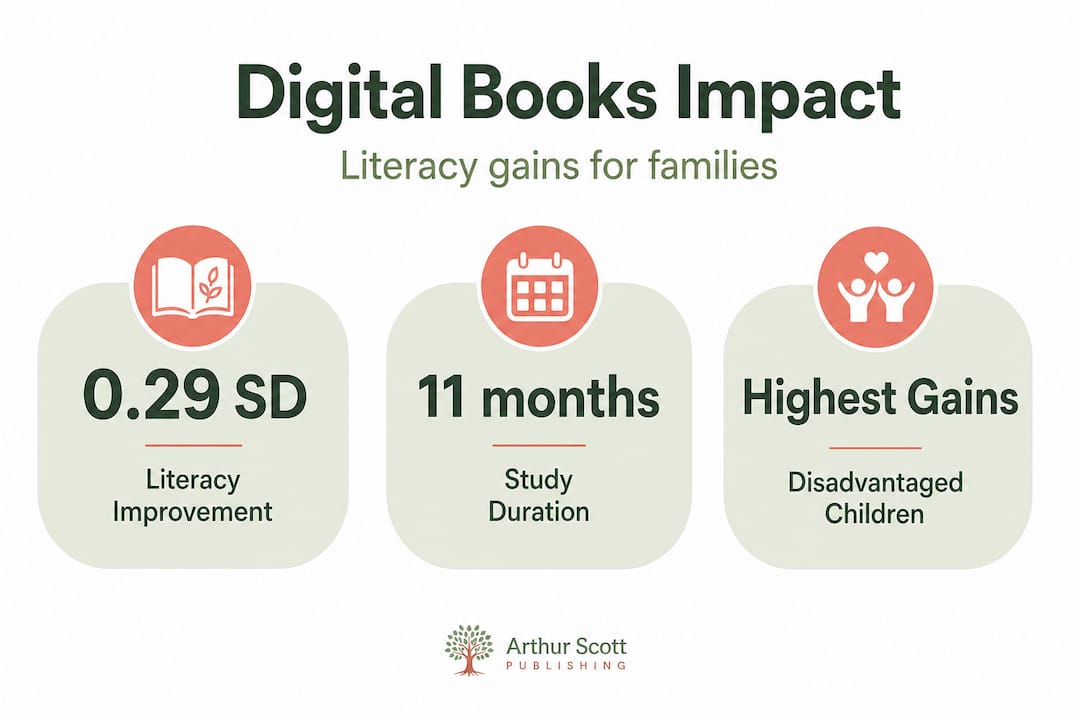
A rigorous study of a digital library program for young, disadvantaged children found that simply providing access to a curated collection of e-books for parent-child shared reading produced measurable, statistically significant literacy skill improvements. No extra coaching, no complicated intervention. Just access.
The improvement measured was 0.29 standard deviations after 11 months. In educational research terms, that is a meaningful gain, comparable to many structured classroom interventions that require far more resources to deliver. For families who worry their children are falling behind, that number is genuinely encouraging.
| Condition | Outcome after 11 months |
|---|---|
| Digital library access only | +0.29 SD literacy improvement |
| Digital library plus behavioral reminders | No statistically significant added benefit |
| No digital library access (control group) | Baseline, no measurable gain |
The table above makes one thing crystal clear: access itself is the active ingredient. Adding reminder messages or behavioral prompts on top of access did not produce additional gains. This is an important finding for families who feel overwhelmed by complex parenting programs. You do not need to do everything perfectly. You need to start.
The question of how families incorporate e-books for learning still matters, but in a simpler way than most guides suggest. Consistent use, even informal and relaxed, is what drives results.
Pro Tip: Set a simple "digital book time" for 15 to 20 minutes each evening, tied to an existing habit like after dinner or before bed. Consistency beats duration every time. Families who made shared e-book reading part of an existing routine saw the strongest long-term engagement in multiple studies.
There is also an equity angle worth naming. The children who benefited most in the literacy study were from disadvantaged backgrounds, the exact population most often left behind by resource-heavy interventions. Free digital books level a playing field that has been uneven for a long time. Explore challenges and solutions for parenting if you are navigating a high-stress family environment where resources feel scarce.
Boosting motivation and reading attitudes, especially for less engaged readers
While cognitive skills are foundational, how do digital books transform reading motivation and self-belief? The stories are in the data.
One of the most compelling findings in the literacy research literature comes from a large-scale National Literacy Trust study on e-books and reading attitudes. The headline result: e-book access increases reading motivation and improves attitudes toward reading, particularly among boys and reluctant readers. Those are traditionally the hardest groups to reach with conventional reading programs.
The attitudinal shifts were striking. Children who had access to e-books were more likely to say they enjoyed reading, less likely to say reading was "difficult," and more likely to describe reading as something "cool" rather than a chore. For a parent who has fought nightly battles over homework or bedtime stories, those shifts represent real quality of life improvement.
| Attitude measure | Before e-book access | After e-book access |
|---|---|---|
| "Reading is enjoyable" | Low-moderate | Significantly higher |
| "Reading feels difficult" | High among reluctant readers | Noticeably reduced |
| "Reading is cool" | Low, especially boys | Increased, largest gains in boys |
| Overall literacy attainment | Below average for reluctant readers | Measurable improvement |
The largest gains consistently showed up in the children who started furthest behind. That pattern matters for family empowerment because it means free digital books are not just maintaining advantages for already-strong readers. They are closing gaps.
Why this works: E-books often include interactive features, adjustable text sizes, and audio support that make reading feel less intimidating. The technology itself reduces the physical barrier of "this page looks too hard," which frees up the child's emotional energy for actual engagement with content.
Here is a simple approach for empowering learning with e-books at home, especially for reluctant readers:
- Let children choose: Give them agency over which topics or genres they explore first. Interest drives motivation more than any reward system.
- Start short: Five to ten minute sessions with a fun, visually engaging title builds the habit without pressure.
- Read together first: Sit alongside your child for the first few sessions to reduce anxiety about doing it "wrong."
- Celebrate engagement, not performance: Praise the act of reading, not scores or speed.
- Rotate formats: Mix e-books with audio formats so children who struggle with visual reading can still experience stories.
These steps are practical, low-cost, and grounded in the same evidence base that produced the attitudinal data above.
Practical steps to maximize the benefits of free digital books for your family
With the evidence on your side, here is how you can turn free digital books into a real driver of family growth and wellness.
The research is clear that implementation details matter. A digital library alone drives improvement, but how your family incorporates it into daily routines amplifies those benefits significantly over time.
Getting started:
- Identify your goal: Are you focused on children's literacy, your own personal growth, or family behavioral health? Pick one starting point so you are not overwhelmed.
- Find your source: Platforms like Arthur Scott Publishing offer free, curated digital books for empowerment focused specifically on mental wellness, family dynamics, and behavioral health.
- Set a specific time: Anchor digital book time to an existing routine, such as after breakfast or before bed, so it becomes automatic rather than effortful.
- Choose age-appropriate titles: For children, match the content to their interests and reading level. For adults, choose titles that address a real current challenge rather than abstract self-improvement.
- Review together: After reading, spend two to three minutes talking about what you noticed or found interesting. Reflection cements learning in a way that passive reading alone cannot.
- Adjust as you go: If a title is not engaging anyone, move on. There is no sunk cost when the books are free.
Common pitfalls to watch out for include setting overly rigid schedules that become stressful, choosing titles that are too advanced for children and triggering frustration, and treating reading as a performance rather than a pleasure. The research on reluctant readers specifically shows that pressure backfires. Make reading feel safe and optional-ish, even when it is a daily habit.
Pro Tip: For adults using self-help e-books, keep a simple notebook nearby and write down one idea from each session that you want to try. Action, not just reading, is what produces behavioral change.
A few final pointers:
- Use audio formats when attention or energy is low. Listening still builds vocabulary and comprehension.
- Involve the whole family by choosing titles that overlap generations. A story about resilience works for a seven-year-old and a parent simultaneously.
- Revisit titles: Rereading a favorite builds fluency in children and reinforces insights in adults. There is no rule that says every session needs new material.
What most guides miss: more is not always better (and how to make free digital books truly work for you)
Here is the part most articles skip entirely. The dominant message in the personal growth space is that more resources, more tools, more strategies equals better outcomes. The data on digital libraries flatly contradicts that belief.
The research showed that behavioral messages added no benefit beyond simply having access to the digital library. Families who received extra prompts, reminders, and messages did not outperform families who just had books available. Access was enough.
That finding deserves to sit with you for a moment. We are living in an era of notification overload, habit-tracking apps, and relentless optimization culture. The instinct is always to add more. But for families trying to build genuine wellness and literacy habits, the lesson here is almost the opposite. Less friction, less noise, more space for the actual experience of reading together.
The same principle applies to personal growth e-books for adults. Downloading twenty self-help titles and never finishing one is a very modern problem. The meaningful outcome comes from choosing one relevant title, reading it with intention, and reflecting on what to actually change. Volume is not the point. Depth is.
There is also something worth naming about shared experiences specifically. When families read together, whether a children's story before bed or a chapter of a wellness book at the kitchen table, they are doing something more than absorbing information. They are building the kind of relational trust and communication habits that the lessons on family support lessons consistently point to as foundational for long-term mental health.
Free digital books are powerful not because of their features or their volume, but because they lower the barrier to connection. That is the insight most guides miss entirely.
Ready for more? Free digital resources and next steps for empowered families
If this guide sparks ideas for your family, there are practical next steps right at your fingertips.
Arthur Scott Publishing exists specifically for families and individuals who want real growth without the price tag. Dr. Arthur Scott's library of free e-books covers family empowerment, behavioral health, perseverance, and self-awareness, all the themes this article has connected to genuine research outcomes.
Whether you are a parent navigating daily parenting resources, someone curious about publishing's impact on real families, or simply ready to explore what free digital books can do for your household, the personal growth and family empowerment library is waiting. No signup fees. No barriers. Just tools designed to make your family's growth feel achievable starting today.
Frequently asked questions
Are free digital books effective compared to physical books for family routines?
Free digital books can be a flexible and engaging option for families; research shows measurable literacy gains even without physical resources, making them a practical alternative or complement to traditional books.
Can free digital books improve mental health and not just academic outcomes?
Shared reading and bibliotherapy with free digital books may support mental wellness, but the clinical evidence is still emerging. Reading interventions including shared digital reading are recognized as low-cost, scalable supports that lack robust long-term clinical trials.
What's the best way to get reluctant readers interested in free digital books?
Let children help choose topics and start with interactive, age-appropriate titles. E-book access increases motivation especially for less engaged readers when they feel ownership over what they are reading.
Do reminders and behavior messages add value to a digital library for families?
Research shows access alone is often enough. Behavioral messages added no extra benefit beyond access to the digital library itself, suggesting families should focus on making books available rather than layering on complex prompting systems.